🎯 Success is a must. No to failure...
CORRECT: NABTEB LITERATURE ANSWERS 2026
✅ Open Access
✍️ Admin | 📅 16th June 2026 | 👁 489 views
(TYPE A)
SECTION A: ANSWER ONE(1) QUESTION FROM THIS SECTION
(1)
The character of Iya Agba (Omofadeke Adunni) is central to the play’s concern with tyranny, truth, and the downfall of unjust rulers in Once Upon an Elephant. The play presents Ajanaku as a usurper-king who maintains power through manipulation, greed, and the suppression of opposition, and against this backdrop, Iya Agba becomes an important voice of truth that exposes the corruption of his rule and foretells its collapse.
Iya Agba is an elderly woman in the palace who is wrongly regarded as mad and therefore dismissed by the royal court. However, beneath this label, she is portrayed as a figure who possesses deep knowledge of palace secrets, including the truth about Ajanaku’s origin and legitimacy. She first appears during a dispute where Ajanaku acts unjustly and interrupts with a symbolic story of an elephant destroyed by its own desire for power. She later confronts him directly, refusing his royal title and calling him by his birth name, Olaniyonu, while also hinting at the truth known by Serubawon. She further challenges Omoyeni and criticises the moral decay of the palace, leading repeatedly to her banishment by Ajanaku.
The major literary device used in her portrayal is symbolism. Iya Agba represents truth and justice operating outside the corrupt political system. Her so-called madness functions as a disguise that allows her to speak freely without immediate destruction. Her riddles and story of the elephant serve as allegory, foreshadowing Ajanaku’s downfall since the elephant symbolically represents him. Her repeated banishment also highlights the inability of tyranny to tolerate truth.
The significance of her role is that she shows that truth, though often ignored or silenced, cannot be permanently destroyed. Despite being dismissed, she continues to speak out until her revelations contribute to the exposure and eventual fall of Ajanaku. She therefore embodies the play’s message that justice and truth ultimately overcome tyranny.
===================================
(2)
The dramatic techniques in Once Upon an Elephant are closely tied to its central themes of tyranny, truth, and the downfall of unjust power. Ademilua-Afolayan uses these techniques not merely for artistic expression but to expose corruption in Ajanaku’s rule and to highlight the eventual triumph of justice. Through devices such as historification, symbolism, and riddling speech, the playwright effectively communicates political criticism and reinforces the moral message of the play.
One key technique is historification, where the play is set in a fictionalised Yoruba kingdom. This distance allows the playwright to critique issues like corruption, bribery of kingmakers, and oppression of dissent without directly naming real political figures. It also makes the message universal, showing that tyranny and abuse of power are not limited to one society or era but can occur in any political system.
Another important technique is symbolism, especially the image of the elephant. Ajanaku identifies himself with the elephant to represent strength, authority, and dominance over others. However, Iya Agba’s allegorical story of an elephant destroyed by its own ambition transforms this symbol into a warning of self-destruction. The elephant therefore becomes a symbol of tyrannical power that eventually collapses under its own excesses, reinforcing the idea that oppression is temporary.
The third technique is riddles and proverbs, mainly used through Iya Agba. This reflects Yoruba oral tradition, where indirect speech is used to communicate sensitive truths safely. Through riddles, she reveals Ajanaku’s illegitimacy and the moral decay within the palace while avoiding direct confrontation. This technique also shows how traditional wisdom serves as a voice of resistance against political oppression.
In conclusion, historification, symbolism, and riddling speech work together to strengthen the play’s central message. They make the political critique more engaging, culturally rooted, and powerful, while ultimately showing that truth and justice, though initially suppressed, will always overcome tyranny.
===================================
(3)
The Marriage of Anansewa is fundamentally a play about greed, trickery, and the commercialization of marriage. Sutherland uses the comic actions of Ananse to satirize a society where marriage is treated as a financial arrangement controlled by a desperate father. The theme of trickery and manipulation of social customs for personal gain runs throughout the play.
The main characters include Ananse, the cunning protagonist, Anansewa, his daughter who becomes the object of his scheme, Christie, his niece who represents caution, and the four wealthy chiefs, Chief of Chiefs Togbe Klu IV, Chief Tsiagbe, Chief Gyamfi, and Chief Otuben, who are drawn into Ananse’s deception. The Players or Mouth Piece also help to comment on the action.
Ananse sends identical courtship letters to the four chiefs, inviting them to begin the knocking process. Despite Christie’s warnings, all four chiefs respond with gifts, enriching Ananse. He later escalates the deception by announcing Anansewa’s death, which brings more gifts. The tension rises when the Chief of Chiefs insists on seeing the body, but Ananse stages a dramatic performance in which Anansewa “revives,” allowing him to resolve the situation in his favour.
The significance of these events is that Sutherland uses comedy and deception to expose greed and the commodification of marriage. The play entertains while also criticising a society where relationships are influenced by wealth and manipulation, highlighting both the cleverness and moral weakness in Ananse’s actions.
===================================
(4)
Marriage as a transaction and the gap between appearance and reality lie at the centre of The Marriage of Anansewa, and the Akwasua or Akosua episode clearly introduces this theme. Before his larger scheme with the four chiefs, Ananse tests his deceptive skills on a smaller scale by disguising Christie as “Akosua” to present her as a prospective bride to an in law, making the episode a rehearsal for the later deception involving Anansewa.
The main figures are Ananse, the architect of the trick; Christie, his niece and housekeeper who is forced into the disguise; and the unnamed messenger or in law who represents the suitor’s side. Christie, despite often acting as the voice of reason and caution, becomes the unwilling participant in Ananse’s deception, showing her discomfort with his manipulative plans.
The main literary device here is dramatic irony combined with disguise and mistaken identity. The audience knows that “Akosua” is actually Christie in disguise, while the messenger does not, creating humour and tension. Ananse carefully controls Christie’s behaviour and presentation, showing his skill in managing appearances. The renaming of Christie also reflects the play’s concern with identity, since changing a name suggests how easily people can be rebranded for personal gain, a practice that later extends to Anansewa herself.
The significance of this episode is that it establishes Ananse’s pattern of manipulation early in the play. It shows that he is already willing to use disguise and deception to gain financially, and it prepares the audience for the larger scheme involving the four chiefs. It also reinforces Christie’s role as both participant and critic, highlighting the tension between moral awareness and survival within Ananse’s world.
===================================
SECTION B: ANSWER ONE(1) QUESTION FROM THIS SECTION
(5)
(i) Sybil Birling: In An Inspector Calls, social responsibility is the central theme, and Sybil Birling’s actions reveal the dangers of class prejudice and selfishness. Sybil Birling is Mr Birling’s wife, a wealthy and status conscious woman who serves on a charity committee. The Inspector reveals that she refused assistance to a pregnant Eva Smith, who had approached the committee under another name. Believing Eva to be undeserving, Sybil harshly rejected her request and insisted that the father of the child should bear responsibility, only to discover that the father was her own son, Eric. Her significance lies in her self righteous refusal to accept guilt even after the truth is exposed. She therefore represents the older generation’s resistance to change and Priestley’s criticism of social irresponsibility.
(ii) Inspector Goole: Inspector Goole is the mysterious investigator whose arrival and questioning drive the action of the play. His true identity remains uncertain because no inspector of that name appears to exist, suggesting that he may represent something beyond an ordinary policeman. Throughout the play, he exposes each character’s contribution to Eva Smith’s suffering and challenges their moral values. His famous statement that “we are members of one body” expresses Priestley’s belief that society functions best when people care for one another. The significance of Inspector Goole lies in his role as the embodiment of conscience, justice, and social responsibility, warning humanity of the consequences of selfishness and neglect.
(iii) Gerald Croft: Gerald Croft is Sheila Birling’s fiancé and the son of Mr Birling’s business rival. During the investigation, it is revealed that he had an affair with Eva Smith, whom he knew as Daisy Renton, and supported her for a period before ending the relationship when it no longer suited him. Although Gerald is more honest than some of the older characters and admits his actions, he quickly welcomes the possibility that the Inspector was a fraud and attempts to move on from the incident. His significance lies in the contrast between his respectable appearance and his self interest. By refusing to learn fully from the experience, he aligns himself more closely with the older generation than with Sheila and Eric, who accept responsibility for their actions.
===================================
(6)
The theme of social responsibility is central to An Inspector Calls, and Inspector Goole is the main figure through which Priestley expresses this message. He is not only an investigator but also a dramatic symbol of conscience, exposing the moral failures of the Birling family.
Inspector Goole arrives to investigate the suicide of Eva Smith and reveals how each character contributes to her death. Mr Birling dismisses her from his factory, Sheila has her sacked from Milwards, Gerald Croft exploits and abandons her, Eric forces a relationship on her and steals money, while Mrs Birling refuses her charity support. Through his questioning, the Inspector shows that these separate actions combine to cause tragedy, making him a moral force rather than a normal policeman.
The main literary device is personification of conscience. His name suggests something ghostly, and his calm authority and knowledge of events make him seem beyond an ordinary inspector. The revelation that no Inspector Goole exists on police records strengthens his symbolic role as a representation of moral judgement rather than a real person.
This is reinforced in his final speech, where he warns that people must realise they are “members of one body” or face consequences “in fire and blood and anguish.” This reflects Priestley’s post war message that ignoring social responsibility leads to disaster. The Inspector does not punish the characters physically but forces them to recognise their guilt.
His significance is that he embodies conscience itself. Even after his disappearance, the final telephone call confirming another death suggests that his warning is real and ongoing. Priestley uses him to show that conscience cannot be escaped and that society will always be called to account until it learns responsibility.
===================================
(7)
The conflict at the heart of A Man for All Seasons is between individual conscience and state power, and within this conflict Thomas Cromwell represents those who serve power through manipulation and self interest. The description of him as a “wolf in sheep’s clothing” reflects his outward appearance of loyalty and legality, which hides his ruthless pursuit of personal and political success, especially in his destruction of Sir Thomas More.
Cromwell rises from a modest position to become one of the most powerful figures in Henry VIII’s court by supporting the King’s divorce and new marriage. Outwardly, he appears efficient, reasonable, and loyal, presenting himself as a lawful administrator simply carrying out the King’s wishes. In his dealings with More, he claims to seek only compliance or silence, but in reality he is building a case to eliminate him.
His “sheep’s clothing” lies in his use of legal procedure and calm reasoning to disguise persecution. He repeatedly acknowledges that More has broken no law, yet continues to search for ways to convict him, showing that the legal system is being manipulated rather than fairly applied. His use of Richard Rich is the clearest example, as he encourages Rich to give false testimony that ultimately leads to More’s conviction. This reveals Cromwell’s “wolf” nature, where ambition and strategy override truth and justice.
The significance of Cromwell’s portrayal is that it shows how authority and law can be used as tools of oppression while still appearing legitimate. By contrasting Cromwell’s calculated manipulation with More’s consistent integrity, the play exposes how dangerous political systems become when power hides behind the appearance of justice. Cromwell therefore represents the corrupting potential of political ambition disguised as duty.
===================================
(8)
The conflict between individual conscience and institutional power in A Man for All Seasons is shown through the contrast between Sir Thomas More and Thomas Cranmer, who represent personal conviction versus political conformity.
Sir Thomas More is Lord Chancellor and a devout Catholic who refuses to accept the King as head of the Church because of his conscience. He is prepared to lose his position and life rather than betray his beliefs. Thomas Cranmer, the Archbishop of Canterbury, is portrayed as politically compliant and spiritually detached, treating religion as an instrument of state policy rather than personal faith, and he supports the King’s decisions against More.
The main literary device is character foiling, supported by irony. More, a layman, shows stronger moral conviction than Cranmer, the highest religious authority in England. This exposes the tension between genuine belief and institutional role.
The significance is that Bolt suggests true integrity lies in conscience, not office or rank. More represents moral consistency rooted in faith, while Cranmer represents institutional compromise shaped by political power, reinforcing the idea that authority does not guarantee moral truth.
===================================
SECTION C: ANSWER ONE(1) QUESTION FROM THIS SECTION
(9)
Osundare’s Not My Business explores political oppression under dictatorship and the danger of complacency expressed through the attitude “it’s not my business.” Euphemism, the use of mild or indirect language to soften harsh realities, is a key device used to expose how state violence is disguised and normalised.
The main terms include euphemism itself and the repeated refrain that reflects the speaker’s self-deception. The victims Akanni, Danladi, Chinwe, and later the speaker, show how this language operates across different incidents of oppression.
Euphemism is seen in descriptions of violence such as Akanni being “taken away,” which hides the reality of arrest or abduction. Danladi is “dragged out” of class and “detained,” a word that conceals unlawful imprisonment, while Chinwe’s job application simply “disappeared,” masking workplace victimisation. These expressions reduce brutal actions into mild, almost routine language.
The speaker also uses euphemism in the refrain that as long as the violence does not affect his food or comfort, it is “not my business.” This turns moral indifference into a false sense of self protection, disguising cowardice as practicality.
The significance of this pattern is revealed when the soldiers eventually come for the speaker himself. The earlier softened language collapses into direct violence, showing that euphemism has been used to hide reality and encourage silence. Osundare therefore warns that distancing oneself through gentle language or indifference only delays the consequences of injustice, which eventually affects everyone.
===================================
(10)
New Tongue by Elizabeth L. A. Kamara explores the tension between adopting a foreign language and remaining rooted in native linguistic and cultural identity, with cultural alienation as the central consequence. The “new tongue” represents colonial language, often associated with education and social advancement, but also with the loss of cultural belonging.
The central figure is the speaker, who is caught between two linguistic worlds: the “old tongue,” linked to family, tradition, and ancestral identity, and the “new tongue,” linked to modern education and wider opportunity. The main literary device is symbolism, as the “tongue” represents not only language but also identity, culture, and worldview. Thus, acquiring a new tongue symbolises a shift in identity and belonging.
Cultural alienation is shown in the speaker’s experience of distance from family and community as fluency in the new language increases. Mastery of the new tongue weakens connection to the old one, creating a sense of in-betweenness where the speaker fully belongs to neither world.
The significance of this theme is that it reflects the postcolonial experience of linguistic displacement. Kamara presents the new tongue as both beneficial and costly, offering opportunity while causing cultural separation. By using the image of the tongue itself, the poem personalises alienation as a deep identity change that affects how the speaker relates to others and to self.
===================================
SECTION D: ANSWER ONE(1) QUESTION FROM THIS SECTION
(11)
She Walks in Beauty is built around the theme of ideal beauty as a perfect harmony of physical appearance and inner goodness. Byron presents beauty as a balanced union of light and darkness, moving from cosmic imagery in the first stanza to moral qualities in the final stanza.
The central figure is the woman described by the speaker, inspired by Byron’s encounter with Lady Wilmot Horner at a social event, whose dark mourning dress with sparkling decoration influenced the poem’s contrast of light and dark.
The first major image compares the woman to “the night / Of cloudless climes and starry skies,” presenting beauty as a harmony of opposites. The darkness of night combined with the brightness of stars reflects her physical appearance and introduces the idea that beauty lies in balance. This is reinforced in the contrast between “all that’s best of dark and bright” and the “tender light” denied to “gaudy day,” suggesting that subtle harmony is superior to harsh brightness.
In the second stanza, the image of balance continues through precise description: “one shade the more, one ray the less” would destroy her “nameless grace.” Her “raven tress” and softly illuminated face reinforce the blend of dark and light, while also suggesting that her beauty depends on perfect proportion and cannot be altered without loss.
The final stanza shifts from physical imagery to moral qualities. Her “smiles” and “tints that glow” reflect inner goodness, while her “mind at peace with all below” and “heart whose love is innocent” show that her outward beauty mirrors inner virtue. The same language of light and calm is used to link appearance with morality.
The significance of this imagery is that Byron presents beauty as a unified harmony of body and soul. The poem’s structured movement from cosmic imagery to physical description and finally to moral character reinforces the idea that true beauty exists in the perfect balance between external appearance and internal goodness.
===================================
(12)
Digging by Seamus Heaney explores the theme of poetic vocation and ancestral legacy, with hard work and diligence as the linking values across three generations of the speaker’s family, his grandfather, father, and himself.
The central figures are the speaker, a poet at his writing desk, his father, seen digging in the flower beds, and his grandfather, remembered cutting turf at Toner’s bog. All three are united by skill, precision, and dedication to their work, despite the different forms it takes.
Hard work is shown through detailed images of physical labour. The father is described digging with his spade “going down and down,” showing steady effort and control. The grandfather is remembered as a highly skilled worker who could cut more turf than anyone else, reflecting excellence and endurance. Even as a child, the speaker observes this diligence when he brings milk to his grandfather, who quickly returns to his work, showing complete focus and commitment.
The main literary device is extended metaphor, as Heaney compares writing poetry to digging. The repetition of family labour establishes a tradition of hard work, while the speaker’s pen is described as “snug as a gun,” suggesting readiness and precision. When he says he has “no spade to follow,” it marks a shift from physical labour to artistic labour, but not a rejection of effort.
The significance is that Heaney validates poetry as a form of work equal in value to farming and manual labour. By transferring the imagery of digging to writing, he shows that true diligence lies in skill, effort, and depth of engagement, not in the type of work performed. The poem ends with the speaker affirming, “I’ll dig with it,” showing continuity between generations through different forms of labour.
(TYPE B)
SECTION A: ANSWER ONE(1) QUESTION FROM THIS SECTION
(1)
The dramatic techniques in Once Upon an Elephant are closely tied to its central themes of tyranny, truth, and the downfall of unjust power. Ademilua-Afolayan uses these techniques not merely for artistic expression but to expose corruption in Ajanaku’s rule and to highlight the eventual triumph of justice. Through devices such as historification, symbolism, and riddling speech, the playwright effectively communicates political criticism and reinforces the moral message of the play.
One key technique is historification, where the play is set in a fictionalised Yoruba kingdom. This distance allows the playwright to critique issues like corruption, bribery of kingmakers, and oppression of dissent without directly naming real political figures. It also makes the message universal, showing that tyranny and abuse of power are not limited to one society or era but can occur in any political system.
Another important technique is symbolism, especially the image of the elephant. Ajanaku identifies himself with the elephant to represent strength, authority, and dominance over others. However, Iya Agba’s allegorical story of an elephant destroyed by its own ambition transforms this symbol into a warning of self-destruction. The elephant therefore becomes a symbol of tyrannical power that eventually collapses under its own excesses, reinforcing the idea that oppression is temporary.
The third technique is riddles and proverbs, mainly used through Iya Agba. This reflects Yoruba oral tradition, where indirect speech is used to communicate sensitive truths safely. Through riddles, she reveals Ajanaku’s illegitimacy and the moral decay within the palace while avoiding direct confrontation. This technique also shows how traditional wisdom serves as a voice of resistance against political oppression.
In conclusion, historification, symbolism, and riddling speech work together to strengthen the play’s central message. They make the political critique more engaging, culturally rooted, and powerful, while ultimately showing that truth and justice, though initially suppressed, will always overcome tyranny.
===================================
(2)
The character of Iya Agba (Omofadeke Adunni) is central to the play’s concern with tyranny, truth, and the downfall of unjust rulers in Once Upon an Elephant. The play presents Ajanaku as a usurper-king who maintains power through manipulation, greed, and the suppression of opposition, and against this backdrop, Iya Agba becomes an important voice of truth that exposes the corruption of his rule and foretells its collapse.
Iya Agba is an elderly woman in the palace who is wrongly regarded as mad and therefore dismissed by the royal court. However, beneath this label, she is portrayed as a figure who possesses deep knowledge of palace secrets, including the truth about Ajanaku’s origin and legitimacy. She first appears during a dispute where Ajanaku acts unjustly and interrupts with a symbolic story of an elephant destroyed by its own desire for power. She later confronts him directly, refusing his royal title and calling him by his birth name, Olaniyonu, while also hinting at the truth known by Serubawon. She further challenges Omoyeni and criticises the moral decay of the palace, leading repeatedly to her banishment by Ajanaku.
The major literary device used in her portrayal is symbolism. Iya Agba represents truth and justice operating outside the corrupt political system. Her so-called madness functions as a disguise that allows her to speak freely without immediate destruction. Her riddles and story of the elephant serve as allegory, foreshadowing Ajanaku’s downfall since the elephant symbolically represents him. Her repeated banishment also highlights the inability of tyranny to tolerate truth.
The significance of her role is that she shows that truth, though often ignored or silenced, cannot be permanently destroyed. Despite being dismissed, she continues to speak out until her revelations contribute to the exposure and eventual fall of Ajanaku. She therefore embodies the play’s message that justice and truth ultimately overcome tyranny.
===================================
(3)
The Marriage of Anansewa is fundamentally a play about greed, trickery, and the commercialization of marriage. Sutherland uses the comic actions of Ananse to satirize a society where marriage is treated as a financial arrangement controlled by a desperate father. The theme of trickery and manipulation of social customs for personal gain runs throughout the play.
The main characters include Ananse, the cunning protagonist, Anansewa, his daughter who becomes the object of his scheme, Christie, his niece who represents caution, and the four wealthy chiefs, Chief of Chiefs Togbe Klu IV, Chief Tsiagbe, Chief Gyamfi, and Chief Otuben, who are drawn into Ananse’s deception. The Players or Mouth Piece also help to comment on the action.
Ananse sends identical courtship letters to the four chiefs, inviting them to begin the knocking process. Despite Christie’s warnings, all four chiefs respond with gifts, enriching Ananse. He later escalates the deception by announcing Anansewa’s death, which brings more gifts. The tension rises when the Chief of Chiefs insists on seeing the body, but Ananse stages a dramatic performance in which Anansewa “revives,” allowing him to resolve the situation in his favour.
The significance of these events is that Sutherland uses comedy and deception to expose greed and the commodification of marriage. The play entertains while also criticising a society where relationships are influenced by wealth and manipulation, highlighting both the cleverness and moral weakness in Ananse’s actions.
===================================
(4)
Marriage as a transaction and the gap between appearance and reality lie at the centre of The Marriage of Anansewa, and the Akwasua or Akosua episode clearly introduces this theme. Before his larger scheme with the four chiefs, Ananse tests his deceptive skills on a smaller scale by disguising Christie as “Akosua” to present her as a prospective bride to an in law, making the episode a rehearsal for the later deception involving Anansewa.
The main figures are Ananse, the architect of the trick; Christie, his niece and housekeeper who is forced into the disguise; and the unnamed messenger or in law who represents the suitor’s side. Christie, despite often acting as the voice of reason and caution, becomes the unwilling participant in Ananse’s deception, showing her discomfort with his manipulative plans.
The main literary device here is dramatic irony combined with disguise and mistaken identity. The audience knows that “Akosua” is actually Christie in disguise, while the messenger does not, creating humour and tension. Ananse carefully controls Christie’s behaviour and presentation, showing his skill in managing appearances. The renaming of Christie also reflects the play’s concern with identity, since changing a name suggests how easily people can be rebranded for personal gain, a practice that later extends to Anansewa herself.
The significance of this episode is that it establishes Ananse’s pattern of manipulation early in the play. It shows that he is already willing to use disguise and deception to gain financially, and it prepares the audience for the larger scheme involving the four chiefs. It also reinforces Christie’s role as both participant and critic, highlighting the tension between moral awareness and survival within Ananse’s world.
===================================
SECTION B: ANSWER ONE(1) QUESTION FROM THIS SECTION
(5)
The theme of social responsibility is central to An Inspector Calls, and Inspector Goole is the main figure through which Priestley expresses this message. He is not only an investigator but also a dramatic symbol of conscience, exposing the moral failures of the Birling family.
Inspector Goole arrives to investigate the suicide of Eva Smith and reveals how each character contributes to her death. Mr Birling dismisses her from his factory, Sheila has her sacked from Milwards, Gerald Croft exploits and abandons her, Eric forces a relationship on her and steals money, while Mrs Birling refuses her charity support. Through his questioning, the Inspector shows that these separate actions combine to cause tragedy, making him a moral force rather than a normal policeman.
The main literary device is personification of conscience. His name suggests something ghostly, and his calm authority and knowledge of events make him seem beyond an ordinary inspector. The revelation that no Inspector Goole exists on police records strengthens his symbolic role as a representation of moral judgement rather than a real person.
This is reinforced in his final speech, where he warns that people must realise they are “members of one body” or face consequences “in fire and blood and anguish.” This reflects Priestley’s post war message that ignoring social responsibility leads to disaster. The Inspector does not punish the characters physically but forces them to recognise their guilt.
His significance is that he embodies conscience itself. Even after his disappearance, the final telephone call confirming another death suggests that his warning is real and ongoing. Priestley uses him to show that conscience cannot be escaped and that society will always be called to account until it learns responsibility.
===================================
(6)
(i) Sybil Birling: In An Inspector Calls, social responsibility is the central theme, and Sybil Birling’s actions reveal the dangers of class prejudice and selfishness. Sybil Birling is Mr Birling’s wife, a wealthy and status conscious woman who serves on a charity committee. The Inspector reveals that she refused assistance to a pregnant Eva Smith, who had approached the committee under another name. Believing Eva to be undeserving, Sybil harshly rejected her request and insisted that the father of the child should bear responsibility, only to discover that the father was her own son, Eric. Her significance lies in her self righteous refusal to accept guilt even after the truth is exposed. She therefore represents the older generation’s resistance to change and Priestley’s criticism of social irresponsibility.
(ii) Inspector Goole: Inspector Goole is the mysterious investigator whose arrival and questioning drive the action of the play. His true identity remains uncertain because no inspector of that name appears to exist, suggesting that he may represent something beyond an ordinary policeman. Throughout the play, he exposes each character’s contribution to Eva Smith’s suffering and challenges their moral values. His famous statement that “we are members of one body” expresses Priestley’s belief that society functions best when people care for one another. The significance of Inspector Goole lies in his role as the embodiment of conscience, justice, and social responsibility, warning humanity of the consequences of selfishness and neglect.
(iii) Gerald Croft: Gerald Croft is Sheila Birling’s fiancé and the son of Mr Birling’s business rival. During the investigation, it is revealed that he had an affair with Eva Smith, whom he knew as Daisy Renton, and supported her for a period before ending the relationship when it no longer suited him. Although Gerald is more honest than some of the older characters and admits his actions, he quickly welcomes the possibility that the Inspector was a fraud and attempts to move on from the incident. His significance lies in the contrast between his respectable appearance and his self interest. By refusing to learn fully from the experience, he aligns himself more closely with the older generation than with Sheila and Eric, who accept responsibility for their actions.
===================================
(7)
The conflict at the heart of A Man for All Seasons is between individual conscience and state power, and within this conflict Thomas Cromwell represents those who serve power through manipulation and self interest. The description of him as a “wolf in sheep’s clothing” reflects his outward appearance of loyalty and legality, which hides his ruthless pursuit of personal and political success, especially in his destruction of Sir Thomas More.
Cromwell rises from a modest position to become one of the most powerful figures in Henry VIII’s court by supporting the King’s divorce and new marriage. Outwardly, he appears efficient, reasonable, and loyal, presenting himself as a lawful administrator simply carrying out the King’s wishes. In his dealings with More, he claims to seek only compliance or silence, but in reality he is building a case to eliminate him.
His “sheep’s clothing” lies in his use of legal procedure and calm reasoning to disguise persecution. He repeatedly acknowledges that More has broken no law, yet continues to search for ways to convict him, showing that the legal system is being manipulated rather than fairly applied. His use of Richard Rich is the clearest example, as he encourages Rich to give false testimony that ultimately leads to More’s conviction. This reveals Cromwell’s “wolf” nature, where ambition and strategy override truth and justice.
The significance of Cromwell’s portrayal is that it shows how authority and law can be used as tools of oppression while still appearing legitimate. By contrasting Cromwell’s calculated manipulation with More’s consistent integrity, the play exposes how dangerous political systems become when power hides behind the appearance of justice. Cromwell therefore represents the corrupting potential of political ambition disguised as duty.
===================================
(8)
The conflict between individual conscience and institutional power in A Man for All Seasons is shown through the contrast between Sir Thomas More and Thomas Cranmer, who represent personal conviction versus political conformity.
Sir Thomas More is Lord Chancellor and a devout Catholic who refuses to accept the King as head of the Church because of his conscience. He is prepared to lose his position and life rather than betray his beliefs. Thomas Cranmer, the Archbishop of Canterbury, is portrayed as politically compliant and spiritually detached, treating religion as an instrument of state policy rather than personal faith, and he supports the King’s decisions against More.
The main literary device is character foiling, supported by irony. More, a layman, shows stronger moral conviction than Cranmer, the highest religious authority in England. This exposes the tension between genuine belief and institutional role.
The significance is that Bolt suggests true integrity lies in conscience, not office or rank. More represents moral consistency rooted in faith, while Cranmer represents institutional compromise shaped by political power, reinforcing the idea that authority does not guarantee moral truth.
===================================
SECTION C: ANSWER ONE(1) QUESTION FROM THIS SECTION
(9)
New Tongue by Elizabeth L. A. Kamara explores the tension between adopting a foreign language and remaining rooted in native linguistic and cultural identity, with cultural alienation as the central consequence. The “new tongue” represents colonial language, often associated with education and social advancement, but also with the loss of cultural belonging.
The central figure is the speaker, who is caught between two linguistic worlds: the “old tongue,” linked to family, tradition, and ancestral identity, and the “new tongue,” linked to modern education and wider opportunity. The main literary device is symbolism, as the “tongue” represents not only language but also identity, culture, and worldview. Thus, acquiring a new tongue symbolises a shift in identity and belonging.
Cultural alienation is shown in the speaker’s experience of distance from family and community as fluency in the new language increases. Mastery of the new tongue weakens connection to the old one, creating a sense of in-betweenness where the speaker fully belongs to neither world.
The significance of this theme is that it reflects the postcolonial experience of linguistic displacement. Kamara presents the new tongue as both beneficial and costly, offering opportunity while causing cultural separation. By using the image of the tongue itself, the poem personalises alienation as a deep identity change that affects how the speaker relates to others and to self.
===================================
(10)
Osundare’s Not My Business explores political oppression under dictatorship and the danger of complacency expressed through the attitude “it’s not my business.” Euphemism, the use of mild or indirect language to soften harsh realities, is a key device used to expose how state violence is disguised and normalised.
The main terms include euphemism itself and the repeated refrain that reflects the speaker’s self-deception. The victims Akanni, Danladi, Chinwe, and later the speaker, show how this language operates across different incidents of oppression.
Euphemism is seen in descriptions of violence such as Akanni being “taken away,” which hides the reality of arrest or abduction. Danladi is “dragged out” of class and “detained,” a word that conceals unlawful imprisonment, while Chinwe’s job application simply “disappeared,” masking workplace victimisation. These expressions reduce brutal actions into mild, almost routine language.
The speaker also uses euphemism in the refrain that as long as the violence does not affect his food or comfort, it is “not my business.” This turns moral indifference into a false sense of self protection, disguising cowardice as practicality.
The significance of this pattern is revealed when the soldiers eventually come for the speaker himself. The earlier softened language collapses into direct violence, showing that euphemism has been used to hide reality and encourage silence. Osundare therefore warns that distancing oneself through gentle language or indifference only delays the consequences of injustice, which eventually affects everyone.
===================================
SECTION D: ANSWER ONE(1) QUESTION FROM THIS SECTION
(11)
She Walks in Beauty is built around the theme of ideal beauty as a perfect harmony of physical appearance and inner goodness. Byron presents beauty as a balanced union of light and darkness, moving from cosmic imagery in the first stanza to moral qualities in the final stanza.
The central figure is the woman described by the speaker, inspired by Byron’s encounter with Lady Wilmot Horner at a social event, whose dark mourning dress with sparkling decoration influenced the poem’s contrast of light and dark.
The first major image compares the woman to “the night / Of cloudless climes and starry skies,” presenting beauty as a harmony of opposites. The darkness of night combined with the brightness of stars reflects her physical appearance and introduces the idea that beauty lies in balance. This is reinforced in the contrast between “all that’s best of dark and bright” and the “tender light” denied to “gaudy day,” suggesting that subtle harmony is superior to harsh brightness.
In the second stanza, the image of balance continues through precise description: “one shade the more, one ray the less” would destroy her “nameless grace.” Her “raven tress” and softly illuminated face reinforce the blend of dark and light, while also suggesting that her beauty depends on perfect proportion and cannot be altered without loss.
The final stanza shifts from physical imagery to moral qualities. Her “smiles” and “tints that glow” reflect inner goodness, while her “mind at peace with all below” and “heart whose love is innocent” show that her outward beauty mirrors inner virtue. The same language of light and calm is used to link appearance with morality.
The significance of this imagery is that Byron presents beauty as a unified harmony of body and soul. The poem’s structured movement from cosmic imagery to physical description and finally to moral character reinforces the idea that true beauty exists in the perfect balance between external appearance and internal goodness.
===================================
(12)
Digging by Seamus Heaney explores the theme of poetic vocation and ancestral legacy, with hard work and diligence as the linking values across three generations of the speaker’s family, his grandfather, father, and himself.
The central figures are the speaker, a poet at his writing desk, his father, seen digging in the flower beds, and his grandfather, remembered cutting turf at Toner’s bog. All three are united by skill, precision, and dedication to their work, despite the different forms it takes.
Hard work is shown through detailed images of physical labour. The father is described digging with his spade “going down and down,” showing steady effort and control. The grandfather is remembered as a highly skilled worker who could cut more turf than anyone else, reflecting excellence and endurance. Even as a child, the speaker observes this diligence when he brings milk to his grandfather, who quickly returns to his work, showing complete focus and commitment.
The main literary device is extended metaphor, as Heaney compares writing poetry to digging. The repetition of family labour establishes a tradition of hard work, while the speaker’s pen is described as “snug as a gun,” suggesting readiness and precision. When he says he has “no spade to follow,” it marks a shift from physical labour to artistic labour, but not a rejection of effort.
The significance is that Heaney validates poetry as a form of work equal in value to farming and manual labour. By transferring the imagery of digging to writing, he shows that true diligence lies in skill, effort, and depth of engagement, not in the type of work performed. The poem ends with the speaker affirming, “I’ll dig with it,” showing continuity between generations through different forms of labour.
(TYPE C)
SECTION A: ANSWER ONE(1) QUESTION FROM THIS SECTION
(1)
The character of Iya Agba (Omofadeke Adunni) is central to the play’s concern with tyranny, truth, and the downfall of unjust rulers in Once Upon an Elephant. The play presents Ajanaku as a usurper-king who maintains power through manipulation, greed, and the suppression of opposition, and against this backdrop, Iya Agba becomes an important voice of truth that exposes the corruption of his rule and foretells its collapse.
Iya Agba is an elderly woman in the palace who is wrongly regarded as mad and therefore dismissed by the royal court. However, beneath this label, she is portrayed as a figure who possesses deep knowledge of palace secrets, including the truth about Ajanaku’s origin and legitimacy. She first appears during a dispute where Ajanaku acts unjustly and interrupts with a symbolic story of an elephant destroyed by its own desire for power. She later confronts him directly, refusing his royal title and calling him by his birth name, Olaniyonu, while also hinting at the truth known by Serubawon. She further challenges Omoyeni and criticises the moral decay of the palace, leading repeatedly to her banishment by Ajanaku.
The major literary device used in her portrayal is symbolism. Iya Agba represents truth and justice operating outside the corrupt political system. Her so-called madness functions as a disguise that allows her to speak freely without immediate destruction. Her riddles and story of the elephant serve as allegory, foreshadowing Ajanaku’s downfall since the elephant symbolically represents him. Her repeated banishment also highlights the inability of tyranny to tolerate truth.
The significance of her role is that she shows that truth, though often ignored or silenced, cannot be permanently destroyed. Despite being dismissed, she continues to speak out until her revelations contribute to the exposure and eventual fall of Ajanaku. She therefore embodies the play’s message that justice and truth ultimately overcome tyranny.
===================================
(2)
The dramatic techniques in Once Upon an Elephant are closely tied to its central themes of tyranny, truth, and the downfall of unjust power. Ademilua-Afolayan uses these techniques not merely for artistic expression but to expose corruption in Ajanaku’s rule and to highlight the eventual triumph of justice. Through devices such as historification, symbolism, and riddling speech, the playwright effectively communicates political criticism and reinforces the moral message of the play.
One key technique is historification, where the play is set in a fictionalised Yoruba kingdom. This distance allows the playwright to critique issues like corruption, bribery of kingmakers, and oppression of dissent without directly naming real political figures. It also makes the message universal, showing that tyranny and abuse of power are not limited to one society or era but can occur in any political system.
Another important technique is symbolism, especially the image of the elephant. Ajanaku identifies himself with the elephant to represent strength, authority, and dominance over others. However, Iya Agba’s allegorical story of an elephant destroyed by its own ambition transforms this symbol into a warning of self-destruction. The elephant therefore becomes a symbol of tyrannical power that eventually collapses under its own excesses, reinforcing the idea that oppression is temporary.
The third technique is riddles and proverbs, mainly used through Iya Agba. This reflects Yoruba oral tradition, where indirect speech is used to communicate sensitive truths safely. Through riddles, she reveals Ajanaku’s illegitimacy and the moral decay within the palace while avoiding direct confrontation. This technique also shows how traditional wisdom serves as a voice of resistance against political oppression.
In conclusion, historification, symbolism, and riddling speech work together to strengthen the play’s central message. They make the political critique more engaging, culturally rooted, and powerful, while ultimately showing that truth and justice, though initially suppressed, will always overcome tyranny.
===================================
(3)
Marriage as a transaction and the gap between appearance and reality lie at the centre of The Marriage of Anansewa, and the Akwasua or Akosua episode clearly introduces this theme. Before his larger scheme with the four chiefs, Ananse tests his deceptive skills on a smaller scale by disguising Christie as “Akosua” to present her as a prospective bride to an in law, making the episode a rehearsal for the later deception involving Anansewa.
The main figures are Ananse, the architect of the trick; Christie, his niece and housekeeper who is forced into the disguise; and the unnamed messenger or in law who represents the suitor’s side. Christie, despite often acting as the voice of reason and caution, becomes the unwilling participant in Ananse’s deception, showing her discomfort with his manipulative plans.
The main literary device here is dramatic irony combined with disguise and mistaken identity. The audience knows that “Akosua” is actually Christie in disguise, while the messenger does not, creating humour and tension. Ananse carefully controls Christie’s behaviour and presentation, showing his skill in managing appearances. The renaming of Christie also reflects the play’s concern with identity, since changing a name suggests how easily people can be rebranded for personal gain, a practice that later extends to Anansewa herself.
The significance of this episode is that it establishes Ananse’s pattern of manipulation early in the play. It shows that he is already willing to use disguise and deception to gain financially, and it prepares the audience for the larger scheme involving the four chiefs. It also reinforces Christie’s role as both participant and critic, highlighting the tension between moral awareness and survival within Ananse’s world.
===================================
(4)
The Marriage of Anansewa is fundamentally a play about greed, trickery, and the commercialization of marriage. Sutherland uses the comic actions of Ananse to satirize a society where marriage is treated as a financial arrangement controlled by a desperate father. The theme of trickery and manipulation of social customs for personal gain runs throughout the play.
The main characters include Ananse, the cunning protagonist, Anansewa, his daughter who becomes the object of his scheme, Christie, his niece who represents caution, and the four wealthy chiefs, Chief of Chiefs Togbe Klu IV, Chief Tsiagbe, Chief Gyamfi, and Chief Otuben, who are drawn into Ananse’s deception. The Players or Mouth Piece also help to comment on the action.
Ananse sends identical courtship letters to the four chiefs, inviting them to begin the knocking process. Despite Christie’s warnings, all four chiefs respond with gifts, enriching Ananse. He later escalates the deception by announcing Anansewa’s death, which brings more gifts. The tension rises when the Chief of Chiefs insists on seeing the body, but Ananse stages a dramatic performance in which Anansewa “revives,” allowing him to resolve the situation in his favour.
The significance of these events is that Sutherland uses comedy and deception to expose greed and the commodification of marriage. The play entertains while also criticising a society where relationships are influenced by wealth and manipulation, highlighting both the cleverness and moral weakness in Ananse’s actions.
===================================
SECTION B: ANSWER ONE(1) QUESTION FROM THIS SECTION
(5)
The theme of social responsibility is central to An Inspector Calls, and Inspector Goole is the main figure through which Priestley expresses this message. He is not only an investigator but also a dramatic symbol of conscience, exposing the moral failures of the Birling family.
Inspector Goole arrives to investigate the suicide of Eva Smith and reveals how each character contributes to her death. Mr Birling dismisses her from his factory, Sheila has her sacked from Milwards, Gerald Croft exploits and abandons her, Eric forces a relationship on her and steals money, while Mrs Birling refuses her charity support. Through his questioning, the Inspector shows that these separate actions combine to cause tragedy, making him a moral force rather than a normal policeman.
The main literary device is personification of conscience. His name suggests something ghostly, and his calm authority and knowledge of events make him seem beyond an ordinary inspector. The revelation that no Inspector Goole exists on police records strengthens his symbolic role as a representation of moral judgement rather than a real person.
This is reinforced in his final speech, where he warns that people must realise they are “members of one body” or face consequences “in fire and blood and anguish.” This reflects Priestley’s post war message that ignoring social responsibility leads to disaster. The Inspector does not punish the characters physically but forces them to recognise their guilt.
His significance is that he embodies conscience itself. Even after his disappearance, the final telephone call confirming another death suggests that his warning is real and ongoing. Priestley uses him to show that conscience cannot be escaped and that society will always be called to account until it learns responsibility.
===================================
(6)
(i) Sybil Birling: In An Inspector Calls, social responsibility is the central theme, and Sybil Birling’s actions reveal the dangers of class prejudice and selfishness. Sybil Birling is Mr Birling’s wife, a wealthy and status conscious woman who serves on a charity committee. The Inspector reveals that she refused assistance to a pregnant Eva Smith, who had approached the committee under another name. Believing Eva to be undeserving, Sybil harshly rejected her request and insisted that the father of the child should bear responsibility, only to discover that the father was her own son, Eric. Her significance lies in her self righteous refusal to accept guilt even after the truth is exposed. She therefore represents the older generation’s resistance to change and Priestley’s criticism of social irresponsibility.
(ii) Inspector Goole: Inspector Goole is the mysterious investigator whose arrival and questioning drive the action of the play. His true identity remains uncertain because no inspector of that name appears to exist, suggesting that he may represent something beyond an ordinary policeman. Throughout the play, he exposes each character’s contribution to Eva Smith’s suffering and challenges their moral values. His famous statement that “we are members of one body” expresses Priestley’s belief that society functions best when people care for one another. The significance of Inspector Goole lies in his role as the embodiment of conscience, justice, and social responsibility, warning humanity of the consequences of selfishness and neglect.
(iii) Gerald Croft: Gerald Croft is Sheila Birling’s fiancé and the son of Mr Birling’s business rival. During the investigation, it is revealed that he had an affair with Eva Smith, whom he knew as Daisy Renton, and supported her for a period before ending the relationship when it no longer suited him. Although Gerald is more honest than some of the older characters and admits his actions, he quickly welcomes the possibility that the Inspector was a fraud and attempts to move on from the incident. His significance lies in the contrast between his respectable appearance and his self interest. By refusing to learn fully from the experience, he aligns himself more closely with the older generation than with Sheila and Eric, who accept responsibility for their actions.
===================================
(7)
The conflict between individual conscience and institutional power in A Man for All Seasons is shown through the contrast between Sir Thomas More and Thomas Cranmer, who represent personal conviction versus political conformity.
Sir Thomas More is Lord Chancellor and a devout Catholic who refuses to accept the King as head of the Church because of his conscience. He is prepared to lose his position and life rather than betray his beliefs. Thomas Cranmer, the Archbishop of Canterbury, is portrayed as politically compliant and spiritually detached, treating religion as an instrument of state policy rather than personal faith, and he supports the King’s decisions against More.
The main literary device is character foiling, supported by irony. More, a layman, shows stronger moral conviction than Cranmer, the highest religious authority in England. This exposes the tension between genuine belief and institutional role.
The significance is that Bolt suggests true integrity lies in conscience, not office or rank. More represents moral consistency rooted in faith, while Cranmer represents institutional compromise shaped by political power, reinforcing the idea that authority does not guarantee moral truth.
===================================
(8)
The conflict at the heart of A Man for All Seasons is between individual conscience and state power, and within this conflict Thomas Cromwell represents those who serve power through manipulation and self interest. The description of him as a “wolf in sheep’s clothing” reflects his outward appearance of loyalty and legality, which hides his ruthless pursuit of personal and political success, especially in his destruction of Sir Thomas More.
Cromwell rises from a modest position to become one of the most powerful figures in Henry VIII’s court by supporting the King’s divorce and new marriage. Outwardly, he appears efficient, reasonable, and loyal, presenting himself as a lawful administrator simply carrying out the King’s wishes. In his dealings with More, he claims to seek only compliance or silence, but in reality he is building a case to eliminate him.
His “sheep’s clothing” lies in his use of legal procedure and calm reasoning to disguise persecution. He repeatedly acknowledges that More has broken no law, yet continues to search for ways to convict him, showing that the legal system is being manipulated rather than fairly applied. His use of Richard Rich is the clearest example, as he encourages Rich to give false testimony that ultimately leads to More’s conviction. This reveals Cromwell’s “wolf” nature, where ambition and strategy override truth and justice.
The significance of Cromwell’s portrayal is that it shows how authority and law can be used as tools of oppression while still appearing legitimate. By contrasting Cromwell’s calculated manipulation with More’s consistent integrity, the play exposes how dangerous political systems become when power hides behind the appearance of justice. Cromwell therefore represents the corrupting potential of political ambition disguised as duty.
===================================
SECTION C: ANSWER ONE(1) QUESTION FROM THIS SECTION
(9)
New Tongue by Elizabeth L. A. Kamara explores the tension between adopting a foreign language and remaining rooted in native linguistic and cultural identity, with cultural alienation as the central consequence. The “new tongue” represents colonial language, often associated with education and social advancement, but also with the loss of cultural belonging.
The central figure is the speaker, who is caught between two linguistic worlds: the “old tongue,” linked to family, tradition, and ancestral identity, and the “new tongue,” linked to modern education and wider opportunity. The main literary device is symbolism, as the “tongue” represents not only language but also identity, culture, and worldview. Thus, acquiring a new tongue symbolises a shift in identity and belonging.
Cultural alienation is shown in the speaker’s experience of distance from family and community as fluency in the new language increases. Mastery of the new tongue weakens connection to the old one, creating a sense of in-betweenness where the speaker fully belongs to neither world.
The significance of this theme is that it reflects the postcolonial experience of linguistic displacement. Kamara presents the new tongue as both beneficial and costly, offering opportunity while causing cultural separation. By using the image of the tongue itself, the poem personalises alienation as a deep identity change that affects how the speaker relates to others and to self.
===================================
(10)
Osundare’s Not My Business explores political oppression under dictatorship and the danger of complacency expressed through the attitude “it’s not my business.” Euphemism, the use of mild or indirect language to soften harsh realities, is a key device used to expose how state violence is disguised and normalised.
The main terms include euphemism itself and the repeated refrain that reflects the speaker’s self-deception. The victims Akanni, Danladi, Chinwe, and later the speaker, show how this language operates across different incidents of oppression.
Euphemism is seen in descriptions of violence such as Akanni being “taken away,” which hides the reality of arrest or abduction. Danladi is “dragged out” of class and “detained,” a word that conceals unlawful imprisonment, while Chinwe’s job application simply “disappeared,” masking workplace victimisation. These expressions reduce brutal actions into mild, almost routine language.
The speaker also uses euphemism in the refrain that as long as the violence does not affect his food or comfort, it is “not my business.” This turns moral indifference into a false sense of self protection, disguising cowardice as practicality.
The significance of this pattern is revealed when the soldiers eventually come for the speaker himself. The earlier softened language collapses into direct violence, showing that euphemism has been used to hide reality and encourage silence. Osundare therefore warns that distancing oneself through gentle language or indifference only delays the consequences of injustice, which eventually affects everyone.
===================================
SECTION D: ANSWER ONE(1) QUESTION FROM THIS SECTION
(11)
Digging by Seamus Heaney explores the theme of poetic vocation and ancestral legacy, with hard work and diligence as the linking values across three generations of the speaker’s family, his grandfather, father, and himself.
The central figures are the speaker, a poet at his writing desk, his father, seen digging in the flower beds, and his grandfather, remembered cutting turf at Toner’s bog. All three are united by skill, precision, and dedication to their work, despite the different forms it takes.
Hard work is shown through detailed images of physical labour. The father is described digging with his spade “going down and down,” showing steady effort and control. The grandfather is remembered as a highly skilled worker who could cut more turf than anyone else, reflecting excellence and endurance. Even as a child, the speaker observes this diligence when he brings milk to his grandfather, who quickly returns to his work, showing complete focus and commitment.
The main literary device is extended metaphor, as Heaney compares writing poetry to digging. The repetition of family labour establishes a tradition of hard work, while the speaker’s pen is described as “snug as a gun,” suggesting readiness and precision. When he says he has “no spade to follow,” it marks a shift from physical labour to artistic labour, but not a rejection of effort.
The significance is that Heaney validates poetry as a form of work equal in value to farming and manual labour. By transferring the imagery of digging to writing, he shows that true diligence lies in skill, effort, and depth of engagement, not in the type of work performed. The poem ends with the speaker affirming, “I’ll dig with it,” showing continuity between generations through different forms of labour.
===================================
(12)
She Walks in Beauty is built around the theme of ideal beauty as a perfect harmony of physical appearance and inner goodness. Byron presents beauty as a balanced union of light and darkness, moving from cosmic imagery in the first stanza to moral qualities in the final stanza.
The central figure is the woman described by the speaker, inspired by Byron’s encounter with Lady Wilmot Horner at a social event, whose dark mourning dress with sparkling decoration influenced the poem’s contrast of light and dark.
The first major image compares the woman to “the night / Of cloudless climes and starry skies,” presenting beauty as a harmony of opposites. The darkness of night combined with the brightness of stars reflects her physical appearance and introduces the idea that beauty lies in balance. This is reinforced in the contrast between “all that’s best of dark and bright” and the “tender light” denied to “gaudy day,” suggesting that subtle harmony is superior to harsh brightness.
In the second stanza, the image of balance continues through precise description: “one shade the more, one ray the less” would destroy her “nameless grace.” Her “raven tress” and softly illuminated face reinforce the blend of dark and light, while also suggesting that her beauty depends on perfect proportion and cannot be altered without loss.
The final stanza shifts from physical imagery to moral qualities. Her “smiles” and “tints that glow” reflect inner goodness, while her “mind at peace with all below” and “heart whose love is innocent” show that her outward beauty mirrors inner virtue. The same language of light and calm is used to link appearance with morality.
The significance of this imagery is that Byron presents beauty as a unified harmony of body and soul. The poem’s structured movement from cosmic imagery to physical description and finally to moral character reinforces the idea that true beauty exists in the perfect balance between external appearance and internal goodness.
(TYPE D)
SECTION A: ANSWER ONE(1) QUESTION FROM THIS SECTION
(1)
The character of Iya Agba (Omofadeke Adunni) is central to the play’s concern with tyranny, truth, and the downfall of unjust rulers in Once Upon an Elephant. The play presents Ajanaku as a usurper-king who maintains power through manipulation, greed, and the suppression of opposition, and against this backdrop, Iya Agba becomes an important voice of truth that exposes the corruption of his rule and foretells its collapse.
Iya Agba is an elderly woman in the palace who is wrongly regarded as mad and therefore dismissed by the royal court. However, beneath this label, she is portrayed as a figure who possesses deep knowledge of palace secrets, including the truth about Ajanaku’s origin and legitimacy. She first appears during a dispute where Ajanaku acts unjustly and interrupts with a symbolic story of an elephant destroyed by its own desire for power. She later confronts him directly, refusing his royal title and calling him by his birth name, Olaniyonu, while also hinting at the truth known by Serubawon. She further challenges Omoyeni and criticises the moral decay of the palace, leading repeatedly to her banishment by Ajanaku.
The major literary device used in her portrayal is symbolism. Iya Agba represents truth and justice operating outside the corrupt political system. Her so-called madness functions as a disguise that allows her to speak freely without immediate destruction. Her riddles and story of the elephant serve as allegory, foreshadowing Ajanaku’s downfall since the elephant symbolically represents him. Her repeated banishment also highlights the inability of tyranny to tolerate truth.
The significance of her role is that she shows that truth, though often ignored or silenced, cannot be permanently destroyed. Despite being dismissed, she continues to speak out until her revelations contribute to the exposure and eventual fall of Ajanaku. She therefore embodies the play’s message that justice and truth ultimately overcome tyranny.
===================================
(2)
The dramatic techniques in Once Upon an Elephant are closely tied to its central themes of tyranny, truth, and the downfall of unjust power. Ademilua-Afolayan uses these techniques not merely for artistic expression but to expose corruption in Ajanaku’s rule and to highlight the eventual triumph of justice. Through devices such as historification, symbolism, and riddling speech, the playwright effectively communicates political criticism and reinforces the moral message of the play.
One key technique is historification, where the play is set in a fictionalised Yoruba kingdom. This distance allows the playwright to critique issues like corruption, bribery of kingmakers, and oppression of dissent without directly naming real political figures. It also makes the message universal, showing that tyranny and abuse of power are not limited to one society or era but can occur in any political system.
Another important technique is symbolism, especially the image of the elephant. Ajanaku identifies himself with the elephant to represent strength, authority, and dominance over others. However, Iya Agba’s allegorical story of an elephant destroyed by its own ambition transforms this symbol into a warning of self-destruction. The elephant therefore becomes a symbol of tyrannical power that eventually collapses under its own excesses, reinforcing the idea that oppression is temporary.
The third technique is riddles and proverbs, mainly used through Iya Agba. This reflects Yoruba oral tradition, where indirect speech is used to communicate sensitive truths safely. Through riddles, she reveals Ajanaku’s illegitimacy and the moral decay within the palace while avoiding direct confrontation. This technique also shows how traditional wisdom serves as a voice of resistance against political oppression.
In conclusion, historification, symbolism, and riddling speech work together to strengthen the play’s central message. They make the political critique more engaging, culturally rooted, and powerful, while ultimately showing that truth and justice, though initially suppressed, will always overcome tyranny.
===================================
(3)
Marriage as a transaction and the gap between appearance and reality lie at the centre of The Marriage of Anansewa, and the Akwasua or Akosua episode clearly introduces this theme. Before his larger scheme with the four chiefs, Ananse tests his deceptive skills on a smaller scale by disguising Christie as “Akosua” to present her as a prospective bride to an in law, making the episode a rehearsal for the later deception involving Anansewa.
The main figures are Ananse, the architect of the trick; Christie, his niece and housekeeper who is forced into the disguise; and the unnamed messenger or in law who represents the suitor’s side. Christie, despite often acting as the voice of reason and caution, becomes the unwilling participant in Ananse’s deception, showing her discomfort with his manipulative plans.
The main literary device here is dramatic irony combined with disguise and mistaken identity. The audience knows that “Akosua” is actually Christie in disguise, while the messenger does not, creating humour and tension. Ananse carefully controls Christie’s behaviour and presentation, showing his skill in managing appearances. The renaming of Christie also reflects the play’s concern with identity, since changing a name suggests how easily people can be rebranded for personal gain, a practice that later extends to Anansewa herself.
The significance of this episode is that it establishes Ananse’s pattern of manipulation early in the play. It shows that he is already willing to use disguise and deception to gain financially, and it prepares the audience for the larger scheme involving the four chiefs. It also reinforces Christie’s role as both participant and critic, highlighting the tension between moral awareness and survival within Ananse’s world.
===================================
(4)
The Marriage of Anansewa is fundamentally a play about greed, trickery, and the commercialization of marriage. Sutherland uses the comic actions of Ananse to satirize a society where marriage is treated as a financial arrangement controlled by a desperate father. The theme of trickery and manipulation of social customs for personal gain runs throughout the play.
The main characters include Ananse, the cunning protagonist, Anansewa, his daughter who becomes the object of his scheme, Christie, his niece who represents caution, and the four wealthy chiefs, Chief of Chiefs Togbe Klu IV, Chief Tsiagbe, Chief Gyamfi, and Chief Otuben, who are drawn into Ananse’s deception. The Players or Mouth Piece also help to comment on the action.
Ananse sends identical courtship letters to the four chiefs, inviting them to begin the knocking process. Despite Christie’s warnings, all four chiefs respond with gifts, enriching Ananse. He later escalates the deception by announcing Anansewa’s death, which brings more gifts. The tension rises when the Chief of Chiefs insists on seeing the body, but Ananse stages a dramatic performance in which Anansewa “revives,” allowing him to resolve the situation in his favour.
The significance of these events is that Sutherland uses comedy and deception to expose greed and the commodification of marriage. The play entertains while also criticising a society where relationships are influenced by wealth and manipulation, highlighting both the cleverness and moral weakness in Ananse’s actions.
===================================
SECTION B: ANSWER ONE(1) QUESTION FROM THIS SECTION
(5)
The theme of social responsibility is central to An Inspector Calls, and Inspector Goole is the main figure through which Priestley expresses this message. He is not only an investigator but also a dramatic symbol of conscience, exposing the moral failures of the Birling family.
Inspector Goole arrives to investigate the suicide of Eva Smith and reveals how each character contributes to her death. Mr Birling dismisses her from his factory, Sheila has her sacked from Milwards, Gerald Croft exploits and abandons her, Eric forces a relationship on her and steals money, while Mrs Birling refuses her charity support. Through his questioning, the Inspector shows that these separate actions combine to cause tragedy, making him a moral force rather than a normal policeman.
The main literary device is personification of conscience. His name suggests something ghostly, and his calm authority and knowledge of events make him seem beyond an ordinary inspector. The revelation that no Inspector Goole exists on police records strengthens his symbolic role as a representation of moral judgement rather than a real person.
This is reinforced in his final speech, where he warns that people must realise they are “members of one body” or face consequences “in fire and blood and anguish.” This reflects Priestley’s post war message that ignoring social responsibility leads to disaster. The Inspector does not punish the characters physically but forces them to recognise their guilt.
His significance is that he embodies conscience itself. Even after his disappearance, the final telephone call confirming another death suggests that his warning is real and ongoing. Priestley uses him to show that conscience cannot be escaped and that society will always be called to account until it learns responsibility.
===================================
(6)
(i) Sybil Birling: In An Inspector Calls, social responsibility is the central theme, and Sybil Birling’s actions reveal the dangers of class prejudice and selfishness. Sybil Birling is Mr Birling’s wife, a wealthy and status conscious woman who serves on a charity committee. The Inspector reveals that she refused assistance to a pregnant Eva Smith, who had approached the committee under another name. Believing Eva to be undeserving, Sybil harshly rejected her request and insisted that the father of the child should bear responsibility, only to discover that the father was her own son, Eric. Her significance lies in her self righteous refusal to accept guilt even after the truth is exposed. She therefore represents the older generation’s resistance to change and Priestley’s criticism of social irresponsibility.
(ii) Inspector Goole: Inspector Goole is the mysterious investigator whose arrival and questioning drive the action of the play. His true identity remains uncertain because no inspector of that name appears to exist, suggesting that he may represent something beyond an ordinary policeman. Throughout the play, he exposes each character’s contribution to Eva Smith’s suffering and challenges their moral values. His famous statement that “we are members of one body” expresses Priestley’s belief that society functions best when people care for one another. The significance of Inspector Goole lies in his role as the embodiment of conscience, justice, and social responsibility, warning humanity of the consequences of selfishness and neglect.
(iii) Gerald Croft: Gerald Croft is Sheila Birling’s fiancé and the son of Mr Birling’s business rival. During the investigation, it is revealed that he had an affair with Eva Smith, whom he knew as Daisy Renton, and supported her for a period before ending the relationship when it no longer suited him. Although Gerald is more honest than some of the older characters and admits his actions, he quickly welcomes the possibility that the Inspector was a fraud and attempts to move on from the incident. His significance lies in the contrast between his respectable appearance and his self interest. By refusing to learn fully from the experience, he aligns himself more closely with the older generation than with Sheila and Eric, who accept responsibility for their actions.
===================================
(7)
The conflict at the heart of A Man for All Seasons is between individual conscience and state power, and within this conflict Thomas Cromwell represents those who serve power through manipulation and self interest. The description of him as a “wolf in sheep’s clothing” reflects his outward appearance of loyalty and legality, which hides his ruthless pursuit of personal and political success, especially in his destruction of Sir Thomas More.
Cromwell rises from a modest position to become one of the most powerful figures in Henry VIII’s court by supporting the King’s divorce and new marriage. Outwardly, he appears efficient, reasonable, and loyal, presenting himself as a lawful administrator simply carrying out the King’s wishes. In his dealings with More, he claims to seek only compliance or silence, but in reality he is building a case to eliminate him.
His “sheep’s clothing” lies in his use of legal procedure and calm reasoning to disguise persecution. He repeatedly acknowledges that More has broken no law, yet continues to search for ways to convict him, showing that the legal system is being manipulated rather than fairly applied. His use of Richard Rich is the clearest example, as he encourages Rich to give false testimony that ultimately leads to More’s conviction. This reveals Cromwell’s “wolf” nature, where ambition and strategy override truth and justice.
The significance of Cromwell’s portrayal is that it shows how authority and law can be used as tools of oppression while still appearing legitimate. By contrasting Cromwell’s calculated manipulation with More’s consistent integrity, the play exposes how dangerous political systems become when power hides behind the appearance of justice. Cromwell therefore represents the corrupting potential of political ambition disguised as duty.
===================================
(8)
The conflict between individual conscience and institutional power in A Man for All Seasons is shown through the contrast between Sir Thomas More and Thomas Cranmer, who represent personal conviction versus political conformity.
Sir Thomas More is Lord Chancellor and a devout Catholic who refuses to accept the King as head of the Church because of his conscience. He is prepared to lose his position and life rather than betray his beliefs. Thomas Cranmer, the Archbishop of Canterbury, is portrayed as politically compliant and spiritually detached, treating religion as an instrument of state policy rather than personal faith, and he supports the King’s decisions against More.
The main literary device is character foiling, supported by irony. More, a layman, shows stronger moral conviction than Cranmer, the highest religious authority in England. This exposes the tension between genuine belief and institutional role.
The significance is that Bolt suggests true integrity lies in conscience, not office or rank. More represents moral consistency rooted in faith, while Cranmer represents institutional compromise shaped by political power, reinforcing the idea that authority does not guarantee moral truth.
===================================
SECTION C: ANSWER ONE(1) QUESTION FROM THIS SECTION
(9)
New Tongue by Elizabeth L. A. Kamara explores the tension between adopting a foreign language and remaining rooted in native linguistic and cultural identity, with cultural alienation as the central consequence. The “new tongue” represents colonial language, often associated with education and social advancement, but also with the loss of cultural belonging.
The central figure is the speaker, who is caught between two linguistic worlds: the “old tongue,” linked to family, tradition, and ancestral identity, and the “new tongue,” linked to modern education and wider opportunity. The main literary device is symbolism, as the “tongue” represents not only language but also identity, culture, and worldview. Thus, acquiring a new tongue symbolises a shift in identity and belonging.
Cultural alienation is shown in the speaker’s experience of distance from family and community as fluency in the new language increases. Mastery of the new tongue weakens connection to the old one, creating a sense of in-betweenness where the speaker fully belongs to neither world.
The significance of this theme is that it reflects the postcolonial experience of linguistic displacement. Kamara presents the new tongue as both beneficial and costly, offering opportunity while causing cultural separation. By using the image of the tongue itself, the poem personalises alienation as a deep identity change that affects how the speaker relates to others and to self.
===================================
(10)
Osundare’s Not My Business explores political oppression under dictatorship and the danger of complacency expressed through the attitude “it’s not my business.” Euphemism, the use of mild or indirect language to soften harsh realities, is a key device used to expose how state violence is disguised and normalised.
The main terms include euphemism itself and the repeated refrain that reflects the speaker’s self-deception. The victims Akanni, Danladi, Chinwe, and later the speaker, show how this language operates across different incidents of oppression.
Euphemism is seen in descriptions of violence such as Akanni being “taken away,” which hides the reality of arrest or abduction. Danladi is “dragged out” of class and “detained,” a word that conceals unlawful imprisonment, while Chinwe’s job application simply “disappeared,” masking workplace victimisation. These expressions reduce brutal actions into mild, almost routine language.
The speaker also uses euphemism in the refrain that as long as the violence does not affect his food or comfort, it is “not my business.” This turns moral indifference into a false sense of self protection, disguising cowardice as practicality.
The significance of this pattern is revealed when the soldiers eventually come for the speaker himself. The earlier softened language collapses into direct violence, showing that euphemism has been used to hide reality and encourage silence. Osundare therefore warns that distancing oneself through gentle language or indifference only delays the consequences of injustice, which eventually affects everyone.
===================================
SECTION D: ANSWER ONE(1) QUESTION FROM THIS SECTION
(11)
Digging by Seamus Heaney explores the theme of poetic vocation and ancestral legacy, with hard work and diligence as the linking values across three generations of the speaker’s family, his grandfather, father, and himself.
The central figures are the speaker, a poet at his writing desk, his father, seen digging in the flower beds, and his grandfather, remembered cutting turf at Toner’s bog. All three are united by skill, precision, and dedication to their work, despite the different forms it takes.
Hard work is shown through detailed images of physical labour. The father is described digging with his spade “going down and down,” showing steady effort and control. The grandfather is remembered as a highly skilled worker who could cut more turf than anyone else, reflecting excellence and endurance. Even as a child, the speaker observes this diligence when he brings milk to his grandfather, who quickly returns to his work, showing complete focus and commitment.
The main literary device is extended metaphor, as Heaney compares writing poetry to digging. The repetition of family labour establishes a tradition of hard work, while the speaker’s pen is described as “snug as a gun,” suggesting readiness and precision. When he says he has “no spade to follow,” it marks a shift from physical labour to artistic labour, but not a rejection of effort.
The significance is that Heaney validates poetry as a form of work equal in value to farming and manual labour. By transferring the imagery of digging to writing, he shows that true diligence lies in skill, effort, and depth of engagement, not in the type of work performed. The poem ends with the speaker affirming, “I’ll dig with it,” showing continuity between generations through different forms of labour.
===================================
(12)
She Walks in Beauty is built around the theme of ideal beauty as a perfect harmony of physical appearance and inner goodness. Byron presents beauty as a balanced union of light and darkness, moving from cosmic imagery in the first stanza to moral qualities in the final stanza.
The central figure is the woman described by the speaker, inspired by Byron’s encounter with Lady Wilmot Horner at a social event, whose dark mourning dress with sparkling decoration influenced the poem’s contrast of light and dark.
The first major image compares the woman to “the night / Of cloudless climes and starry skies,” presenting beauty as a harmony of opposites. The darkness of night combined with the brightness of stars reflects her physical appearance and introduces the idea that beauty lies in balance. This is reinforced in the contrast between “all that’s best of dark and bright” and the “tender light” denied to “gaudy day,” suggesting that subtle harmony is superior to harsh brightness.
In the second stanza, the image of balance continues through precise description: “one shade the more, one ray the less” would destroy her “nameless grace.” Her “raven tress” and softly illuminated face reinforce the blend of dark and light, while also suggesting that her beauty depends on perfect proportion and cannot be altered without loss.
The final stanza shifts from physical imagery to moral qualities. Her “smiles” and “tints that glow” reflect inner goodness, while her “mind at peace with all below” and “heart whose love is innocent” show that her outward beauty mirrors inner virtue. The same language of light and calm is used to link appearance with morality.
The significance of this imagery is that Byron presents beauty as a unified harmony of body and soul. The poem’s structured movement from cosmic imagery to physical description and finally to moral character reinforces the idea that true beauty exists in the perfect balance between external appearance and internal goodness.
(TYPE D)
SECTION A: ANSWER ONE(1) QUESTION FROM THIS SECTION
(1)
The character of Iya Agba (Omofadeke Adunni) is central to the play’s concern with tyranny, truth, and the downfall of unjust rulers in Once Upon an Elephant. The play presents Ajanaku as a usurper-king who maintains power through manipulation, greed, and the suppression of opposition, and against this backdrop, Iya Agba becomes an important voice of truth that exposes the corruption of his rule and foretells its collapse.
Iya Agba is an elderly woman in the palace who is wrongly regarded as mad and therefore dismissed by the royal court. However, beneath this label, she is portrayed as a figure who possesses deep knowledge of palace secrets, including the truth about Ajanaku’s origin and legitimacy. She first appears during a dispute where Ajanaku acts unjustly and interrupts with a symbolic story of an elephant destroyed by its own desire for power. She later confronts him directly, refusing his royal title and calling him by his birth name, Olaniyonu, while also hinting at the truth known by Serubawon. She further challenges Omoyeni and criticises the moral decay of the palace, leading repeatedly to her banishment by Ajanaku.
The major literary device used in her portrayal is symbolism. Iya Agba represents truth and justice operating outside the corrupt political system. Her so-called madness functions as a disguise that allows her to speak freely without immediate destruction. Her riddles and story of the elephant serve as allegory, foreshadowing Ajanaku’s downfall since the elephant symbolically represents him. Her repeated banishment also highlights the inability of tyranny to tolerate truth.
The significance of her role is that she shows that truth, though often ignored or silenced, cannot be permanently destroyed. Despite being dismissed, she continues to speak out until her revelations contribute to the exposure and eventual fall of Ajanaku. She therefore embodies the play’s message that justice and truth ultimately overcome tyranny.
===================================
(2)
The dramatic techniques in Once Upon an Elephant are closely tied to its central themes of tyranny, truth, and the downfall of unjust power. Ademilua-Afolayan uses these techniques not merely for artistic expression but to expose corruption in Ajanaku’s rule and to highlight the eventual triumph of justice. Through devices such as historification, symbolism, and riddling speech, the playwright effectively communicates political criticism and reinforces the moral message of the play.
One key technique is historification, where the play is set in a fictionalised Yoruba kingdom. This distance allows the playwright to critique issues like corruption, bribery of kingmakers, and oppression of dissent without directly naming real political figures. It also makes the message universal, showing that tyranny and abuse of power are not limited to one society or era but can occur in any political system.
Another important technique is symbolism, especially the image of the elephant. Ajanaku identifies himself with the elephant to represent strength, authority, and dominance over others. However, Iya Agba’s allegorical story of an elephant destroyed by its own ambition transforms this symbol into a warning of self-destruction. The elephant therefore becomes a symbol of tyrannical power that eventually collapses under its own excesses, reinforcing the idea that oppression is temporary.
The third technique is riddles and proverbs, mainly used through Iya Agba. This reflects Yoruba oral tradition, where indirect speech is used to communicate sensitive truths safely. Through riddles, she reveals Ajanaku’s illegitimacy and the moral decay within the palace while avoiding direct confrontation. This technique also shows how traditional wisdom serves as a voice of resistance against political oppression.
In conclusion, historification, symbolism, and riddling speech work together to strengthen the play’s central message. They make the political critique more engaging, culturally rooted, and powerful, while ultimately showing that truth and justice, though initially suppressed, will always overcome tyranny.
===================================
(3)
Marriage as a transaction and the gap between appearance and reality lie at the centre of The Marriage of Anansewa, and the Akwasua or Akosua episode clearly introduces this theme. Before his larger scheme with the four chiefs, Ananse tests his deceptive skills on a smaller scale by disguising Christie as “Akosua” to present her as a prospective bride to an in law, making the episode a rehearsal for the later deception involving Anansewa.
The main figures are Ananse, the architect of the trick; Christie, his niece and housekeeper who is forced into the disguise; and the unnamed messenger or in law who represents the suitor’s side. Christie, despite often acting as the voice of reason and caution, becomes the unwilling participant in Ananse’s deception, showing her discomfort with his manipulative plans.
The main literary device here is dramatic irony combined with disguise and mistaken identity. The audience knows that “Akosua” is actually Christie in disguise, while the messenger does not, creating humour and tension. Ananse carefully controls Christie’s behaviour and presentation, showing his skill in managing appearances. The renaming of Christie also reflects the play’s concern with identity, since changing a name suggests how easily people can be rebranded for personal gain, a practice that later extends to Anansewa herself.
The significance of this episode is that it establishes Ananse’s pattern of manipulation early in the play. It shows that he is already willing to use disguise and deception to gain financially, and it prepares the audience for the larger scheme involving the four chiefs. It also reinforces Christie’s role as both participant and critic, highlighting the tension between moral awareness and survival within Ananse’s world.
===================================
(4)
The Marriage of Anansewa is fundamentally a play about greed, trickery, and the commercialization of marriage. Sutherland uses the comic actions of Ananse to satirize a society where marriage is treated as a financial arrangement controlled by a desperate father. The theme of trickery and manipulation of social customs for personal gain runs throughout the play.
The main characters include Ananse, the cunning protagonist, Anansewa, his daughter who becomes the object of his scheme, Christie, his niece who represents caution, and the four wealthy chiefs, Chief of Chiefs Togbe Klu IV, Chief Tsiagbe, Chief Gyamfi, and Chief Otuben, who are drawn into Ananse’s deception. The Players or Mouth Piece also help to comment on the action.
Ananse sends identical courtship letters to the four chiefs, inviting them to begin the knocking process. Despite Christie’s warnings, all four chiefs respond with gifts, enriching Ananse. He later escalates the deception by announcing Anansewa’s death, which brings more gifts. The tension rises when the Chief of Chiefs insists on seeing the body, but Ananse stages a dramatic performance in which Anansewa “revives,” allowing him to resolve the situation in his favour.
The significance of these events is that Sutherland uses comedy and deception to expose greed and the commodification of marriage. The play entertains while also criticising a society where relationships are influenced by wealth and manipulation, highlighting both the cleverness and moral weakness in Ananse’s actions.
===================================
SECTION B: ANSWER ONE(1) QUESTION FROM THIS SECTION
(5)
The theme of social responsibility is central to An Inspector Calls, and Inspector Goole is the main figure through which Priestley expresses this message. He is not only an investigator but also a dramatic symbol of conscience, exposing the moral failures of the Birling family.
Inspector Goole arrives to investigate the suicide of Eva Smith and reveals how each character contributes to her death. Mr Birling dismisses her from his factory, Sheila has her sacked from Milwards, Gerald Croft exploits and abandons her, Eric forces a relationship on her and steals money, while Mrs Birling refuses her charity support. Through his questioning, the Inspector shows that these separate actions combine to cause tragedy, making him a moral force rather than a normal policeman.
The main literary device is personification of conscience. His name suggests something ghostly, and his calm authority and knowledge of events make him seem beyond an ordinary inspector. The revelation that no Inspector Goole exists on police records strengthens his symbolic role as a representation of moral judgement rather than a real person.
This is reinforced in his final speech, where he warns that people must realise they are “members of one body” or face consequences “in fire and blood and anguish.” This reflects Priestley’s post war message that ignoring social responsibility leads to disaster. The Inspector does not punish the characters physically but forces them to recognise their guilt.
His significance is that he embodies conscience itself. Even after his disappearance, the final telephone call confirming another death suggests that his warning is real and ongoing. Priestley uses him to show that conscience cannot be escaped and that society will always be called to account until it learns responsibility.
===================================
(6)
(i) Sybil Birling: In An Inspector Calls, social responsibility is the central theme, and Sybil Birling’s actions reveal the dangers of class prejudice and selfishness. Sybil Birling is Mr Birling’s wife, a wealthy and status conscious woman who serves on a charity committee. The Inspector reveals that she refused assistance to a pregnant Eva Smith, who had approached the committee under another name. Believing Eva to be undeserving, Sybil harshly rejected her request and insisted that the father of the child should bear responsibility, only to discover that the father was her own son, Eric. Her significance lies in her self righteous refusal to accept guilt even after the truth is exposed. She therefore represents the older generation’s resistance to change and Priestley’s criticism of social irresponsibility.
(ii) Inspector Goole: Inspector Goole is the mysterious investigator whose arrival and questioning drive the action of the play. His true identity remains uncertain because no inspector of that name appears to exist, suggesting that he may represent something beyond an ordinary policeman. Throughout the play, he exposes each character’s contribution to Eva Smith’s suffering and challenges their moral values. His famous statement that “we are members of one body” expresses Priestley’s belief that society functions best when people care for one another. The significance of Inspector Goole lies in his role as the embodiment of conscience, justice, and social responsibility, warning humanity of the consequences of selfishness and neglect.
(iii) Gerald Croft: Gerald Croft is Sheila Birling’s fiancé and the son of Mr Birling’s business rival. During the investigation, it is revealed that he had an affair with Eva Smith, whom he knew as Daisy Renton, and supported her for a period before ending the relationship when it no longer suited him. Although Gerald is more honest than some of the older characters and admits his actions, he quickly welcomes the possibility that the Inspector was a fraud and attempts to move on from the incident. His significance lies in the contrast between his respectable appearance and his self interest. By refusing to learn fully from the experience, he aligns himself more closely with the older generation than with Sheila and Eric, who accept responsibility for their actions.
===================================
(7)
The conflict at the heart of A Man for All Seasons is between individual conscience and state power, and within this conflict Thomas Cromwell represents those who serve power through manipulation and self interest. The description of him as a “wolf in sheep’s clothing” reflects his outward appearance of loyalty and legality, which hides his ruthless pursuit of personal and political success, especially in his destruction of Sir Thomas More.
Cromwell rises from a modest position to become one of the most powerful figures in Henry VIII’s court by supporting the King’s divorce and new marriage. Outwardly, he appears efficient, reasonable, and loyal, presenting himself as a lawful administrator simply carrying out the King’s wishes. In his dealings with More, he claims to seek only compliance or silence, but in reality he is building a case to eliminate him.
His “sheep’s clothing” lies in his use of legal procedure and calm reasoning to disguise persecution. He repeatedly acknowledges that More has broken no law, yet continues to search for ways to convict him, showing that the legal system is being manipulated rather than fairly applied. His use of Richard Rich is the clearest example, as he encourages Rich to give false testimony that ultimately leads to More’s conviction. This reveals Cromwell’s “wolf” nature, where ambition and strategy override truth and justice.
The significance of Cromwell’s portrayal is that it shows how authority and law can be used as tools of oppression while still appearing legitimate. By contrasting Cromwell’s calculated manipulation with More’s consistent integrity, the play exposes how dangerous political systems become when power hides behind the appearance of justice. Cromwell therefore represents the corrupting potential of political ambition disguised as duty.
===================================
(8)
The conflict between individual conscience and institutional power in A Man for All Seasons is shown through the contrast between Sir Thomas More and Thomas Cranmer, who represent personal conviction versus political conformity.
Sir Thomas More is Lord Chancellor and a devout Catholic who refuses to accept the King as head of the Church because of his conscience. He is prepared to lose his position and life rather than betray his beliefs. Thomas Cranmer, the Archbishop of Canterbury, is portrayed as politically compliant and spiritually detached, treating religion as an instrument of state policy rather than personal faith, and he supports the King’s decisions against More.
The main literary device is character foiling, supported by irony. More, a layman, shows stronger moral conviction than Cranmer, the highest religious authority in England. This exposes the tension between genuine belief and institutional role.
The significance is that Bolt suggests true integrity lies in conscience, not office or rank. More represents moral consistency rooted in faith, while Cranmer represents institutional compromise shaped by political power, reinforcing the idea that authority does not guarantee moral truth.
===================================
SECTION C: ANSWER ONE(1) QUESTION FROM THIS SECTION
(9)
New Tongue by Elizabeth L. A. Kamara explores the tension between adopting a foreign language and remaining rooted in native linguistic and cultural identity, with cultural alienation as the central consequence. The “new tongue” represents colonial language, often associated with education and social advancement, but also with the loss of cultural belonging.
The central figure is the speaker, who is caught between two linguistic worlds: the “old tongue,” linked to family, tradition, and ancestral identity, and the “new tongue,” linked to modern education and wider opportunity. The main literary device is symbolism, as the “tongue” represents not only language but also identity, culture, and worldview. Thus, acquiring a new tongue symbolises a shift in identity and belonging.
Cultural alienation is shown in the speaker’s experience of distance from family and community as fluency in the new language increases. Mastery of the new tongue weakens connection to the old one, creating a sense of in-betweenness where the speaker fully belongs to neither world.
The significance of this theme is that it reflects the postcolonial experience of linguistic displacement. Kamara presents the new tongue as both beneficial and costly, offering opportunity while causing cultural separation. By using the image of the tongue itself, the poem personalises alienation as a deep identity change that affects how the speaker relates to others and to self.
===================================
(10)
Osundare’s Not My Business explores political oppression under dictatorship and the danger of complacency expressed through the attitude “it’s not my business.” Euphemism, the use of mild or indirect language to soften harsh realities, is a key device used to expose how state violence is disguised and normalised.
The main terms include euphemism itself and the repeated refrain that reflects the speaker’s self-deception. The victims Akanni, Danladi, Chinwe, and later the speaker, show how this language operates across different incidents of oppression.
Euphemism is seen in descriptions of violence such as Akanni being “taken away,” which hides the reality of arrest or abduction. Danladi is “dragged out” of class and “detained,” a word that conceals unlawful imprisonment, while Chinwe’s job application simply “disappeared,” masking workplace victimisation. These expressions reduce brutal actions into mild, almost routine language.
The speaker also uses euphemism in the refrain that as long as the violence does not affect his food or comfort, it is “not my business.” This turns moral indifference into a false sense of self protection, disguising cowardice as practicality.
The significance of this pattern is revealed when the soldiers eventually come for the speaker himself. The earlier softened language collapses into direct violence, showing that euphemism has been used to hide reality and encourage silence. Osundare therefore warns that distancing oneself through gentle language or indifference only delays the consequences of injustice, which eventually affects everyone.
===================================
SECTION D: ANSWER ONE(1) QUESTION FROM THIS SECTION
(11)
Digging by Seamus Heaney explores the theme of poetic vocation and ancestral legacy, with hard work and diligence as the linking values across three generations of the speaker’s family, his grandfather, father, and himself.
The central figures are the speaker, a poet at his writing desk, his father, seen digging in the flower beds, and his grandfather, remembered cutting turf at Toner’s bog. All three are united by skill, precision, and dedication to their work, despite the different forms it takes.
Hard work is shown through detailed images of physical labour. The father is described digging with his spade “going down and down,” showing steady effort and control. The grandfather is remembered as a highly skilled worker who could cut more turf than anyone else, reflecting excellence and endurance. Even as a child, the speaker observes this diligence when he brings milk to his grandfather, who quickly returns to his work, showing complete focus and commitment.
The main literary device is extended metaphor, as Heaney compares writing poetry to digging. The repetition of family labour establishes a tradition of hard work, while the speaker’s pen is described as “snug as a gun,” suggesting readiness and precision. When he says he has “no spade to follow,” it marks a shift from physical labour to artistic labour, but not a rejection of effort.
The significance is that Heaney validates poetry as a form of work equal in value to farming and manual labour. By transferring the imagery of digging to writing, he shows that true diligence lies in skill, effort, and depth of engagement, not in the type of work performed. The poem ends with the speaker affirming, “I’ll dig with it,” showing continuity between generations through different forms of labour.
===================================
(12)
She Walks in Beauty is built around the theme of ideal beauty as a perfect harmony of physical appearance and inner goodness. Byron presents beauty as a balanced union of light and darkness, moving from cosmic imagery in the first stanza to moral qualities in the final stanza.
The central figure is the woman described by the speaker, inspired by Byron’s encounter with Lady Wilmot Horner at a social event, whose dark mourning dress with sparkling decoration influenced the poem’s contrast of light and dark.
The first major image compares the woman to “the night / Of cloudless climes and starry skies,” presenting beauty as a harmony of opposites. The darkness of night combined with the brightness of stars reflects her physical appearance and introduces the idea that beauty lies in balance. This is reinforced in the contrast between “all that’s best of dark and bright” and the “tender light” denied to “gaudy day,” suggesting that subtle harmony is superior to harsh brightness.
In the second stanza, the image of balance continues through precise description: “one shade the more, one ray the less” would destroy her “nameless grace.” Her “raven tress” and softly illuminated face reinforce the blend of dark and light, while also suggesting that her beauty depends on perfect proportion and cannot be altered without loss.
The final stanza shifts from physical imagery to moral qualities. Her “smiles” and “tints that glow” reflect inner goodness, while her “mind at peace with all below” and “heart whose love is innocent” show that her outward beauty mirrors inner virtue. The same language of light and calm is used to link appearance with morality.
The significance of this imagery is that Byron presents beauty as a unified harmony of body and soul. The poem’s structured movement from cosmic imagery to physical description and finally to moral character reinforces the idea that true beauty exists in the perfect balance between external appearance and internal goodness.
KINDLY CHECK BACK (BEFORE 10:00AM)
Answers Loading...
TYPE A
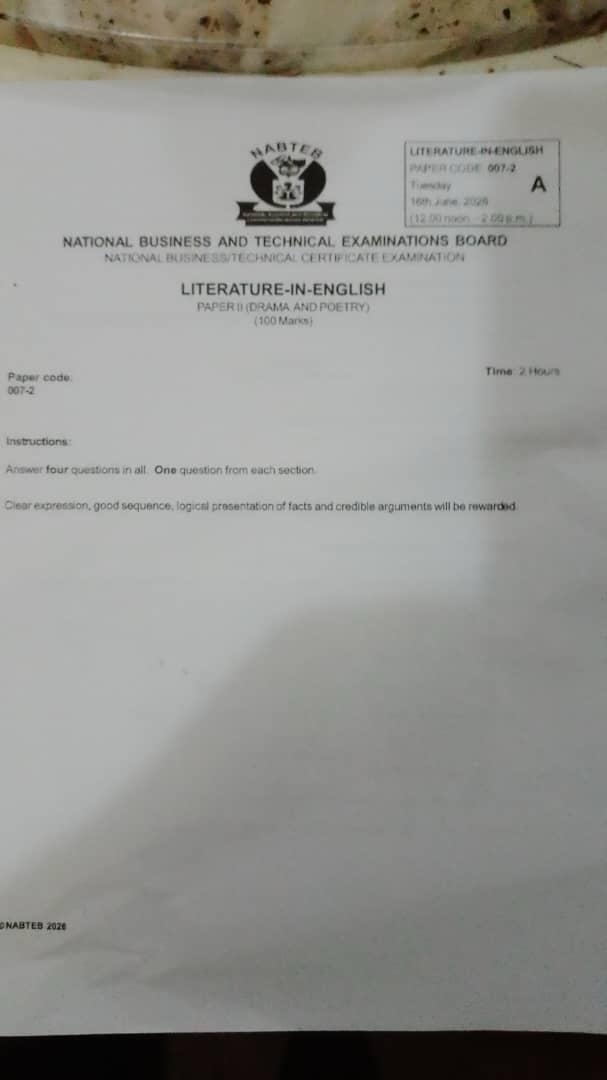
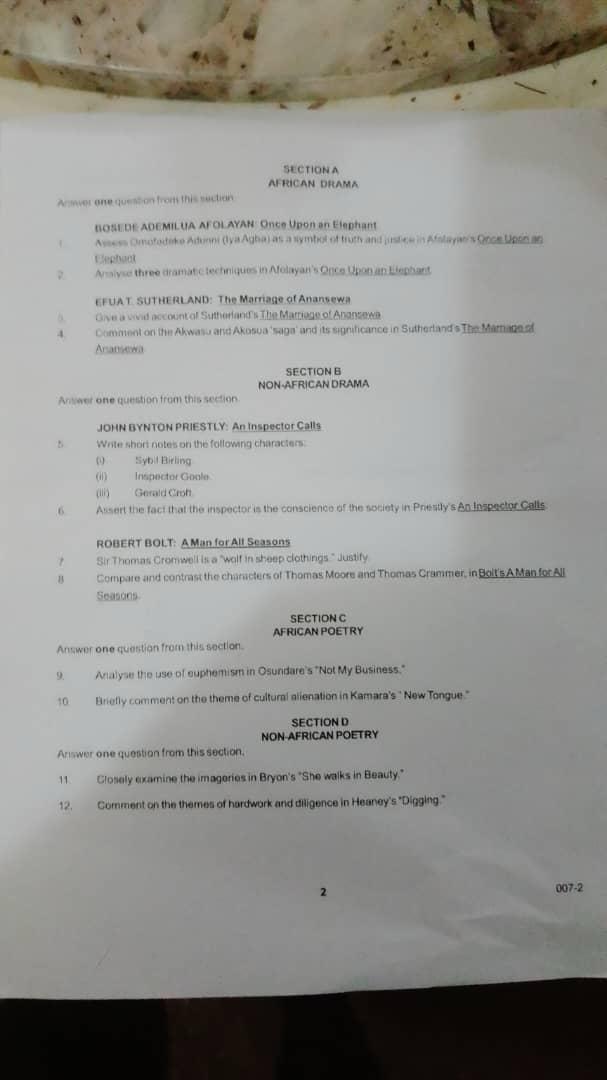
TYPE B
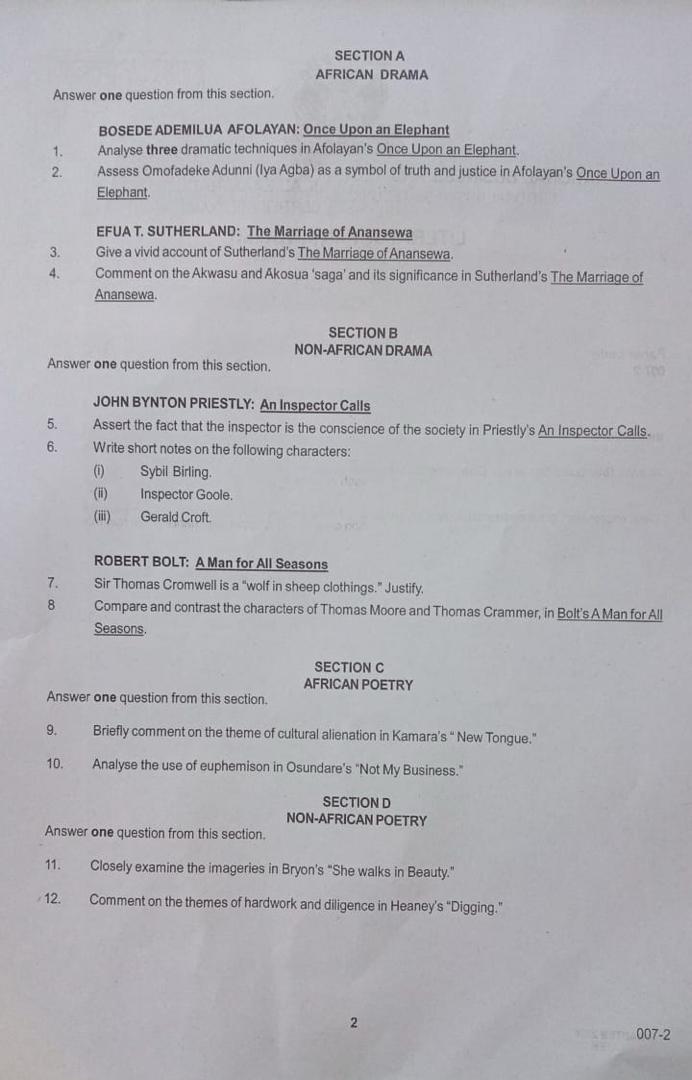
TYPE C