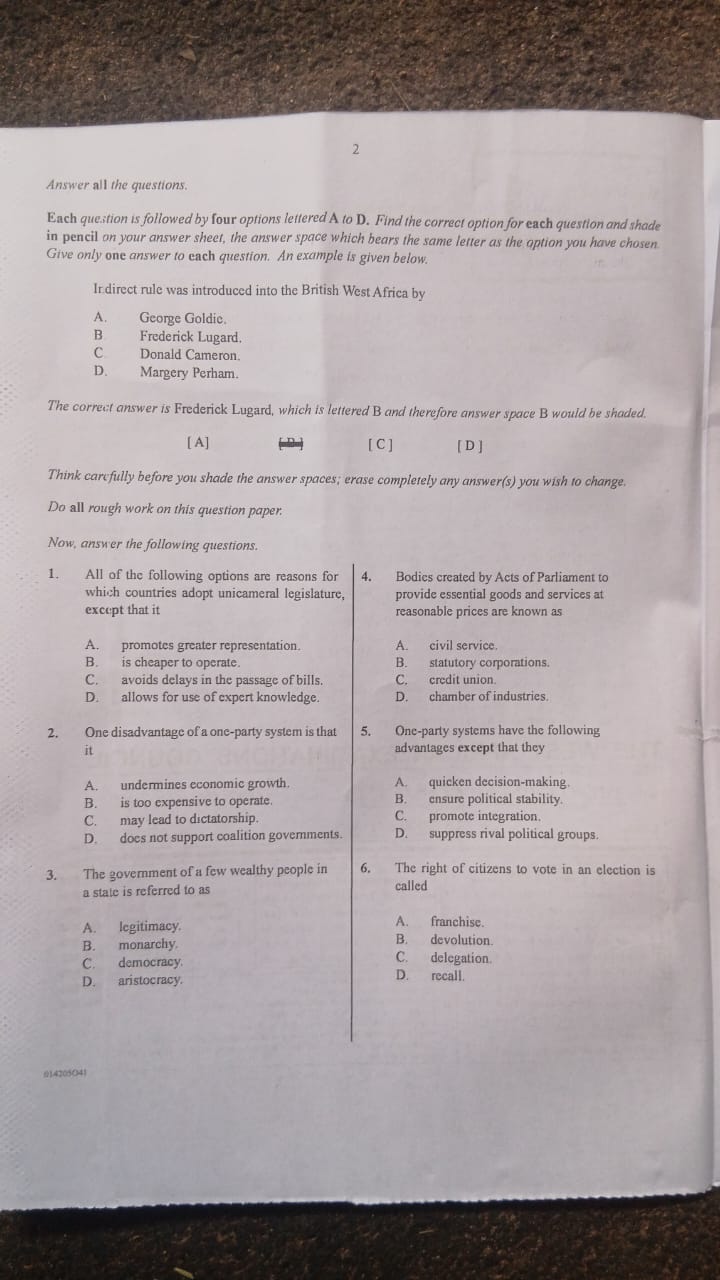
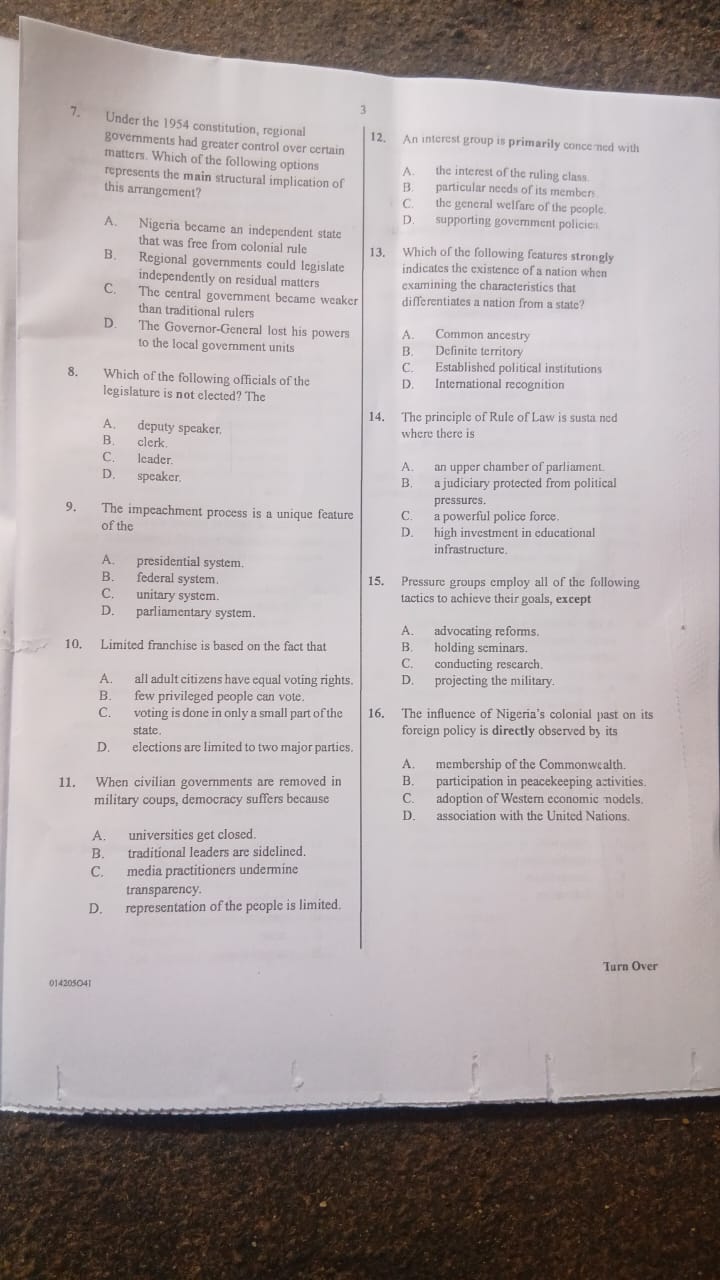
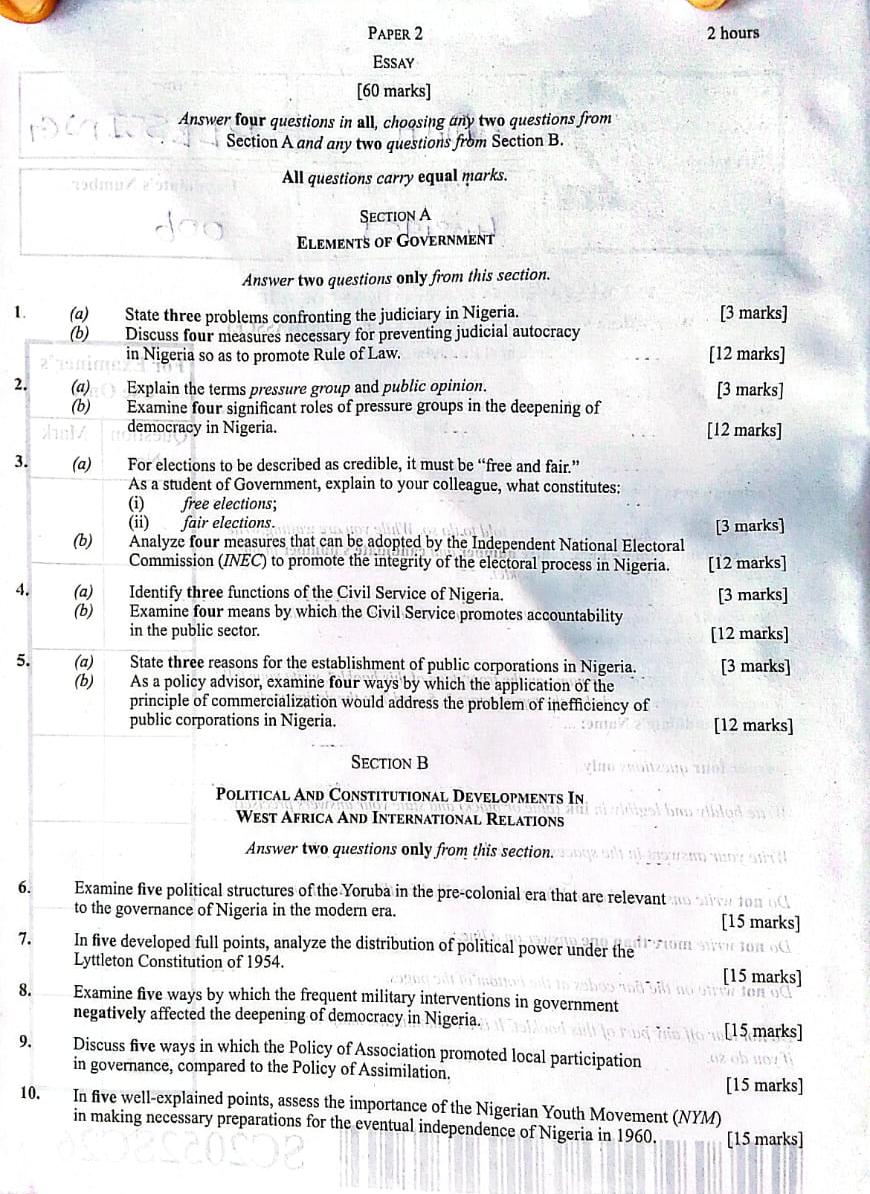
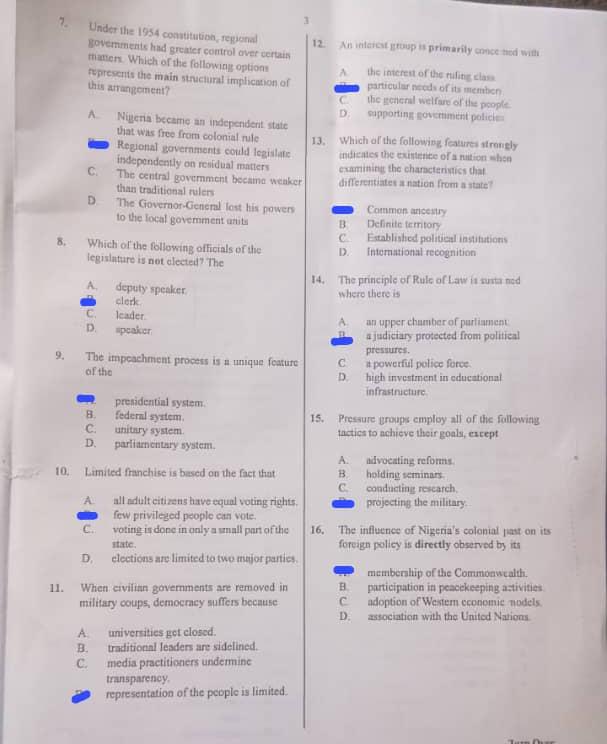
Seems like OBJ are reshuffled, just like yesterday's Maths OBJ.
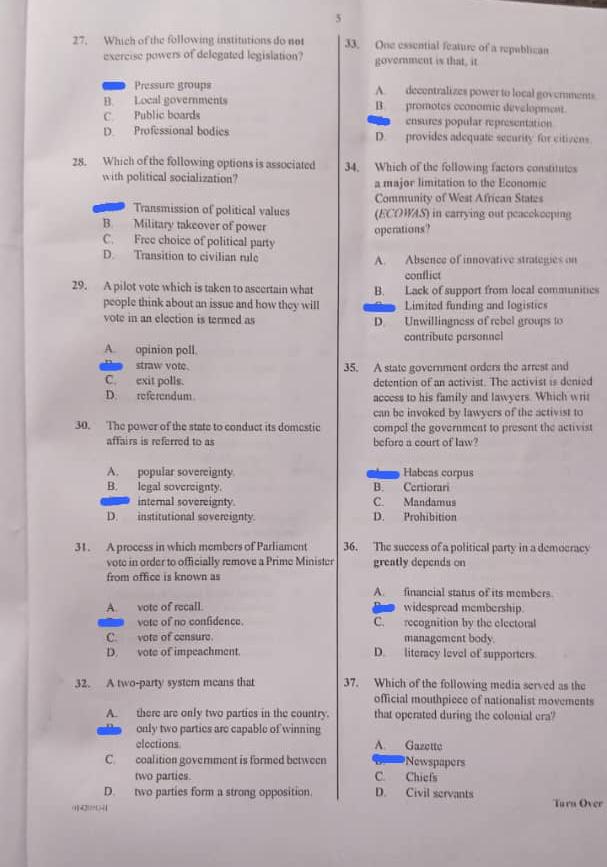
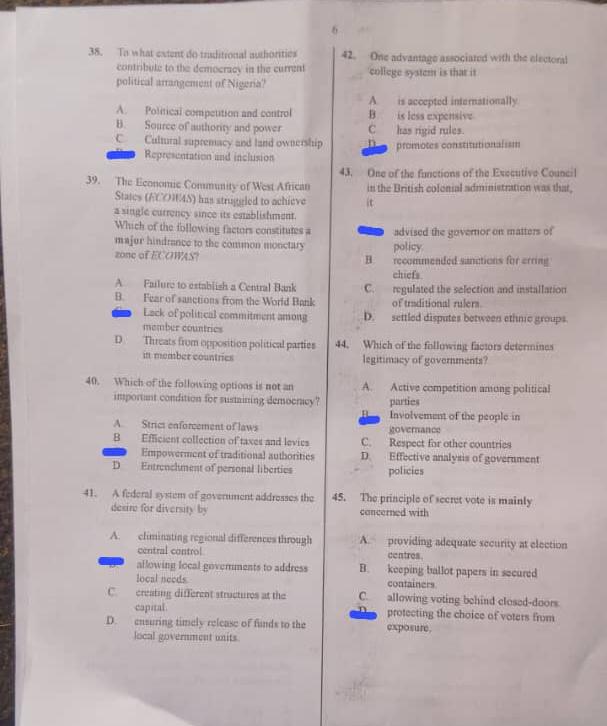
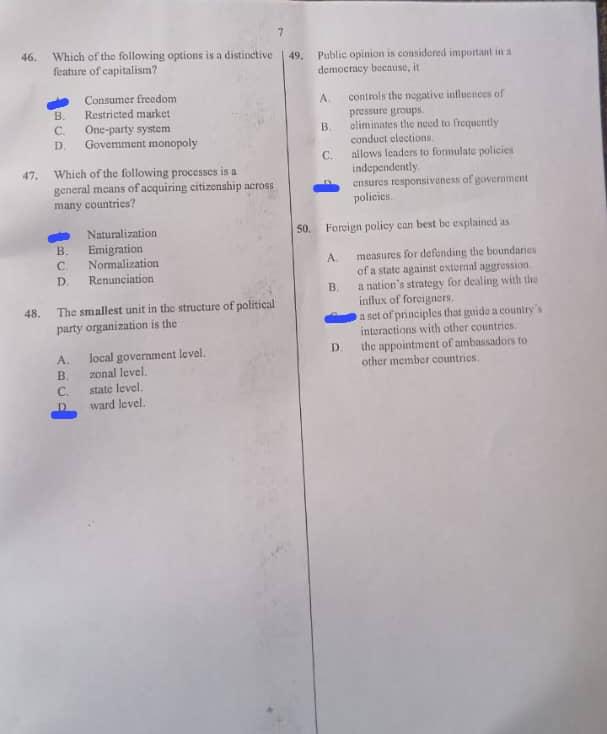
GOVERNMENT OBJ:
1-10: ACDBDABBAB
11-20: DBABDABDAD
21-30: BBAACBAABC
31-40: BBCCABBDCC
41-50: BDABDAADDC
(WITH NUMBERING)
1.A 2.C 3.D 4.B 5.D 6.A 7.B 8.B 9.A 10.B
11.D 12.B 13.A 14.B 15.D 16.A 17.B 18.D 19.A 20.D
21.B 22.B 23.A 24.A 25.C 26.B 27.A 28.A 29.B 30.C
31.B 32.B 33.C 34.C 35.A 36.B 37.B 38.D 39.C 40.C
41.B 42.D 43.A 44.B 45.D 46.A 47.A 48.D 49.D 50.C


⭐ PLEASE NOTE: ALWAYS FOLLOW EXAM INSTRUCTIONS
We often provide answers to all questions, including different versions and alternatives. This does not mean you should write everything.
Simply read the instructions given, select the required questions, and choose the version you prefer.
The extra answers are provided to help make students’ work different and avoid everyone writing the same thing.
Always follow the instructions given for each paper.
(1a)
(PICK ANY THREE)
(i) Corruption and bribery among some judicial officers, which undermine justice and public confidence in the courts.
(ii) Political interference in judicial matters, especially from the executive arm of government.
(iii) Inadequate funding of the judiciary, leading to poor facilities and inefficient administration of justice.
(iv) Delay in the dispensation of justice due to congestion of cases and prolonged court procedures.
(v) Shortage of qualified judicial personnel, such as judges, magistrates, and court officials.
(vi) Lack of full judicial independence, particularly in matters relating to appointment, promotion, and removal of judges.
(vii) Poor remuneration and welfare of judicial officers, which may expose them to corrupt practices.
(1b)
(PICK ANY FOUR)
(i) Ensuring judicial accountability: Judges should be accountable for their conduct and decisions. Complaints against judicial officers should be investigated and appropriate sanctions imposed where misconduct is established. This helps to ensure that judicial powers are exercised responsibly and in the public interest. For example, a judge found guilty of accepting bribes may be suspended or removed from office.
(ii) Strict adherence to the Constitution: The judiciary must operate within the limits prescribed by the Constitution. Judges should interpret and apply the law rather than act beyond their constitutional powers. This prevents arbitrary judgments and protects constitutional democracy. For example, a court should not exercise powers that belong to the legislature.
(iii) Establishment of an effective appeal system: The existence of higher courts to review decisions of lower courts helps to correct errors and prevents individual judges from exercising excessive or arbitrary powers. It also guarantees fairness and justice for litigants. For example, a case decided by a High Court can be appealed to the Court of Appeal.
(iv)Observance of the principle of separation of powers: The judiciary should respect the constitutional roles of the executive and legislature. This prevents judicial encroachment on the functions of other arms of government. As a result, a proper balance of power is maintained in the state. For example, judges should not make laws, as that is the duty of the legislature.
(v) Maintenance of judicial independence: Judges should be free from political pressure and external influence. An independent judiciary is more likely to make fair decisions based on law rather than personal interests. This strengthens public confidence in the administration of justice. For example, a judge should decide an election petition without pressure from politicians.
(vi) Effective disciplinary control by the National Judicial Council (NJC): The NJC should monitor the conduct of judges and discipline those found guilty of corruption, bias, or abuse of office. This promotes integrity within the judiciary. It also serves as a deterrent to other judicial officers. For example, the NJC may recommend the dismissal of a corrupt judge.
(vii) Appointment of competent and qualified judges: Only persons of proven integrity, competence, and experience should be appointed to judicial offices. Qualified judges are less likely to misuse judicial authority. Their sound knowledge of the law enhances the quality of judicial decisions. For example, experienced lawyers may be appointed as High Court judges.
(viii) Transparency in judicial proceedings: Court proceedings should generally be open to the public and media. Public scrutiny helps to prevent arbitrariness and promotes confidence in the administration of justice. It also encourages judges to act impartially and fairly. For example, members of the public may be allowed to observe court proceedings.
(ix) Adequate remuneration and welfare for judicial officers: Providing judges with good salaries and conditions of service reduces the temptation to engage in corrupt practices or abuse their powers. This enables them to perform their duties with honesty and independence. For example, well-paid judges are less likely to accept bribes from litigants.
(x) Strict compliance with the Rule of Law: All persons, including judges, must be subject to the law. Judicial decisions should be based on established legal principles and evidence rather than personal preferences or arbitrary considerations. This ensures equality before the law and protects citizens’ rights. For example, a government official who breaks the law can be tried in court like any other citizen.
=======================
(VERSION II)
(1a)
(PICK ANY THREE)
(i) Corruption among some judicial officers.
(ii) Inadequate funding of the judiciary.
(iii) Delay in the dispensation of justice.
(iv) Political interference in judicial matters.
(v) Shortage of qualified judges and legal personnel.
(vi) Poor working facilities and infrastructure in courts.
(1b)
(PICK ANY FOUR)
(i) Judicial accountability: Judicial officers should be accountable for their actions and decisions. Institutions such as the Judicial Service Commission and the National Judicial Council should investigate complaints against judges and impose sanctions where necessary. This helps to prevent abuse of judicial powers and promotes public confidence in the judiciary.
(ii) Strict adherence to the Constitution: Judges must interpret and apply laws in accordance with the provisions of the Constitution. No judicial officer should act outside the powers granted by law. Respect for constitutional supremacy ensures that the judiciary remains within its lawful limits and protects the rights of citizens.
(iii) Separation of powers: The principle of separation of powers should be maintained so that the judiciary, legislature, and executive operate independently. This prevents any arm of government, including the judiciary, from becoming too powerful and helps to preserve checks and balances in the political system.
(iv) Provision for appeals and judicial review: The legal system should allow individuals to appeal against court decisions they consider unjust. Higher courts should be empowered to review and overturn erroneous judgments. This minimizes the possibility of arbitrary decisions by lower courts and promotes fairness in the administration of justice.
(v) Appointment of competent and ethical judges: Judges should be selected based on merit, professional competence, integrity, and experience rather than political considerations. Competent judges are more likely to deliver fair judgments and uphold the principles of justice and the Rule of Law.
(vi) Regular training and professional development: Judicial officers should undergo continuous training to keep them updated on new laws, legal developments, and ethical standards. Such training enhances their efficiency, objectivity, and commitment to justice.
(vii) Transparency in judicial proceedings: Court proceedings should be conducted openly and judgments should be made available to the public except in cases where confidentiality is required by law. Transparency discourages corruption, favoritism, and arbitrary use of judicial powers.
(viii) Effective enforcement of judicial ethics and discipline: A strong code of conduct should guide the behavior of judicial officers. Any judge found guilty of corruption, misconduct, bias, or abuse of office should face appropriate disciplinary measures. This promotes integrity within the judiciary and prevents judicial autocracy while strengthening the Rule of Law.
(2a)
(PICK ANY ONE)
(i) Pressure Group: A pressure group is an organized association of individuals who share common interests and seek to influence government policies, decisions, and actions in favour of their members. Unlike political parties, they do not contest elections or aim to form a government.
(ii) Public Opinion: Public opinion refers to the collective views, attitudes, beliefs, and judgments expressed by a large number of citizens on matters of public concern. It influences government decisions and policies because leaders often consider the wishes and reactions of the people.
OR
(i) Pressure Group: A pressure group is a voluntary organization of people with similar interests that seeks to influence government policies and decisions in its favour. It does not seek political office but uses various means such as lobbying, petitions, and advocacy to achieve its objectives.
(ii) Public Opinion: Public opinion is the general opinion or viewpoint of the majority of people in a society regarding political, social, or economic issues. It serves as an important guide to government in formulating policies and making decisions that reflect the wishes of the people.
(2b)
(PICK ANY FOUR)
(i) Promotion of Citizens’ Interests: Pressure groups represent and defend the interests of their members by communicating their needs, demands, and grievances to government authorities. Through this role, they ensure that the concerns of different sections of society receive attention in policy-making.
(ii) Political Education and Awareness: Pressure groups educate citizens on political issues, government policies, rights, and responsibilities. By organizing campaigns, seminars, and public discussions, they increase political consciousness and encourage people to participate actively in democratic governance.
(iii) Influence on Government Policies: Pressure groups lobby government officials, legislators, and policymakers to adopt laws and policies that favour their interests. Through persuasion, advocacy, and consultation, they contribute to policy formulation and help shape government decisions.
(iv) Check on Government Excesses: Pressure groups monitor government actions and expose cases of corruption, abuse of power, and injustice. By criticizing unpopular policies and demanding accountability, they help prevent arbitrary rule and strengthen democratic governance in society.
(v) Encouragement of Public Participation: Pressure groups mobilize citizens to engage in political activities such as elections, public debates, protests, and consultations. This participation strengthens democracy by ensuring that government remains responsive to the needs and aspirations of the people.
(vi) Protection of Human Rights: Pressure groups advocate for the protection of fundamental human rights and freedoms. They campaign against discrimination, oppression, and injustice, while ensuring that government actions comply with constitutional provisions and internationally accepted democratic principles.
=========================
(VERSION II)
(2a)
(CHOOSE ANY ONE)
(i)Pressure group is an organized association of individuals who share common interests and seek to influence government policies and decisions without contesting elections or forming a government.
(ii)Public opinion is the collective view, belief, or judgment of the people on issues of public or national importance. It reflects what the majority of citizens think or feel about government policies, programmes, and actions.
OR
(i)Pressure groups attempt to persuade public officials to take actions that favour their members. They use methods such as lobbying, petitions, negotiations, and peaceful demonstrations. Examples include the Nigerian Labour Congress (NLC) and the Nigerian Bar Association (NBA).
(ii)Public opinion is the expression of the attitudes and preferences of the public regarding political, social, and economic matters affecting the state.
It serves as a means through which citizens influence government decisions in a democratic system.
(2b)
(PICK ANY FOUR)
(i) They influence government policies: Pressure groups present the demands and interests of their members to government officials. Through lobbying and advocacy, they help to shape public policies in a democratic state. For example, labour unions often negotiate with government on workers’ welfare.
(ii) They serve as a link between the government and the people: Pressure groups communicate the needs and grievances of citizens to the government. They also explain government policies to their members. For example, professional associations relay members’ concerns to government authorities.
(iii) They promote political participation:Pressure groups encourage citizens to take active interest in public affairs and governance. This strengthens democratic culture and civic responsibility. For example, civil society groups mobilize citizens during elections.
(iv) They protect the rights and interests of their members: Pressure groups defend their members against unfair treatment and advocate for better conditions. This helps to promote justice and equality. For example, the Nigerian Labour Congress (NLC) fights for improved wages for workers.
(v) They act as watchdogs of government: Pressure groups monitor government activities and expose corruption, abuse of power, and maladministration. This promotes accountability and transparency. For example, anti-corruption advocacy groups often demand public accountability.
(vi) They help in political education: Pressure groups educate citizens on their rights, duties, and national issues. An informed citizenry is essential for democratic development. For example, voter education campaigns are often organized by civic groups.
(vii) They contribute to policy formulation: Government may consult pressure groups when making laws or policies because of their expertise and experience. Their contributions improve decision-making. For example, medical associations may advise government on health policies.
(viii) They promote the Rule of Law: Pressure groups challenge unlawful actions through legal means and advocate respect for constitutional provisions. This strengthens democratic governance. For example, human rights organizations may sue government agencies that violate citizens’ rights.
(ix) They help to reduce oppression and injustice: Pressure groups speak against policies or actions that are harmful to the people. Their activities help to safeguard fundamental human rights. For example, civil rights groups campaign against unlawful detention and discrimination.
(x) They promote national development and social welfare: Pressure groups advocate policies that improve the living standards of citizens and enhance national progress. Their efforts often lead to reforms in different sectors. For example, educational groups may campaign for increased funding of schools.
(3ai)
(PICK ANY ONE)
A free election is one in which voters are allowed to make their choices without intimidation, coercion, bribery, threats, or undue influence. Citizens have the freedom to vote for candidates of their choice, campaign freely, express political opinions, and participate in the electoral process without fear.
OR
A free election is an election in which every eligible citizen has the unrestricted right to vote and contest for public office without pressure from government officials, political parties, or any other group. Voters are free to make political choices according to their conscience and preferences.
(3aii)
(PICK ANY ONE)
A fair election is one in which the electoral process is conducted honestly, impartially, and transparently. All contestants are given equal opportunities to campaign and compete, while votes are accurately counted and results are declared without manipulation, thereby reflecting the genuine wishes of the electorate.
OR
A fair election is one conducted according to established electoral laws and regulations, with equal treatment given to all political parties and candidates. The electoral process must be transparent, impartial, and free from fraud, manipulation, or bias, ensuring that election results truly reflect the will of the people.
(3b)
(PICK ANY FOUR)
(i) Proper Voter Registration: INEC should ensure that voter registration is conducted efficiently and transparently. The use of modern technology can help eliminate multiple registrations and fake voters. An accurate voters’ register enhances the credibility of elections and ensures that only eligible citizens participate in voting.
(ii) Use of Electoral Technology: INEC should continue to adopt technologies such as biometric voter accreditation and electronic transmission of results. These technologies help reduce electoral fraud, prevent impersonation, and improve the accuracy and transparency of the electoral process.
(iii) Voter Education and Awareness: INEC should intensify voter education programmes to enlighten citizens on their electoral rights and responsibilities. Educated voters are more likely to participate actively, reject electoral malpractice, and contribute positively to the conduct of credible elections.
(iv) Training of Electoral Officials: Electoral officials should receive adequate training before elections. Properly trained officials are better equipped to handle election materials, enforce electoral guidelines, and manage polling units effectively, thereby reducing errors and irregularities during elections.
(v) Strict Enforcement of Electoral Laws: INEC should work closely with security agencies and relevant institutions to ensure strict compliance with electoral laws. Individuals involved in vote-buying, ballot snatching, or other electoral offences should be investigated and punished to deter future violations.
(vi) Transparency in Result Management: Election results should be collated and announced in a transparent manner. INEC should ensure that results from polling units are properly documented and made accessible to stakeholders, reducing suspicion and increasing public confidence in the outcome.
(vii) Independence and Neutrality: INEC should maintain its independence from political interference and treat all political parties equally. An impartial electoral body is more likely to gain public trust and conduct elections that are accepted as credible by contestants and voters.
(viii) Adequate Security During Elections: INEC should collaborate with security agencies to provide adequate protection for voters, electoral officials, and election materials. A secure electoral environment reduces violence, intimidation, and disruption, enabling citizens to vote freely and confidently.
==============================
(VERSION II)
(3ai)
Free election:
(PICK ANY ONE)
A free election is an election in which eligible voters are allowed to vote for candidates of their choice without intimidation, coercion, threats, harassment, or undue influence from any individual, political party, or government authority. In a free election, citizens are at liberty to express their political preferences and cast their votes according to their conscience.
OR
A free election is one conducted in an atmosphere where fundamental rights such as freedom of speech, freedom of association, and freedom of movement are guaranteed to all participants.
Political parties and candidates are allowed to campaign freely, while voters can make independent political choices.
(3aii)
Fair election:
(PICK ANY ONE)
A fair election is one in which votes are accurately counted and election results genuinely reflect the wishes of the electorate. The process must be transparent, honest, and free from fraud, ballot stuffing, or manipulation of results.
OR
A fair election is an election conducted according to established electoral laws and procedures, where all contestants are treated equally and impartially. There should be no favouritism by electoral officials, and every political party should have an equal opportunity to compete.
(3b)
(PICK ANY FOUR)
(i) Conducting continuous voter education: INEC should educate citizens on electoral procedures, voting rights, and the importance of peaceful participation in elections. This reduces electoral malpractice and encourages informed voting. For example, INEC can organize sensitization programmes through radio, television, and social media.
(ii) Maintaining an accurate and credible voter register: INEC should regularly update the voters’ register to remove deceased persons and prevent multiple registrations. A credible register reduces electoral fraud and enhances confidence in elections. For example, biometric registration can help identify genuine voters.
(iii) Ensuring impartiality and independence: INEC officials must remain neutral and avoid favouring any political party or candidate. This promotes public trust in the electoral process. For example, electoral officers should apply electoral rules equally to all contestants.
(iv) Deploying modern electoral technology: The use of technology can improve transparency and reduce manipulation during elections. Electronic accreditation and transmission of results help to minimize fraud. For example, BVAS can be used to verify voters before voting.
(v) Training electoral officials adequately: INEC should provide regular training for its staff and ad hoc personnel to ensure proper understanding of electoral laws and procedures. Well-trained officials are less likely to make costly mistakes. For example, presiding officers should be trained on voter accreditation and result collation.
(vi) Providing adequate electoral materials on time: Sensitive and non-sensitive election materials should reach polling units before voting begins. This prevents unnecessary delays and confusion on election day. For example, ballot papers and result sheets should arrive at polling units early.
(vii) Enforcing electoral laws and sanctioning offenders: INEC should work with security agencies and the courts to ensure that electoral offenders are punished. This discourages vote-buying, ballot snatching, and other electoral crimes. For example, individuals caught engaging in multiple voting should be prosecuted.
(viii) Promoting transparency in vote counting and result collation: The counting and collation of votes should be conducted openly in the presence of party agents, observers, and voters. This reduces suspicion and strengthens confidence in election outcomes. For example, results should be announced publicly at the polling unit immediately after counting.
(4a)
(PICK ANY THREE)
(i) Implementation of Government Policies
(ii) Advising the Government
(iii) Maintenance of Government Records
(iv) Provision of Essential Public Services
(v) Revenue Collection and Financial Administration
(vi) Preparation of Government Budget
(vii) Maintenance of Law and Order
(4b)
(PICK ANY FOUR)
(i) Proper Record Keeping: The Civil Service maintains accurate records of government activities, expenditures, and decisions. These records make it possible to monitor official actions, verify transactions, and provide evidence when necessary, thereby ensuring transparency and reducing opportunities for corruption and mismanagement.
(ii) Financial Control and Auditing: Civil servants ensure that public funds are spent according to approved budgets and financial regulations. Through auditing and financial monitoring, they help detect irregularities, prevent embezzlement, and ensure that government resources are used for authorized purposes only.
(iii) Compliance with Rules and Regulations: The Civil Service operates according to established laws, procedures, and regulations. By insisting on adherence to official guidelines in government operations, it minimizes arbitrary actions, promotes discipline among public officials, and strengthens accountability in administration.
(iv) Preparation of Reports: Civil servants regularly prepare and submit reports on government programmes and activities. These reports enable supervising authorities to assess performance, identify shortcomings, and ensure that public officials are held responsible for their actions and decisions.
(v) Monitoring and Supervision of Government Activities: The Civil Service supervises the implementation of government policies and programmes through its various ministries and departments. Effective monitoring helps ensure that officials perform their duties properly and remain answerable for their actions and responsibilities.
(vi) Provision of Information to Government: Civil servants provide accurate and timely information required for decision-making and evaluation. This enables government authorities to assess the performance of agencies and officials, thereby promoting transparency, responsibility, and accountability in public administration.
(vii) Enforcement of Public Service Ethics: The Civil Service promotes accountability by enforcing codes of conduct and ethical standards among public servants. Officials who violate established rules may face disciplinary measures, which helps to encourage integrity, honesty, and responsibility in the discharge of duties.
(viii) Assistance to Oversight Bodies: The Civil Service cooperates with institutions such as audit departments, anti-corruption agencies, and legislative committees. By providing necessary documents and information, it facilitates investigations and reviews that help ensure accountability in the public sector.
(5a)
(PICK ANY THREE)
(i) To provide essential services.
(ii) To promote economic development.
(iii) To control strategic industries.
(iv) To prevent monopoly.
(v) To generate revenue for the government.
(vi) To provide employment opportunities.
(vii) To ensure equitable distribution of services.
(viii) To correct market failures.
(ix) To promote national interest.
(x) To encourage industrial development.
(5b)
(PICK ANY FOUR)
(i) Profit-Oriented Management: Commercialization makes public corporations work towards making profit. This encourages management to avoid waste, increase output, and make proper use of available resources so that the organization can generate enough income and operate successfully.
(ii) Improved Accountability: Commercialization makes managers and workers more responsible for their actions and performance. They are expected to give proper accounts of how resources are used, which helps to reduce corruption and improve efficiency in the organization.
(iii) Reduction of Government Dependence: Commercialization reduces the dependence of public corporations on government funding. As a result, they are encouraged to generate their own revenue, spend money wisely, and manage their resources more effectively.
(iv) Increased Operational Efficiency: Commercialization encourages public corporations to adopt better methods of management and operation. This helps to increase productivity, reduce waste, and improve the quality of services provided to the public.
(v) Enhanced Competition: Commercialization exposes public corporations to competition from private businesses. This motivates them to improve their services, reduce costs, and satisfy customers in order to remain relevant and attract more patronage.
(vi) Better Staff Motivation: Commercialized corporations can reward hardworking employees through incentives and promotions. This encourages workers to be more dedicated, productive, and committed to achieving the goals of the organization.
(vii) Faster Decision-Making: Commercialization gives managers more freedom to make decisions without unnecessary delays. This reduces bureaucracy and enables the corporation to respond quickly to challenges and opportunities.
(viii) Improved Service Delivery: Since commercialized corporations depend on customers for income, they are encouraged to provide efficient, reliable, and high-quality services. This helps to improve customer satisfaction and increase public confidence in their operations.
=============================
(5a)
(PICK ANY THREE)
(i) To provide essential services to the public.
(ii) To control strategic sectors of the economy.
(iii) To promote economic development and employment opportunities.
(iv) To prevent the exploitation of consumers by private individuals and organizations.
(v) To ensure equitable distribution of goods and services throughout the country.
(vi) To generate revenue for the government.
(vii) To promote national interest and security in key sectors of the economy.
(viii) To undertake large-scale projects that private investors may be unwilling or unable to finance.
(5b)
(PICK ANY FOUR)
(i) Promotion of profit consciousness: Commercialization encourages public corporations to operate on a profit-oriented basis. This compels management to minimize waste, improve productivity, and utilize resources efficiently in order to generate revenue and remain financially viable.
(ii) Reduction of government dependence: Under commercialization, public corporations are expected to generate enough income to cover their operating costs. This reduces reliance on government subventions and encourages prudent financial management and accountability.
(iii) Improvement in service delivery: Since commercialized corporations must attract and retain customers, they are compelled to provide better and more efficient services. Improved service quality increases customer satisfaction and enhances organizational performance.
(iv) Encouragement of managerial efficiency: Commercialization gives managers greater responsibility for achieving organizational goals. Managers are motivated to adopt modern management techniques, improve decision-making, and ensure effective utilization of available resources.
(v) Reduction of political interference: Commercialization allows public corporations to operate with greater autonomy. Reduced political influence enables management to make decisions based on economic and business considerations, thereby improving efficiency.
(vi) Enhancement of accountability and performance: Commercialized corporations are required to maintain proper financial records and evaluate performance regularly. This promotes transparency, accountability, and the achievement of set objectives.
(vii) Encouragement of competition and innovation: Commercialization exposes public corporations to competitive pressures, motivating them to introduce new ideas, improve operational methods, and increase efficiency in service delivery.
(6)
(PICK ANY FIVE)
(i) The Oba: The Oba was the supreme traditional ruler, symbol of authority, and custodian of customs. He supervised governance, maintained order, and represented the kingdom. In modern Nigeria, this resembles constitutional heads such as presidents and governors who provide leadership, unity, cultural identity, and ceremonial authority within the political system.
(ii) The Oyomesi: The Oyomesi was a council of seven kingmakers who advised the Alaafin and checked his powers. They could compel him to abdicate if he ruled unjustly. This resembles Nigeria’s legislature, which performs oversight, approves policies, and can impeach leaders who abuse authority or violate constitutional expectations.
(iii) The Ogboni Society: The Ogboni was a powerful religious‑judicial body that upheld justice, protected customs, and checked both the Oba and the Oyomesi. It settled disputes and promoted fairness. Its modern relevance appears in Nigeria’s judiciary and traditional councils that interpret laws, resolve conflicts, and ensure accountability in governance.
(iv) Provincial Administration: The Yoruba Empire was divided into provinces governed by Obas, Baales, or Ajele who represented central authority. They maintained order, collected tribute, and enforced policies. This structure resembles Nigeria’s federal and state administrative system, where governors and local officials manage territories under a central national government.
(v) Village Administration: Villages were governed by the Baale and a council of elders who handled local disputes, maintained peace, and coordinated community development. This reflects Nigeria’s local government system, where ward heads, councillors, and community associations manage grassroots administration and ensure effective governance at the community level.
(vi) The Bashorun: The Bashorun was the head of the Oyomesi and acted as prime minister. He coordinated political affairs, advised the Alaafin, and could lead the process of removing a tyrannical king. His role resembles modern chief‑of‑staffs or legislative leaders who influence governance and political decision‑making.
(vii) The Army: The Yoruba army protected the empire, enforced the Oba’s authority, expanded territory, and maintained internal security. It was led by war chiefs who ensured discipline and defence. This parallels Nigeria’s armed forces, which safeguard national sovereignty, maintain peace, and respond to internal and external security threats.
==============≈===============
(VERSION II)
(6)
(PICK ANY FIVE)
(i) The Oba as the Head of Government: The Oba was the political and administrative head of the Yoruba kingdom. He exercised executive authority and ensured peace, order, and security within the state. This is similar to the role of a President or Governor in modern Nigeria. He also represented the unity and authority of the kingdom.
(ii) The Council of Chiefs (Oyomesi): The Oba was assisted by a council of chiefs who advised him on important matters of state. The council also acted as a check on the powers of the Oba. This resembles the advisory and oversight functions of modern legislatures. Their advice helped to ensure good governance.
(iii) The Principle of Checks and Balances: The powers of the Oba were not absolute because institutions such as the Oyomesi could restrain him when necessary. This prevented abuse of power and promoted responsible governance. This principle is reflected in Nigeria’s system of separation of powers. It helped to prevent dictatorship and arbitrary rule.
(iv) The Existence of a Legislative System: Important decisions affecting the kingdom were discussed by the Oba and his chiefs before implementation. This encouraged consultation and collective decision-making. This is similar to law-making processes in modern democratic governments. It ensured that different opinions were considered before decisions were made.
(v) The Judicial System: Traditional courts presided over by the Oba and chiefs settled disputes and administered justice. Laws and customs were enforced to maintain order in society. This is comparable to the role of modern courts in Nigeria. It helped to promote peace and social harmony.
(vi) The Local Government Structure: The Yoruba kingdom was divided into towns and villages administered by subordinate chiefs and local authorities. This ensured effective administration at the grassroots level. This resembles the present local government system in Nigeria. It brought government closer to the people.
(vii) Popular Participation in Governance: Through family heads, chiefs, age grades, and community associations, people contributed to the administration of their communities. This encouraged consultation and representation in governance. This is similar to citizen participation in modern democratic government. It gave the people a sense of belonging in the political system.
(7)
(PICK ANY FIVE)
(i) Federal System of Government: The Lyttleton Constitution of 1954 introduced a true federal system of government in Nigeria. Political power was shared between the federal government and the regional governments. This arrangement recognized the differences among the regions and allowed them to take part in governing the country.
(ii) Division of Legislative Powers: The constitution shared law-making powers between the federal and regional governments through the Exclusive and Concurrent Legislative Lists. The federal government made laws on matters like defence, foreign affairs, currency, and aviation, while both levels of government could make laws on some common matters.
(iii) Regional Autonomy: The Northern, Western, and Eastern Regions were given enough freedom to manage their own affairs. Each region could make laws and carry out policies on matters such as education, agriculture, health, and local government without unnecessary interference from the federal government.
(iv) Separate Regional Governments: Each region had its own government made up of a Premier, Executive Council, and House of Assembly. These institutions exercised political power within their regions and were responsible for the administration and development of regional affairs.
(v) Reduction of Central Government Dominance: Unlike earlier constitutions that gave most powers to the central government, the Lyttleton Constitution reduced the powers of the centre and strengthened the regions. This created a more balanced sharing of political power and enabled the regions to play important roles in governing Nigeria.
(vi) Regional Premiers and Executive Councils: Each region had its own Premier and Executive Council responsible for administering the affairs of the region. This gave the regions considerable political power and enabled them to govern themselves in many important areas.
(vii) Regional Legislatures: The constitution established separate legislatures for each region with the authority to make laws on regional matters. This strengthened regional governments and increased their participation in the political development of Nigeria.
(viii) Reduction of Centralized Authority: The Lyttleton Constitution reduced the concentration of power at the centre by granting greater autonomy to the regions. This ensured that political power was more evenly distributed and allowed the regions to play a greater role in governance.
=========≈===========≈=======
(VERSION II)
(7)
(PICK ANY FIVE)
(i) The Constitution established a federal system of government: Political powers were divided between the central government and the regional governments. This enabled each level of government to perform its constitutional functions independently. It also reduced excessive concentration of power at the centre.
(ii) Legislative powers were shared between the federal and regional governments: The Federal Legislature made laws on matters affecting the whole country, while regional legislatures made laws on matters concerning their respective regions. This allowed each level of government to address issues within its jurisdiction effectively.
(iii) An Exclusive Legislative List was created: Certain important matters such as defence, external affairs, currency, and aviation were placed under the exclusive control of the federal government. This ensured uniformity in the management of national affairs.
(iv) A Concurrent Legislative List was introduced: Both the federal and regional governments could make laws on subjects contained in this list. However, federal law prevailed whenever there was a conflict between federal and regional laws. This encouraged cooperation between the two levels of government.
(v) Residual powers were granted to the regions: Matters not included in either the Exclusive or Concurrent Lists were left for the regional governments to legislate upon. This gave the regions a considerable degree of autonomy in governance.
(vi) Regional governments were given executive powers: Each region had its own executive council responsible for administering regional affairs without undue interference from the central government. This enhanced administrative efficiency within the regions.
(vii) Regional legislatures were established: The Northern, Western, and Eastern Regions each had a legislature empowered to make laws for the peace, order, and good government of their respective regions. This promoted self-government and regional participation in governance.
(viii) The federal government coordinated matters of national importance: While the regions enjoyed considerable autonomy, the central government retained authority over issues affecting the unity, security, and overall interests of Nigeria. This helped to maintain national unity and political stability.
(8)
(PICK ANY FIVE)
(i) Suspension of the Constitution: Military governments often suspended parts or all of the constitution after taking power. This weakened constitutional rule and denied citizens the opportunity to enjoy the democratic rights and freedoms guaranteed by the constitution.
(ii) Dissolution of Democratic Institutions: Military regimes dissolved elected bodies such as the parliament, state assemblies, and local government councils. This disrupted democratic governance and prevented citizens from being represented by leaders of their choice.
(iii) Violation of Fundamental Human Rights: Military governments frequently restricted freedom of speech, association, and the press. Such actions discouraged political participation and weakened the democratic culture necessary for national development.
(iv) Concentration of Power: Military rule concentrated political power in the hands of a few military officers. This reduced accountability, weakened checks and balances, and undermined the democratic principle of separation of powers.
(v) Suppression of Political Parties: Many military regimes banned or restricted the activities of political parties. This limited political competition and denied citizens the opportunity to participate fully in the democratic process.
(vi) Political Instability: Frequent military coups created uncertainty and instability in the political system. This interrupted democratic development and made it difficult for democratic institutions to grow and become firmly established.
(vii) Weakening of the Rule of Law: Military governments often ruled through decrees that overrode existing laws and court decisions. This reduced respect for the rule of law and weakened public confidence in legal and democratic institutions.
(viii) Delay in Democratic Development: Frequent military interventions interrupted civilian governments and delayed the growth of democratic traditions, values, and institutions needed for sustainable democracy in Nigeria.
(ix) Electoral Disruptions: Military takeovers usually led to the cancellation, postponement, or annulment of elections. This prevented the smooth transfer of power through democratic means and weakened public trust in the electoral process.
(x) Discouragement of Political Participation: The authoritarian nature of military rule discouraged citizens from taking active interest in politics. This reduced political awareness and participation, which are essential for the success of democracy.
(9)
(PICK FIVE ONLY)
(i) Greater Inclusion of Traditional Rulers: The Policy of Association recognized and utilized the authority of traditional rulers in the administration of colonies. Chiefs, emirs, and local leaders were allowed to participate in governance and assist colonial officials in maintaining law and order, whereas the Policy of Assimilation largely ignored traditional institutions and attempted to replace them with French administrative structures.
(ii) Respect for Indigenous Institutions: Under the Policy of Association, existing political, social, and cultural institutions were preserved and incorporated into the colonial administration. This enabled local communities to participate in governance through familiar structures, unlike Assimilation, which sought to transform Africans into French citizens by imposing French institutions and practices.
(iii) Increased Opportunities for Local Administration: The Policy of Association allowed qualified Africans to occupy various positions in local government and administrative councils. This gave them practical experience in governance, while the Policy of Assimilation concentrated major administrative powers in the hands of French officials.
(iv) Recognition of Local Customs and Laws: Association permitted the use of customary laws and traditional judicial systems in many local matters. This enabled indigenous people to participate in the administration of justice according to their customs, whereas Assimilation emphasized the application of French laws and legal principles.
(v) Encouragement of Indirect Rule: The Policy of Association encouraged governing colonies through local authorities who acted as intermediaries between the colonial government and the people. This increased local involvement in decision-making, unlike Assimilation, which preferred direct administration by French personnel.
(vi) Promotion of Political Awareness and Leadership: By involving Africans in local councils and administrative responsibilities, the Policy of Association helped to develop leadership skills and political consciousness among the people. Such opportunities were limited under Assimilation because political authority remained largely centralized in French hands.
(vii) Adaptation to Local Conditions: The Policy of Association recognized the uniqueness of different African societies and adjusted administrative methods to suit local realities. This flexibility encouraged broader participation by local communities, whereas Assimilation followed a rigid policy aimed at making Africans adopt French culture and institutions.
(viii) Preparation for Self-Government: Through the involvement of traditional rulers, local councils, and indigenous administrators, the Policy of Association provided Africans with valuable administrative experience and prepared them for future self-rule. In contrast, the Policy of Assimilation offered fewer opportunities for widespread participation in governance and therefore contributed less to the development of local administrative capacity.
===========================
(VERSION II)
(9)
(PICK ANY FIVE)
(i) The Policy of Association allowed Africans to retain their culture and traditions: Unlike Assimilation, which sought to make Africans adopt French culture completely, Association recognized and respected indigenous customs and institutions. This encouraged greater involvement of local people in the administration of their communities. For example, Africans were allowed to continue observing their traditional customs and laws.
(ii) The Policy of Association made use of traditional rulers in administration: The French governed through existing local chiefs and traditional authorities instead of completely replacing them. This enabled Africans to participate more directly in the governance of their areas. For example, village chiefs were used to help maintain law and order.
(iii) The Policy of Association encouraged the appointment of Africans into administrative positions: More Africans were employed in local government and lower administrative offices. This provided opportunities for them to gain political and administrative experience. For example, some Africans served as clerks and local administrators.
(iv) The Policy of Association permitted local institutions to function alongside colonial administration: Traditional courts and local administrative structures were recognized and utilized by the colonial government. This increased the involvement of indigenous people in decision-making processes. For example, traditional courts were allowed to settle certain local disputes.
(v) The Policy of Association promoted gradual political development among Africans: Africans were given greater opportunities to participate in local councils and public affairs without being required to abandon their identity. This helped to prepare them for self-government and eventual independence. For example, Africans were allowed to serve as members of local councils.
(vi) The Policy of Association encouraged local consultation in administration: Colonial officials often consulted local leaders and elders before implementing certain policies. This gave Africans a voice in matters affecting their communities. For example, chiefs could advise colonial officers on local issues.
(vii) The Policy of Association reduced the strict requirements for citizenship and participation: Unlike Assimilation, Africans were not required to become French citizens before participating in local administration. This enabled more indigenous people to take part in governance. For example, local chiefs could participate in administration while still retaining their African identity and customs.
(10)
(PICK FIVE ONLY)
(i) National Political Awareness: The Nigerian Youth Movement (NYM) played a vital role in educating Nigerians about their political rights and responsibilities. Through its activities, campaigns, and public discussions, it awakened political consciousness among the people and encouraged them to participate actively in the struggle against colonial rule.
(ii) Promotion of National Unity: The NYM brought together Nigerians from different ethnic, religious, and regional backgrounds under a common political platform. This helped reduce tribal sentiments and foster a sense of nationalism, which was necessary for achieving independence.
(iii) Training Ground for Future Nationalists: The movement served as a political training institution for many Nigerian leaders who later became prominent figures in the independence struggle. Members gained valuable experience in leadership, political organization, and public administration, which prepared them for self-government.
(iv) Opposition to Colonial Policies: The NYM consistently criticized and challenged unjust colonial policies that hindered the political and economic development of Nigerians. Its resistance to colonial domination increased public demand for constitutional reforms and self-rule.
(v) Encouragement of Political Participation: The movement encouraged Nigerians to take part in elections, political debates, and civic activities. This increased political involvement helped to develop democratic principles and prepared the people for the responsibilities of independent governance.
(vi) Demand for Constitutional Reforms: The NYM advocated for greater African representation in government and pressed for constitutional changes that would give Nigerians a larger role in managing their own affairs. These demands contributed significantly to the gradual transfer of power from the British colonial administration to Nigerians.
(vii) Development of Nationalist Press and Public Opinion: The movement utilized newspapers, public lectures, and political campaigns to spread nationalist ideas. This helped to mobilize public opinion against colonial rule and strengthened support for the independence movement throughout the country.
(viii) Foundation for Modern Political Parties: The organizational structure, political ideals, and nationalist activities of the NYM influenced the emergence of later political parties that spearheaded the final phase of the independence struggle. Its contributions laid a strong foundation for organized political action that eventually led to Nigeria's independence in 1960.
=================≈=============
(VERSION II)
(10)
(PICK ANY FIVE)
(i) Promotion of Nationalism: The Nigerian Youth Movement stimulated nationalist consciousness among Nigerians by encouraging resistance to colonial domination and advocating self-government. Its activities helped unite people behind the common goal of achieving political independence.
(ii) Political Education of Nigerians: The movement educated Nigerians on political rights, governance, and the need for self-rule. Through campaigns, meetings, and publications, it increased political awareness and prepared citizens for active participation in national affairs.
(iii) Encouragement of National Unity: The NYM attracted members from different ethnic and regional backgrounds, promoting cooperation among Nigerians. This fostered a sense of national identity and reduced divisions that could hinder the struggle for independence.
(iv) Training of Future Political Leaders: The organization served as a training ground for many future nationalist leaders. Members gained valuable experience in political organization, leadership, and public administration, which later contributed to Nigeria’s independence movement.
(v) Challenge to Colonial Policies: The NYM criticized and opposed colonial policies that were detrimental to Nigerians. Its persistent demands for reforms increased pressure on the colonial administration to grant greater political representation and constitutional development.
(vi) Expansion of Political Participation: The movement encouraged more Nigerians to engage in political activities. By mobilizing educated youths and other groups, it broadened public involvement in governance and strengthened the demand for self-government.
(vii) Support for Constitutional Reforms: The NYM advocated constitutional changes that would increase Nigerian participation in government. Its efforts contributed to political reforms that gradually prepared the country for responsible self-government and eventual independence.
(viii) Development of Nationalist Press and Public Opinion: The movement used newspapers and public campaigns to spread nationalist ideas and influence public opinion. This helped build widespread support for independence and increased pressure on colonial authorities to respond to Nigerian demands.
Answers Loading...
OBJECTIVES