⭐ PLEASE NOTE: ALWAYS FOLLOW EXAM INSTRUCTIONS
Here With NONIEXPO, We often provide answers to all questions, including different versions and alternatives. This does not mean you should write everything.
Simply read the instructions given, select the required questions, and choose the version you prefer.
The extra answers are provided to help make students’ work different and avoid everyone writing the same thing.
Always follow the instructions given for each paper.
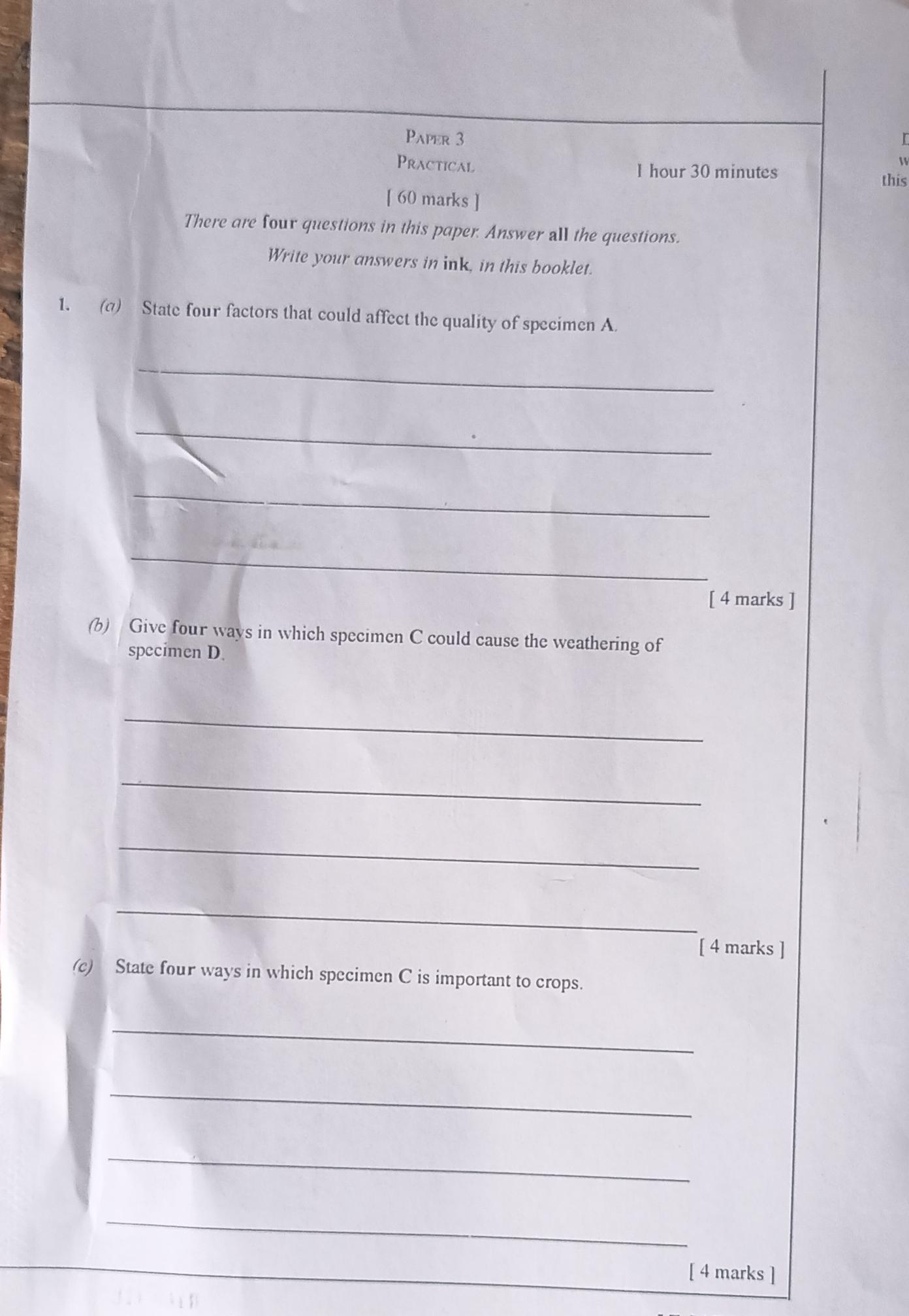
(1a)
(PICK ANY FOUR)
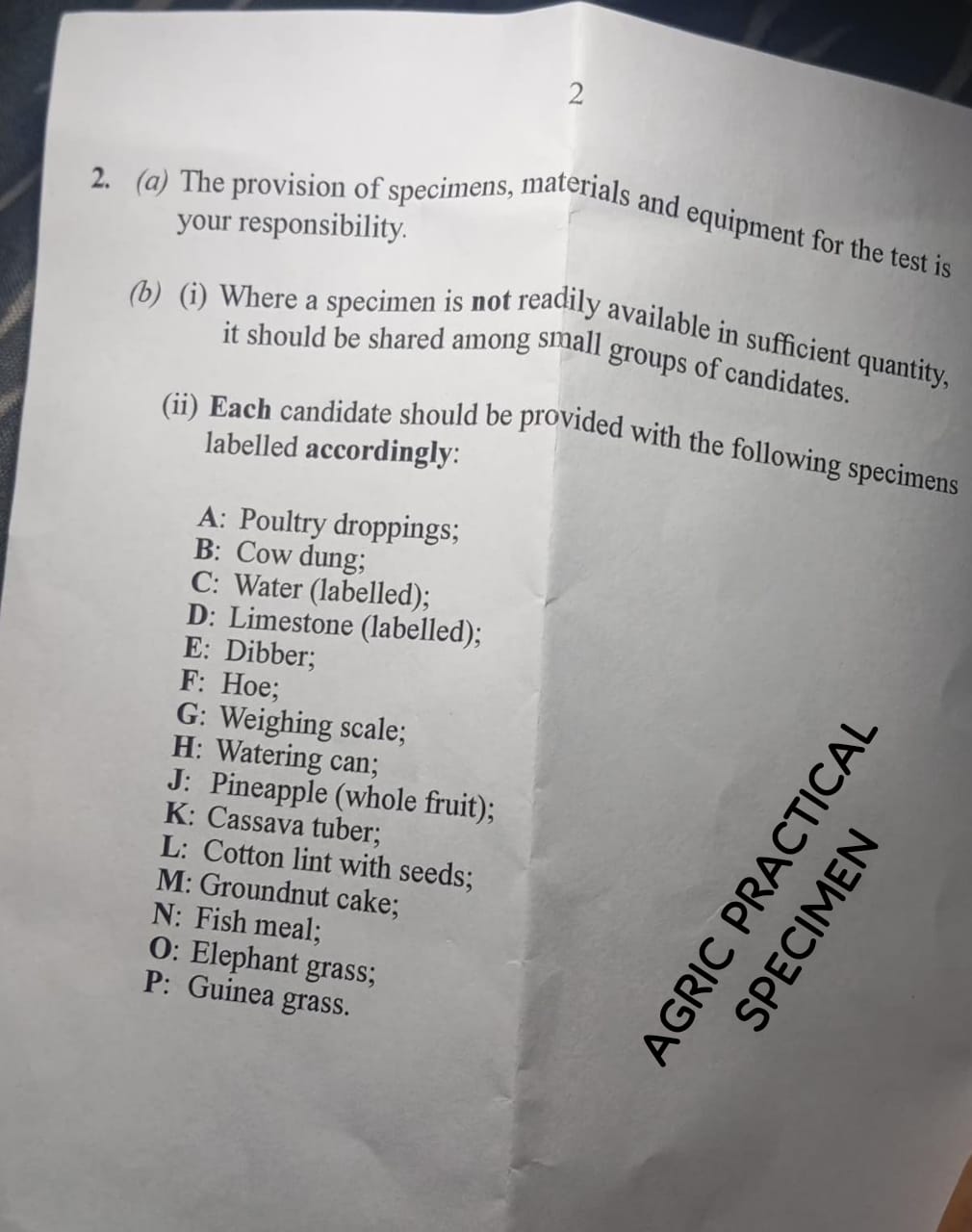
(i) Type or breed of poultry producing the droppings.
(ii) Quality and composition of feed given to the birds.
(iii) Age of the poultry birds.
(iv) Moisture or water content of the droppings.
(v) Method and duration of storage before use.
(vi) Degree of decomposition of the droppings.
(vii) Presence of contaminants such as litter materials, sand or feathers.
(1b)
(PICK ANY FOUR)
(i) Water dissolves limestone gradually in a process called solution weathering.
(ii) Rainwater containing carbon dioxide forms weak carbonic acid which reacts with limestone.
(iii) Water enters cracks and joints in limestone rocks.
(iv) Running water wears away limestone surfaces through abrasion.
(v) Water transports dissolved limestone materials from one place to another.
(vi) Alternate wetting and drying weakens the limestone structure.
(vii) Water promotes chemical reactions that break down limestone into smaller particles.
(1c)
(PICK ANY FOUR)
(i) Water is required for seed germination.
(ii) It is needed for photosynthesis in green plants.
(iii) Water dissolves soil nutrients for absorption by roots.
(iv) It transports nutrients and food materials within the plant.
(v) Water maintains the turgidity and rigidity of plant cells.
(vi) It helps to regulate plant temperature through transpiration.
(vii) Water supports growth and development of crops by participating in metabolic activities.
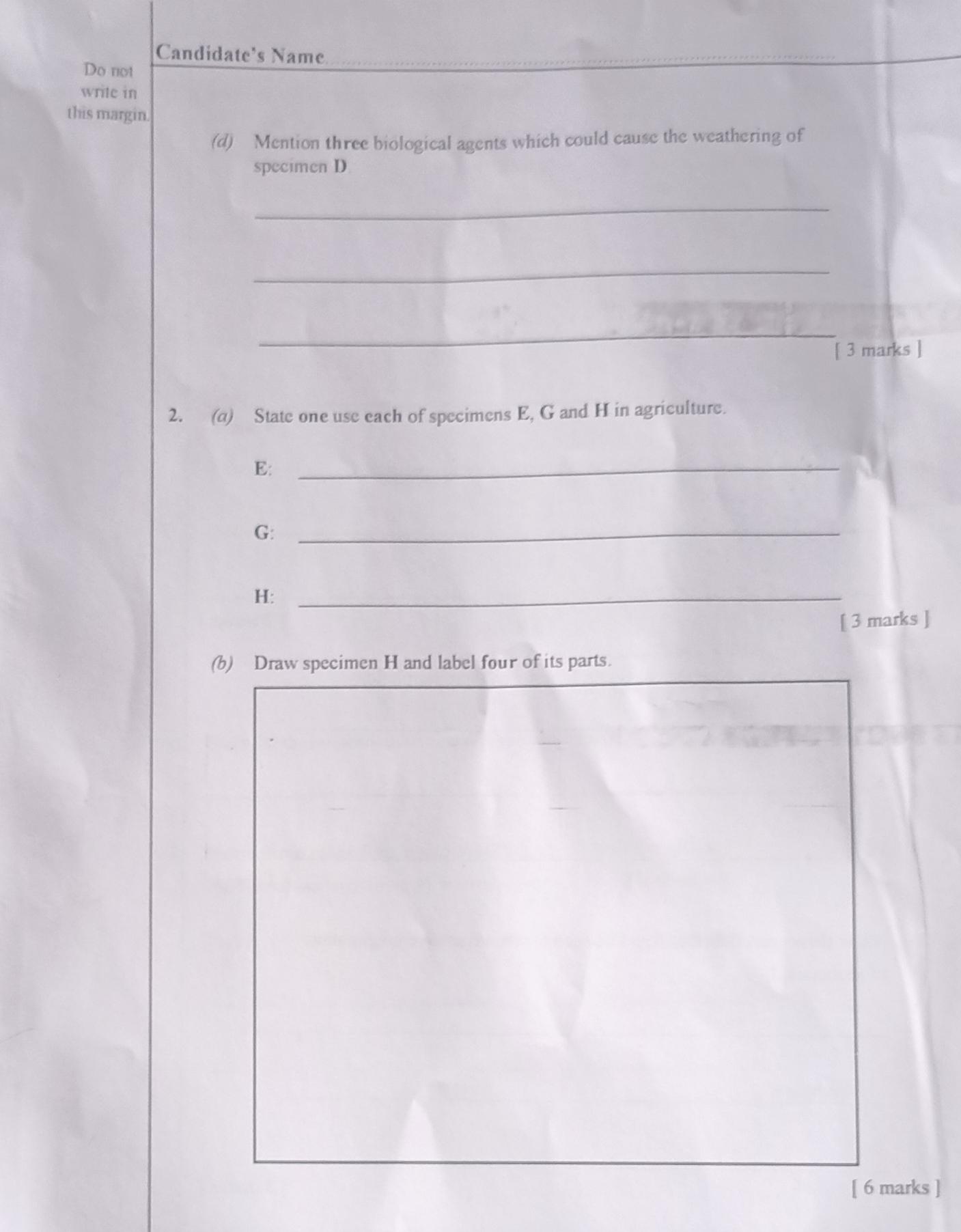
(1d)
(PICK ANY FOUR)
(i) Plant roots.
(ii) Earthworms.
(iii) Termites.
(iv) Ants.
(v) Rodents such as rats and rabbits.
(vi) Micro-organisms such as bacteria and fungi.
==============================
(VERSION II)
(1a)
(PICK ANY FOUR)
(i) Type of feed given to the birds
(ii) Age of the droppings
(iii) Moisture content
(iv) Storage method
(v) Health condition of the birds
(vi) Presence of contaminants
(vii) Environmental conditions
(viii) Method of handling and processing
(ix) Exposure to rain
(x) Exposure to direct sunlight
(1b)
(PICK ANY FOUR)
(i) Water dissolves limestone gradually.
(ii) Rainwater reacts with carbon dioxide to form carbonic acid which dissolves limestone.
(iii) Running water wears away the surface of limestone.
(iv) Water enters cracks and joints in limestone, causing them to widen.
(v) Continuous wetting and drying weakens the limestone.
(vi) Flowing water carries away dissolved limestone materials.
(vii) Water promotes chemical reactions that break down limestone.
(viii) Underground water dissolves limestone to form caves and sinkholes.
(ix) Heavy rainfall increases the rate of limestone weathering.
(x) Water softens limestone, making it easier to break apart.
(1c)
(PICK ANY FOUR)
(i) Water is needed for photosynthesis in plants.
(ii) Water helps in the germination of seeds.
(iii) It dissolves mineral nutrients for absorption by plant roots.
(iv) Water transports nutrients and food within the plant.
(v) It maintains the turgidity of plant cells.
(vi) It helps to regulate the temperature of plants.
(vii) It is required for the growth and development of crops.
(viii) It is necessary for the formation of fruits, seeds and other plant parts.
(ix) It serves as a medium for biochemical reactions in plants.
(x) It helps to prevent wilting in crops.
(1d)
(PICK ANY THREE)
(i) Plant roots
(ii) Earthworms
(iii) Termites
(iv) Bacteria
(v) Fungi
(vi) Burrowing animals
(2a)
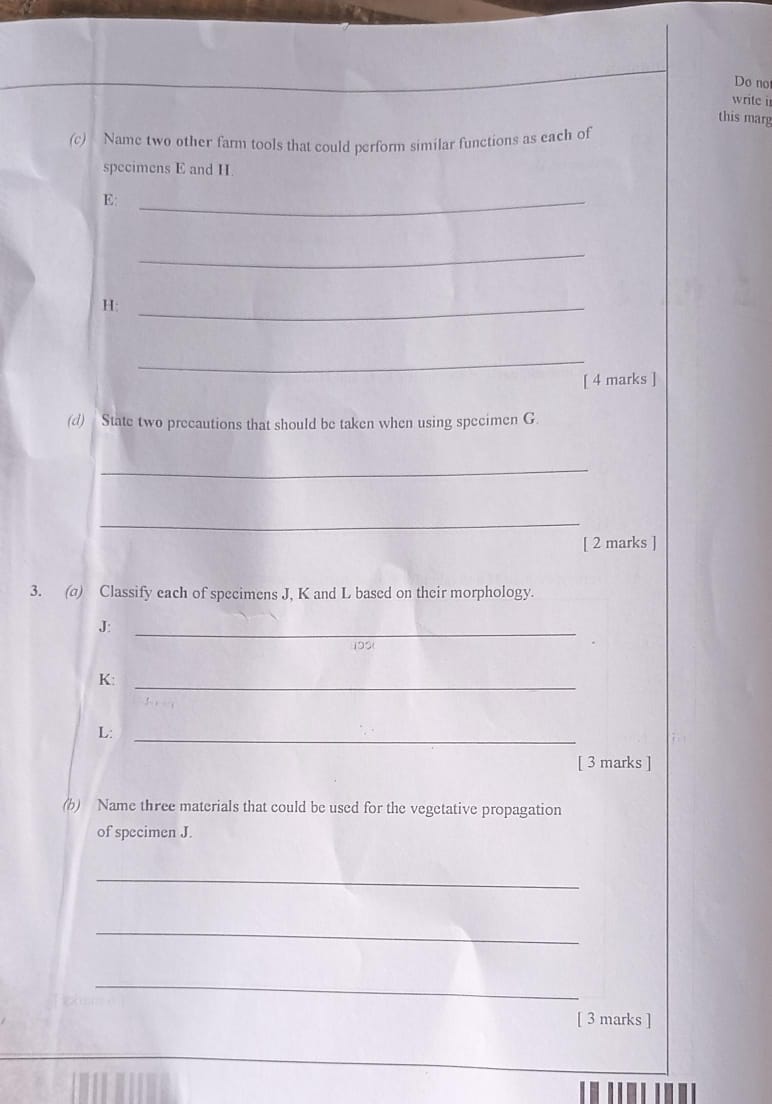
E:
(PICK ANY ONE)
(i) Used for making planting holes for seeds.
(ii) Used for transplanting seedlings.
(iii) Used for spacing plants correctly in the field.
(iv) Used for planting bulbs and cuttings.
(v) Used for marking planting positions in nursery beds.
G:
(PICK ANY ONE)
(i) Used for measuring the weight of farm produce.
(ii) Used for weighing livestock feeds.
(iii) Used for weighing fertilizers before application.
(iv) Used for determining market value of produce based on weight.
(v) Used for measuring harvested products for storage and transport.
H:
(PICK ANY ONE)
(i) Used for watering crops and seedlings.
(ii) Used for applying liquid fertilizers to crops.
(iii) Used for watering nursery beds.
(iv) Used for maintaining soil moisture around plants.
(v) Used for applying certain pesticides and herbicides in liquid form.
(2b)
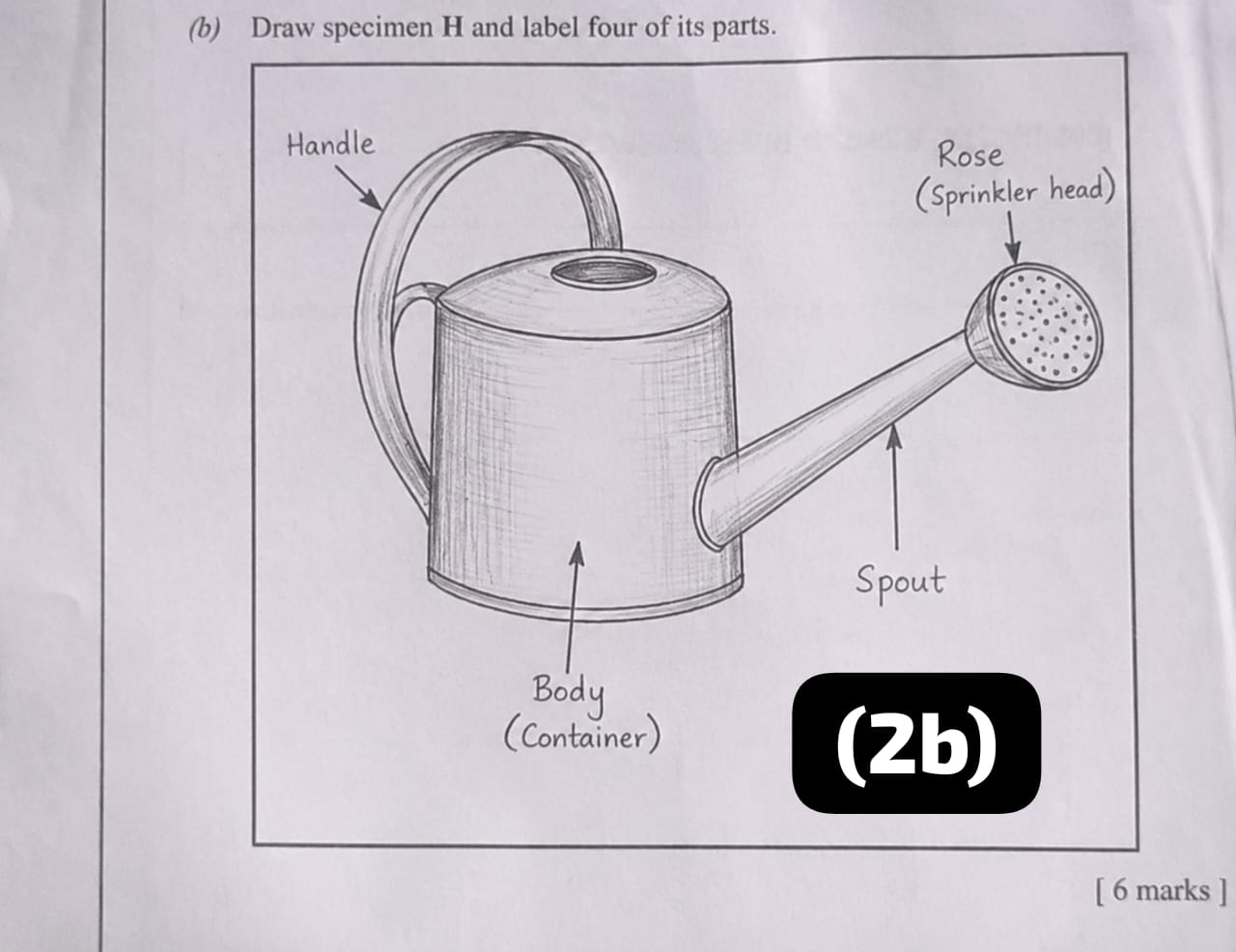
(2c)
E:
(i) Hand trowel
(ii) Garden fork
H:
(i) Hose pipe
(ii) Irrigation sprinkler
(2d)
(i) Place the weighing scale on a flat and stable surface before use.
(ii) Do not overload the scale beyond its capacity.
(3a)
J: Multiple fruit (composite fruit)
K: Tuberous root (storage root)
L: Seed (cotton seed)
(3b)
(PICK ANY THREE)
(i) Suckers.
(ii) Slips.
(iii) Crowns.
(iv) Ratoons.
(v) Stem cuttings (stem setts).
(3c)
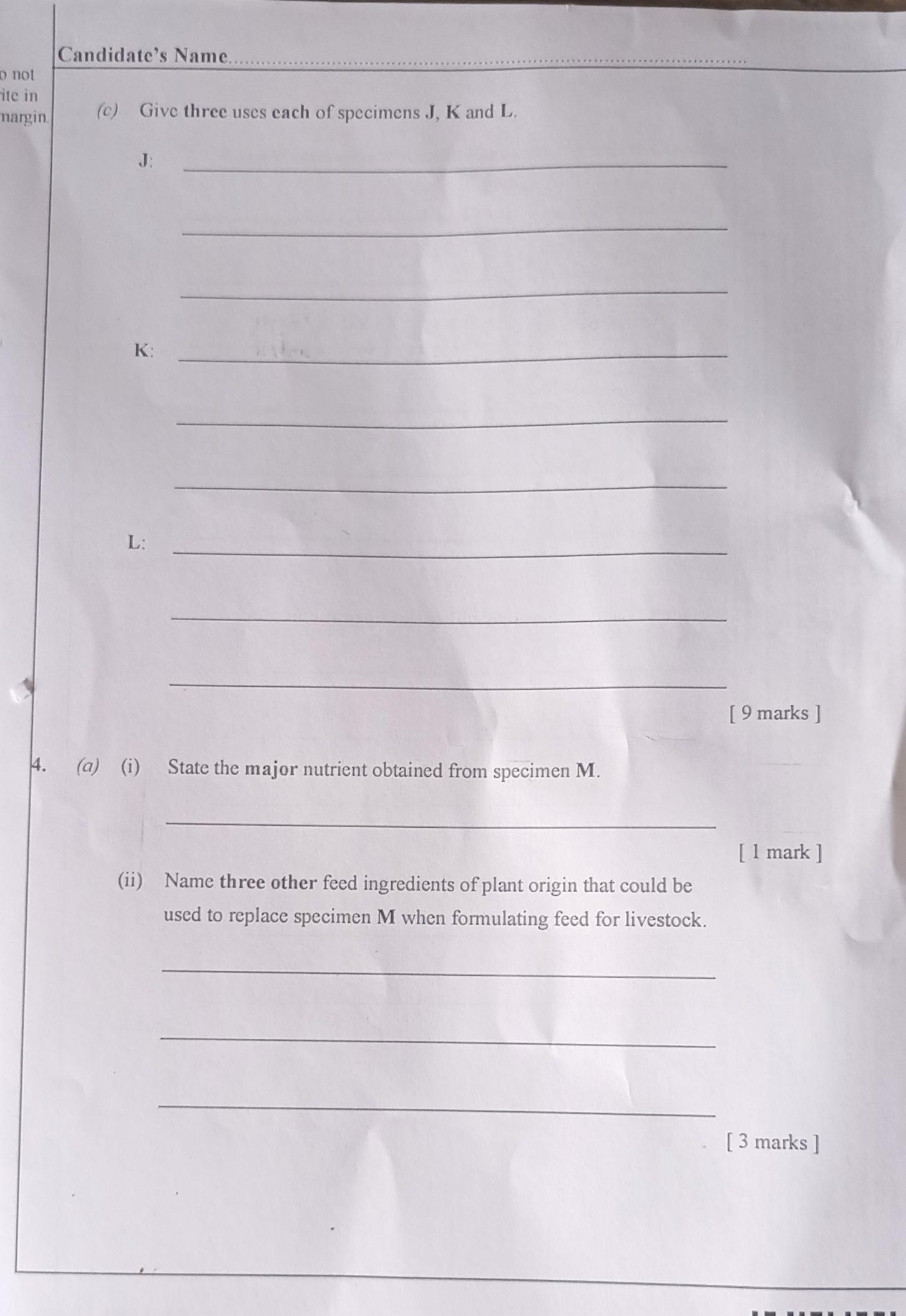
J:
(PICK ANY THREE)
(i) It is used as food and eaten fresh as a fruit.
(ii) It is used for the production of fruit juice and soft drinks.
(iii) It is used for making jam, jelly and marmalade.
(iv) It is used in the preparation of fruit salads and desserts.
(v) It serves as a rich source of vitamins, especially Vitamin C.
K:
(PICK ANY THREE)
(i) It is used for the production of garri.
(ii) It is used for the preparation of fufu (akpu).
(iii) It is used for the production of cassava flour.
(iv) It is used as livestock feed after processing.
(v) It is used for the production of starch and ethanol.
L:
(PICK ANY THREE)
(i) It is used for the manufacture of textiles and clothing materials.
(ii) It is used for the production of thread, yarn and fabric.
(iii) It is used for making mattresses, pillows and cushions.
(iv) It is used for the extraction of cottonseed oil.
(v) It is used for the production of cottonseed cake for livestock feed.
==============================
(VERSION II)
(3a)
J: Pineapple (whole fruit)
K: Cassava rubber
L: Cotton lint with seeds
(3b)
(PICK ANY THREE)
(i) Suckers
(ii) Slips
(iii) Crowns
(iv) Ratoons
(v) Stem cuttings
(vi) Tissue-cultured plantlets
(3c)
J:
(PICK ANY THREE)
(i) Consumed as fresh fruit.
(ii) Used for making fruit juice and beverages.
(iii) Used in the production of jam, wine and canned fruit.
(iv) Used in making fruit salad.
(v) Source of vitamins, especially Vitamin C.
(vi) Used in confectioneries and desserts.
(vii) Generates income through commercial production and sale.
K:
(PICK ANY THREE)
(i) Used for making garri.
(ii) Used for producing fufu/akpu.
(iii) Used as livestock feed after processing.
(iv) Used for producing cassava flour.
(v) Used for making starch.
(vi) Used in the production of ethanol/alcohol.
(vii) Source of carbohydrates for humans.
L:
(PICK ANY THREE)
(i) Used in the textile industry for making clothes and fabrics.
(ii) Used for making mattresses, pillows and bandages.
(iii) Cotton seeds are processed to produce cottonseed oil.
(iv) Cotton seed cake is used as livestock feed.
(v) Used for making ropes and threads.
(vi) Used in the manufacture of fishing nets.
(vii) Used as raw material in paper production.
(4ai)
Protein
(4aii)
(i) Soybean meal
(ii) Cottonseed cake
(iii) Palm kernel cake
(4b)
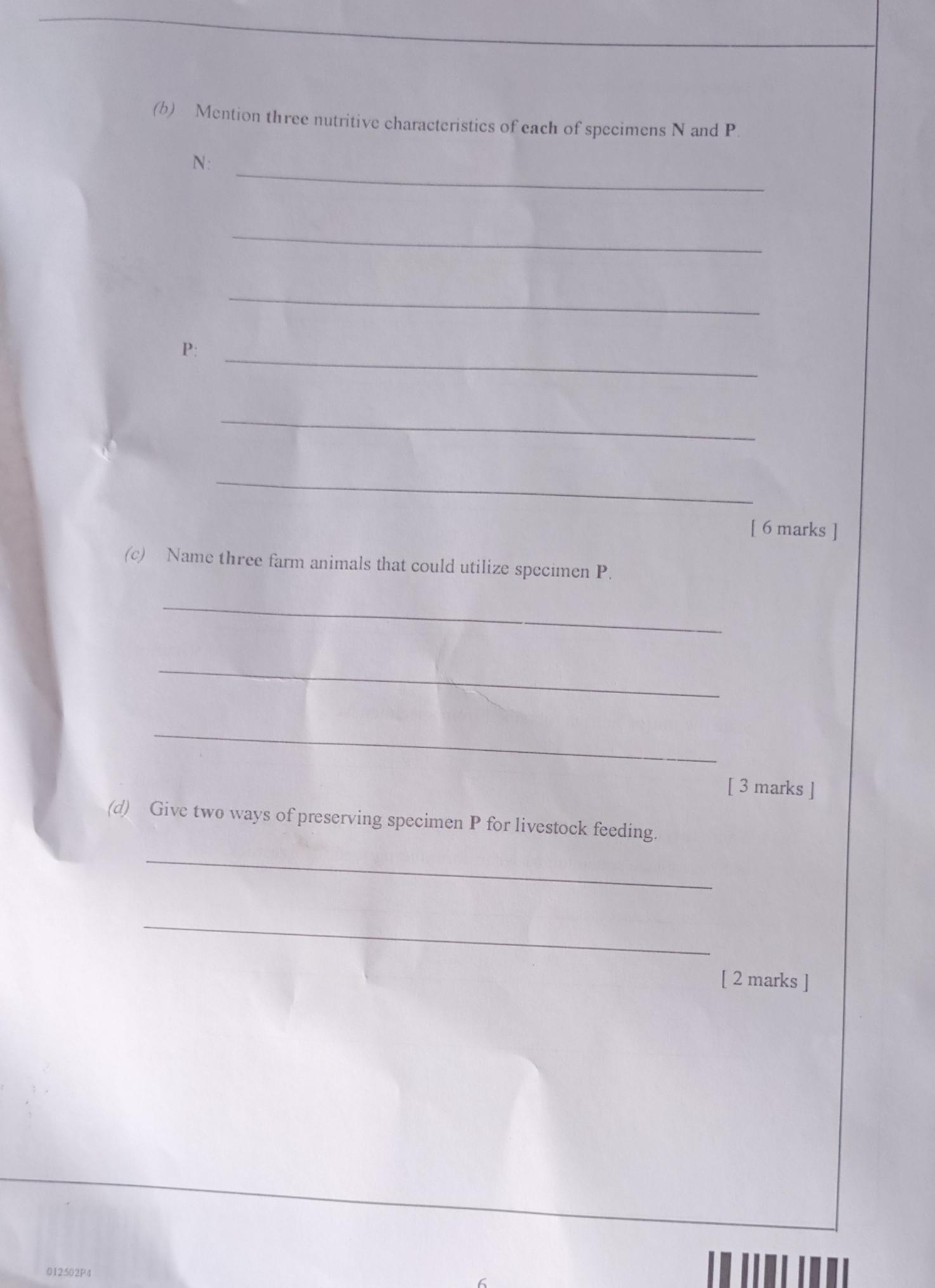
N:
(i) Rich in protein.
(ii) Contains essential amino acids.
(iii) Rich in minerals such as calcium and phosphorus.
P:
(i) Rich in crude fibre.
(ii) Contains carbohydrates that supply energy.
(iii) Contains vitamins and minerals.
(4c)
(i) Cattle
(ii) Sheep
(iii) Goats
(4d)
(PICK ANY TWO)
(i) Hay making (drying and storing).
(ii) Silage making (ensiling).
(iii) Artificial drying using dryers.
(iv) Chopping and storing in a dry, well-ventilated barn.
(v) Conversion into grass meal and storing in bags.
================================
(VERSION II)
(4ai)
Protein
(4aii)
(PICK ANY THREE)
(i) Soybean meal.
(ii) Cottonseed cake.
(iii) Palm kernel cake.
(iv) Coconut cake (copra meal).
(v) Beniseed (sesame) cake.
(4b)
N:
(PICK ANY THREE)
(i) It is rich in protein.
(ii) It contains essential amino acids.
(iii) It is highly digestible.
(iv) It contains minerals such as calcium and phosphorus.
(v) It contains vitamins, especially B-complex vitamins.
(vi) It has low crude fibre content.
P:
(PICK ANY THREE)
(i) It is rich in fibre (roughage).
(ii) It contains carbohydrates which supply energy.
(iii) It contains vitamins needed by livestock.
(iv) It contains minerals such as calcium and phosphorus.
(v) It has high moisture content when fresh.
(vi) It contains a moderate amount of protein, especially when young.
(4c)
(PICK ANY THREE)
(i) Cattle.
(ii) Sheep.
(iii) Goats.
(iv) Rabbits.
(v) Horses.
(4d)
(PICK ANY TWO)
(i) Hay making (drying and storing the grass).
(ii) Ensiling (conversion into silage).
(iii) Artificial drying and storage in a dry place.
(iv) Baling and storing under suitable conditions.
COMPLETED!!
PRACTICAL SPECIMEN 👇👇