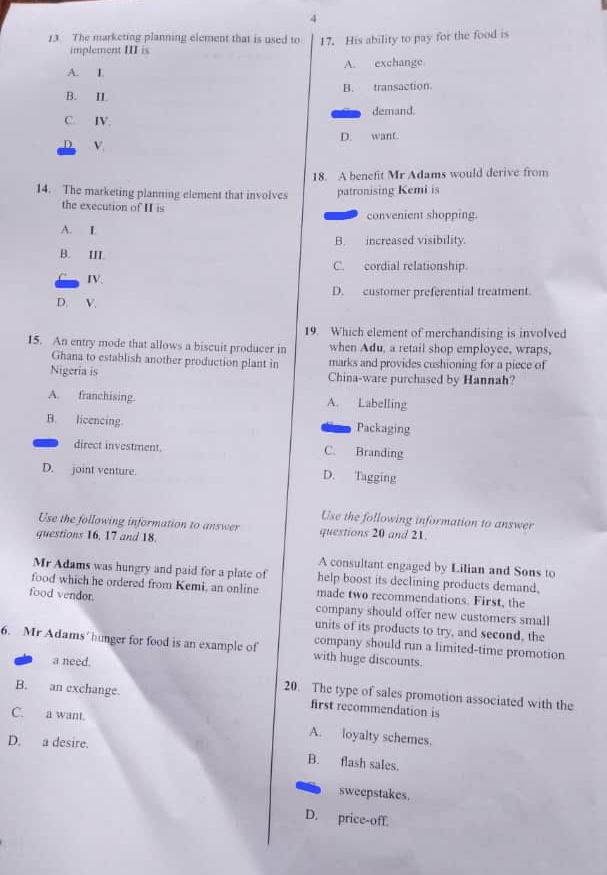
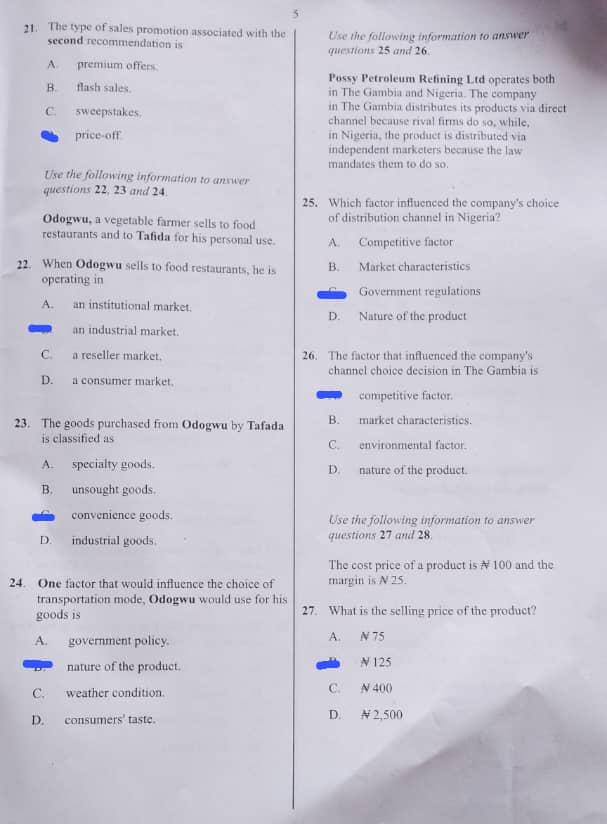
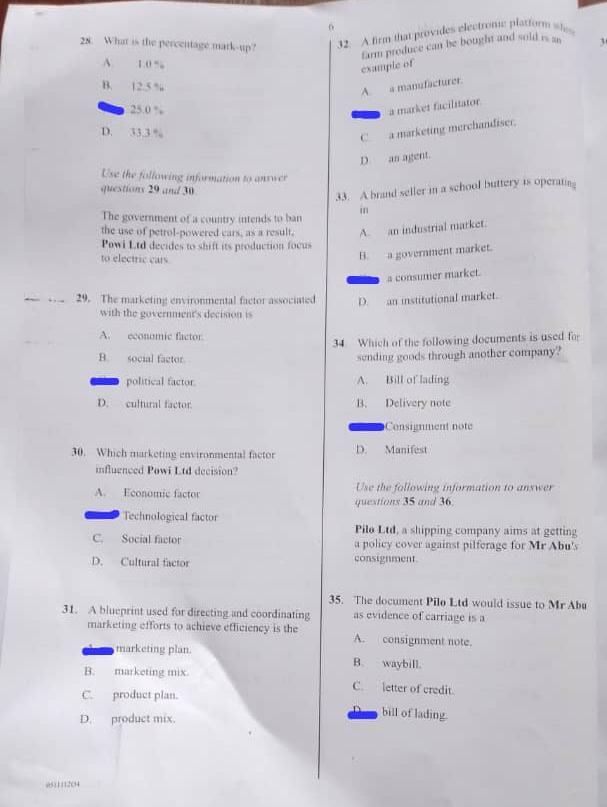
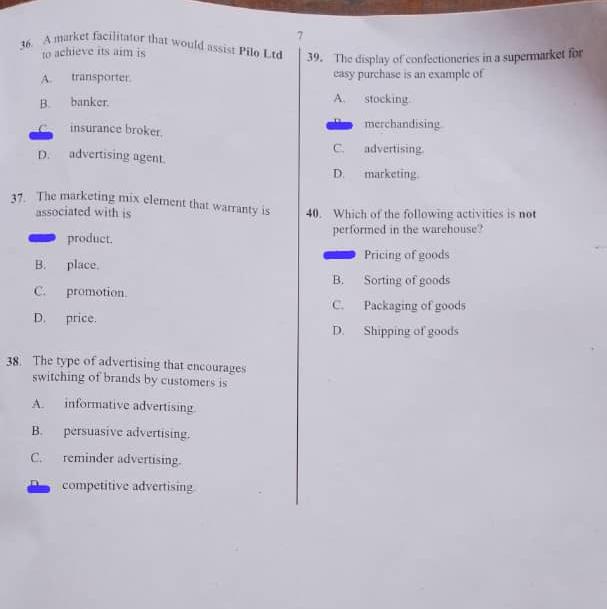
MARKETING OBJ:
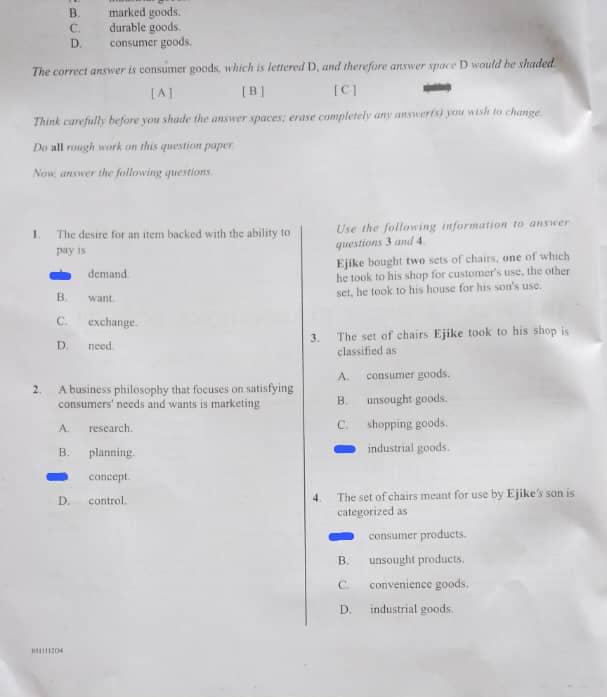
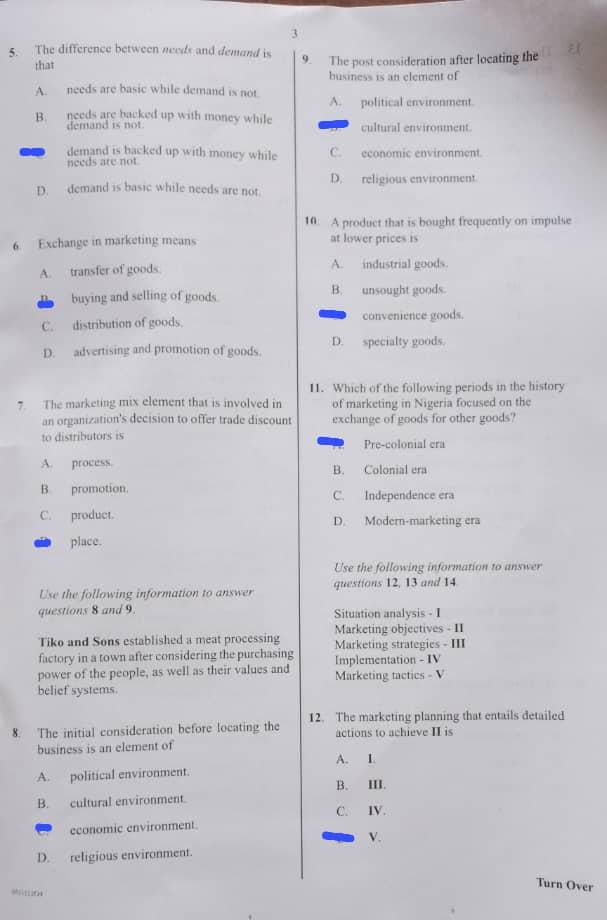
1-10: ACDACBBCBC
11-20: ADDCCACABC
21-30: DBCBCABCCB
31-40: ABCCDCADBA
⭐ PLEASE NOTE: ALWAYS FOLLOW EXAM INSTRUCTIONS
We often provide answers to all questions, including different versions and alternatives. This does not mean you should write everything.
Simply read the instructions given, select the required questions, and choose the version you prefer.
The extra answers are provided to help make students’ work different and avoid everyone writing the same thing.
Always follow the instructions given for each paper.
(VERSION I)
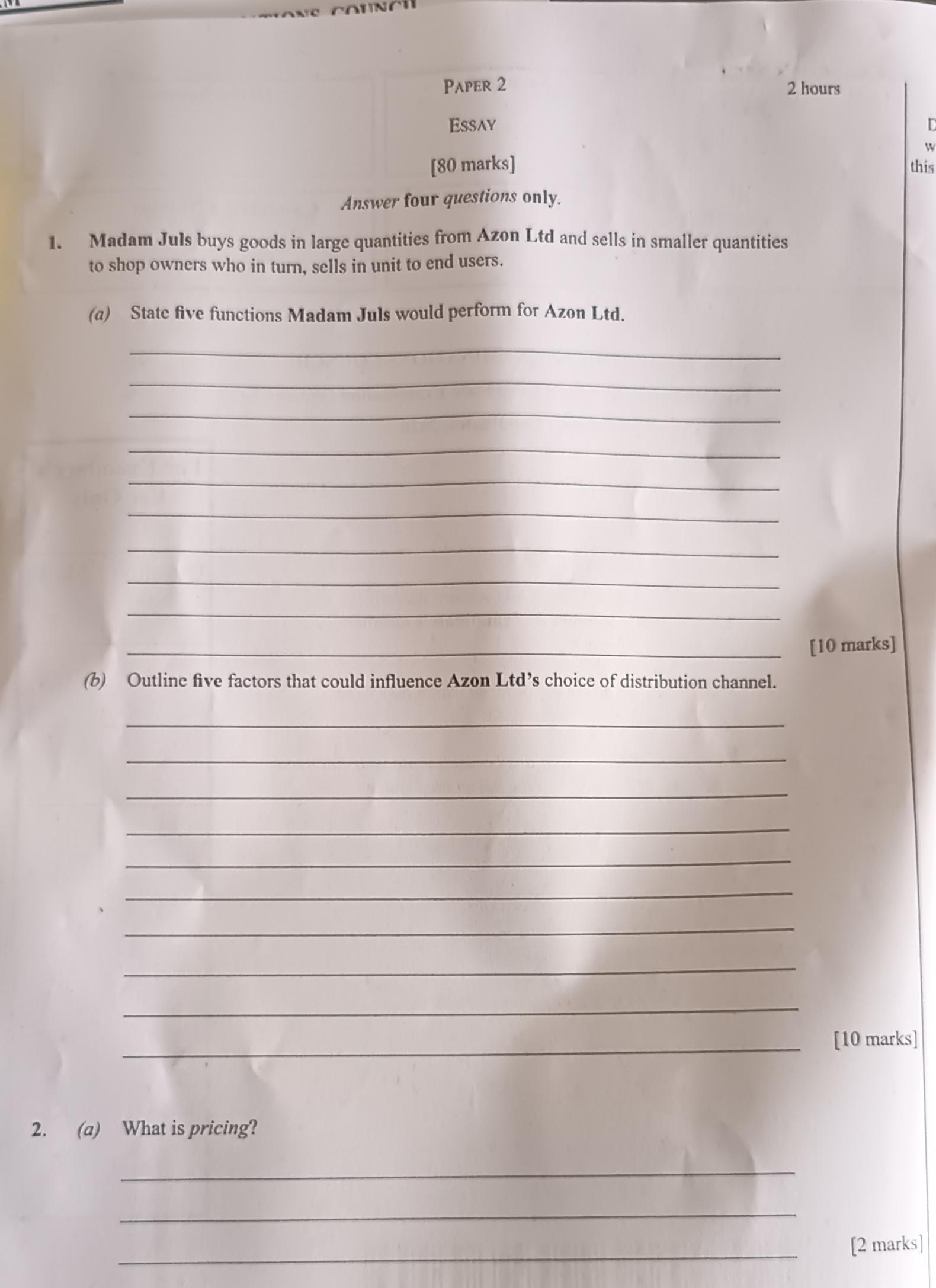
(1a)
(Pick Any Five)
(i) Buying goods in large quantities from Azon Ltd to enable the company sell more products at once and reduce marketing costs.
(ii) Breaking bulk and selling in smaller quantities to retailers who may not have enough capital to buy in large quantities.
(iii) Storing goods until they are needed by retailers, thereby ensuring continuous availability of products in the market.
(iv) Transporting and distributing goods to retailers located in different places, making the products easily accessible.
(v) Financing Azon Ltd through bulk purchases, which helps the company recover its production costs quickly.
(vi) Bearing business risks such as theft, damage, spoilage, and price fluctuations while the goods remain in her possession.
(vii) Providing market information and feedback to Azon Ltd concerning consumer preferences, demand, and competitors’ activities.
(viii) Promoting and advertising Azon Ltd’s products to retailers and encouraging increased sales.
(ix) Maintaining a steady supply of goods to retailers so that shortages are avoided and customers’ needs are met.
(x) Assisting in grading, packaging, and labeling of goods to make them more attractive and suitable for sale.
(1b)
(PICK ANY FIVE)
(i) Nature of the product.
(ii) Perishability of the product.
(iii) Size and financial strength of the manufacturer.
(iv) Nature and size of the market.
(v) Number and location of customers.
(vi) Cost of distribution.
(vii) Availability of middlemen (wholesalers and retailers).
(viii) Government regulations and policies.
(ix) Competition and competitors’ distribution methods.
(x) Desired speed of delivery to consumers.
————————————————————————————————————
(VERSION II)
(1a)
(PICK ANY GIVE)
(i) Madam Juls purchases goods in very large quantities from Azon Ltd., thereby helping the company increase its sales volume.
(ii) She breaks bulk by dividing large quantities of goods into smaller units suitable for retailers’ purchases and resale.
(iii) She stores goods in her warehouse until retailers demand them, ensuring continuous product availability in the market.
(iv) She transports and distributes goods to retailers located in different areas, making products easily accessible to consumers.
(v) She provides valuable market information concerning customer preferences, demand patterns, and competitors’ activities to Azon Ltd.
(vi) She promotes Azon Ltd.’s products among retailers, encouraging wider acceptance and increased sales within the market.
(ix) She bears risks associated with storage and distribution, including theft, deterioration, fire outbreaks, and accidental damage.
(viii) She finances part of the distribution process by purchasing goods before they are eventually sold to consumers.
(ix) She maintains a regular supply of products to retailers, preventing shortages and ensuring customer needs are met.
(1b)
(PICK ANY FIVE)
(i) The nature of the product may determine whether a direct or indirect distribution channel is most appropriate.
(ii) The financial strength of Azon Ltd. can influence its ability to establish and maintain distribution outlets.
(iii) The geographical location and number of customers may affect the choice of a suitable distribution channel.
(iv) The cost involved in using a particular distribution channel can influence the company’s final distribution decision.
(v) The availability and efficiency of wholesalers and retailers may determine the channel selected by Azon Ltd.
(vi) The level of competition in the market may influence the company to adopt a more effective channel.
(vii) Government regulations and trade policies may restrict or encourage the use of certain distribution channels.
(viii) The desired market coverage may influence whether intensive, selective, or exclusive distribution is adopted.
(ix) The size and frequency of customers’ orders may determine the most economical distribution channel to use.
(x) The availability of transportation and communication facilities may influence the efficiency of a chosen channel.
(xi) The company’s marketing objectives and policies may affect the selection of an appropriate distribution channel.
(xii) Prevailing economic conditions may influence distribution costs and the effectiveness of various distribution channels.
(2a)
(PICK ANY ONE)
Pricing is the process of determining and fixing the amount of money a customer must pay for a product or service. It involves setting a price that will cover the cost of production and help the business achieve its objectives, such as making profit and increasing sales.
OR
Pricing is a marketing activity that involves setting a value or selling price for goods and services in order to achieve business objectives such as profit-making, sales growth, or market expansion.
OR
Pricing is the exchange value placed on a product or service, expressed in monetary terms. It represents the amount buyers are willing to pay and sellers are willing to accept for a product or service.
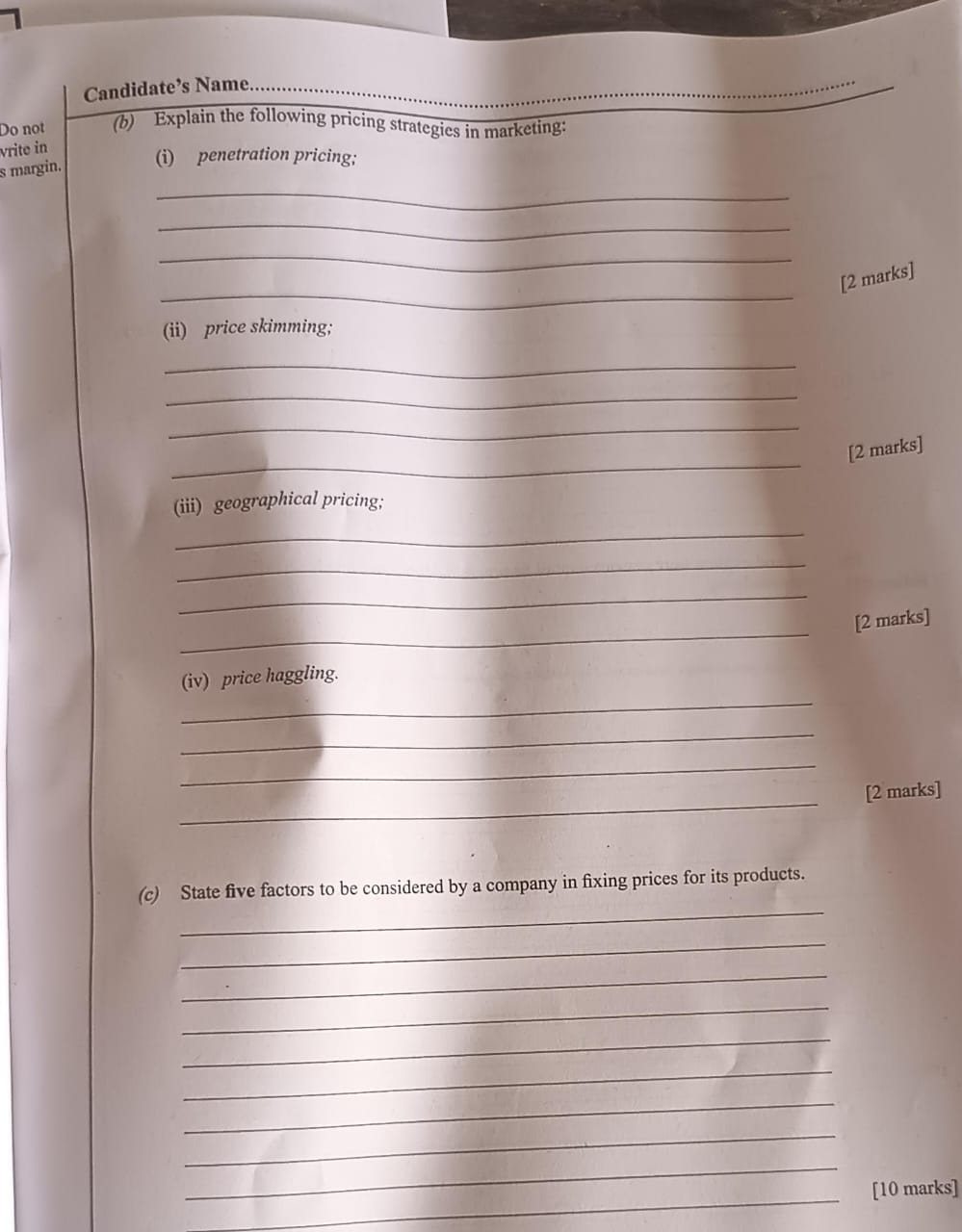
(2bi)
(PICK ANY ONE)
Penetration pricing is a pricing strategy in which a company introduces a new product at a relatively low price in order to attract a large number of customers quickly. The aim is to gain market acceptance and increase market share before competitors can respond.
OR
Penetration pricing is the practice of charging a low initial price for a new product to encourage trial purchases and stimulate demand. Once the product becomes popular and gains customer loyalty, the company may gradually increase the price.
(2bii)
(PICK ANY ONE)
Price skimming is a pricing strategy whereby a company sets a high initial price for a new product and later reduces the price gradually. This enables the company to recover development costs quickly and earn maximum profit from customers who are willing to pay more.
OR
Price skimming involves charging a high price when a product is first introduced into the market and lowering the price over time as competition increases or demand from early buyers declines. It is common with innovative and technological products.
(2biii)
(PICK ANY ONE)
Geographical pricing is a pricing strategy in which the price of a product differs from one location to another. The variation in price is usually due to transportation costs, distribution expenses, taxes, or differences in market conditions.
OR
Geographical pricing refers to the practice of charging customers different prices depending on their geographical location. It ensures that additional costs incurred in supplying goods to distant areas are covered by the selling price.
(2biv)
(PICK ANY ONE)
Price haggling is a pricing method in which buyers and sellers negotiate the price of a product until they reach a mutually acceptable agreement. The final price is therefore determined through bargaining rather than being fixed.
OR
Price haggling is the process of bargaining over the price of goods or services. It is common in open markets where sellers may adjust prices based on the buyer’s negotiating ability and market conditions.
(2c)
(PICK ANY FIVE)
(i) Cost of production: The company must consider the total cost of producing the product so that the selling price will cover costs and yield profit.
(ii) Demand for the product: When demand is high, a company may charge a higher price. When demand is low, it may reduce the price to attract more buyers.
(iii) Prices charged by competitors: A company considers the prices of similar products in the market to remain competitive and avoid losing customers.
(iv) Government policies and regulations: Government taxes, price controls, and other regulations can influence the price a company charges for its products.
(v) Profit objective of the company: The amount of profit the company intends to make will affect the price it fixes for its products.
(vi) Purchasing power of consumers: The company should consider the income level and ability of consumers to pay for the product.
(vii) Nature and quality of the product: High-quality or luxury products are usually sold at higher prices than ordinary products.
(viii) Distribution and transportation costs: The cost of moving products from the producer to consumers may increase the selling price.
(ix) Economic conditions: Factors such as inflation, recession, and changes in the economy can affect pricing decisions.
(x) Company image and marketing objectives: A company may set prices to create a particular image for its products or to achieve specific marketing goals.
————————————————————————————————————
(VERSION II)
(2a)
(PICK ANY ONE)
Pricing is the process of determining and fixing the amount of money that customers will pay for a product or service, taking into consideration factors such as cost of production, demand, and the profit objective of the business.
OR
Pricing is the method by which a business assigns a monetary value to its goods or services before offering them for sale in the market, with the aim of attracting customers and earning profit.
OR
Pricing is the marketing activity of setting an appropriate price for a product or service in order to achieve business objectives such as profit-making, increased sales, and market competitiveness.
(2bi)
Penetration Pricing
(PICK ANY ONE)
Penetration pricing is a strategy in which a company introduces a new product at a very low price in order to attract many customers quickly and gain a large market share.
OR
Penetration pricing involves charging a lower price than competitors when entering the market, with the intention of increasing the price later after the product has become popular.
(2bii)
Price Skimming
(PICK ANY ONE)
Price skimming is a pricing strategy whereby a company sets a very high price for a new product at the initial stage of its introduction to maximize profit from early buyers.
OR
Price skimming is the process by which price is gradually reduced over time as competition increases and more customers are attracted to the product.
(2biii)
Geographical Pricing
(PICK ANY ONE)
Geographical pricing is a pricing strategy in which the price of a product varies according to the location of the buyer or the distance involved in delivering the product.
OR
Geographical pricing is process of taking transportation and distribution costs into consideration, causing customers in different areas to pay different prices for the same product.
(2biv)
Price Haggling
(PICK ANY ONE)
Price haggling is a pricing method in which the buyer and seller negotiate the price of a product until they reach a mutually acceptable amount.
OR
Price haggling is common in open markets where prices are not fixed and customers bargain with sellers before making a purchase.
(2c)
(PICK ANY FIVE)
(i) Cost of production, including expenditure on raw materials, labour, power supply, and other production activities
(ii) Level of demand for the product among existing and potential consumers in the market at a given time.
(iii) Nature and intensity of competition from other firms offering similar or substitute products to consumers.
(iv) Government regulations, taxation policies, and price control measures affecting the operations of businesses and industries.
(v) Profit objectives of the company and the expected return on investment as determined by management.
(vi) Purchasing power and income level of the target consumers in the market where the product is sold.
(vii) Quality, durability, brand image, and uniqueness of the product when compared with competing products.
(viii) Prevailing economic and market conditions within the business environment, such as inflation and changes in consumer spending.
(ix) Cost of distribution, transportation, storage, and other marketing activities required to make the product available to consumers.
(x) Company’s pricing policy, marketing strategy, and desired market position in relation to its competitors.
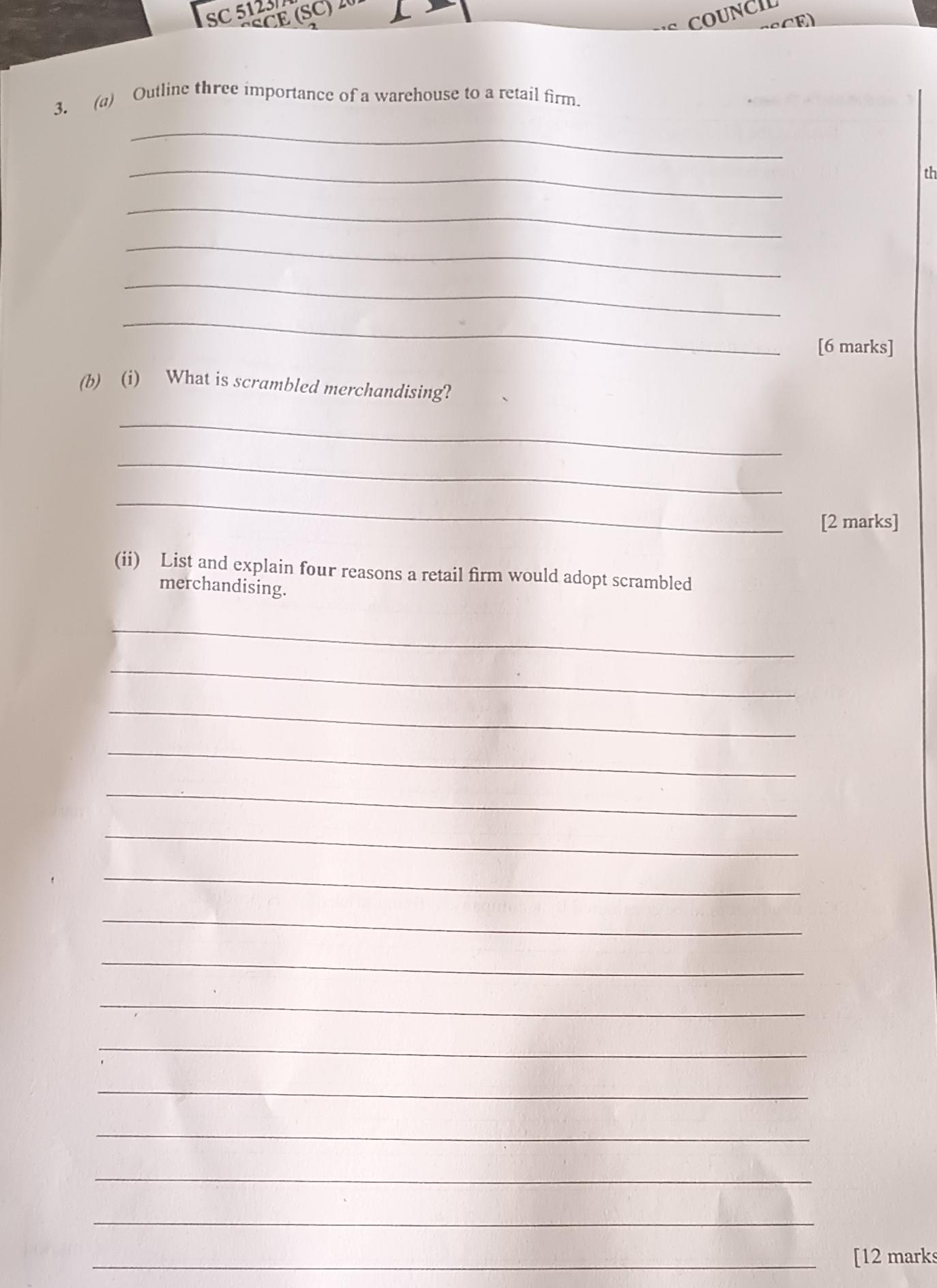
(3a)
(PICK ANY THREE)
(i) It provides storage facilities for goods until they are needed for sale.
(ii) It helps to prevent stock shortages by ensuring that adequate goods are available at all times.
(iii) It protects goods from theft, damage, fire, and adverse weather conditions.
(iv) It enables the retailer to buy goods in bulk and enjoy quantity discounts.
(v) It helps maintain a steady supply of goods throughout the year, especially during periods of high demand.
(vi) It facilitates the efficient distribution and movement of goods to the sales outlet.
(3bi)
(PICK ANY ONE)
Scrambled merchandising is the practice whereby a retail firm sells a wide variety of unrelated products that are not normally associated with its main line of business.
OR
Scrambled merchandising is a retailing strategy in which a retailer adds new and unrelated product lines to its existing range of goods in order to attract more customers and increase sales.
(3bii)
(PICK ANY FOUR)
(i) To increase sales revenue: By offering a wider range of products, the retailer can attract more customers and generate higher sales. Customers who come to buy one item may also purchase other unrelated products.
(ii) To attract and retain customers: Customers can purchase different types of goods in one location, making shopping more convenient. This convenience encourages repeat patronage and customer loyalty.
(iii) To maximize the use of available space: Unused or underutilized store space can be used to display and sell additional products. This helps the retailer make better use of available resources.
(iv) To reduce business risk: Selling different product lines helps the retailer avoid overdependence on a single product category. If demand for one product falls, income from other products can support the business.
(v) To meet changing consumer needs: Customers’ tastes and preferences change over time. By diversifying its product range, the retailer is able to satisfy a wider variety of customer needs.
(vi) To gain a competitive advantage: Offering a broader range of goods can make the retailer more attractive than competitors who sell only a limited range of products.
(vii) To increase profit: Additional product lines create more opportunities for earning profit and improving the overall performance of the business.
(viii) To boost impulse buying: Customers who come to buy one item may be encouraged to purchase other unrelated products displayed in the store, thereby increasing sales.
(ix) To improve customer convenience: Customers save time and transportation costs when they can purchase many different products from one retail outlet.
(x) To increase market share: A wider range of products enables the retailer to attract different groups of customers and capture a larger share of the market.
————————————————————————————————————
(VERSION II)
(3a)
(PICK ANY THREE)
(i) It provides a safe and convenient place for storing goods before they are needed for sale, thereby preventing congestion in the retail shop.
(ii) It helps to maintain a steady supply of goods to customers throughout the year, especially during periods of high demand.
(iii) It enables the retail firm to buy goods in bulk and enjoy quantity discounts, thereby reducing the cost of purchasing.
(iv) It prevents frequent shortages of goods by keeping adequate stock available, ensuring continuous business operations.
(v) It protects goods from theft, damage, spoilage, and adverse weather conditions, thereby reducing business losses.
(vi) It facilitates efficient stock control and proper management of inventory, making it easier to monitor the movement of goods.
(vii) It helps the retail firm to meet sudden increases in demand from customers promptly, thereby improving customer satisfaction.
(3bi)
(PICK ANY ONE)
Scrambled merchandising is the practice whereby a retail firm sells a wide variety of goods, including products that are not traditionally related to its main line of business.
OR
Scrambled merchandising is a retailing strategy in which a store adds new and unrelated product lines to those it normally sells in order to attract more customers.
OR
Scrambled merchandising refers to the sale of different types of goods and services under one roof, even though such products do not belong to the retailer’s usual product range.
(3bii)
(PICK ANY FOUR)
(i) To increase sales revenue: A retail firm adopts scrambled merchandising to sell more products and generate higher sales and profits. The availability of additional product lines creates more opportunities for customers to make purchases.
(ii) To attract more customers: Offering a wider variety of goods encourages more people to visit the store and make purchases. Customers are often attracted to shops where they can obtain several items at the same time.
(iii) To make better use of available shop space: The firm can utilize unused space by displaying additional products that customers may need. This helps to maximize the productivity and profitability of the retail outlet.
(iv) To meet the diverse needs of customers: Customers can buy different types of goods from one location, making shopping more convenient. This saves customers time and transportation costs.
(v) To gain a competitive advantage: Selling a broader range of products helps the firm compete effectively with other retailers. It also enables the business to stand out from competitors that offer a limited range of goods.
(vi) To encourage impulse buying: Customers who come for one product may be tempted to buy other unrelated products displayed in the store. This increases the value of each customer’s purchase and boosts overall sales.
(vii) To improve customer loyalty: When customers can obtain many different products from one store, they are more likely to return regularly and become loyal patrons of the business.
(viii) To reduce business risk: Selling a variety of products helps the firm avoid relying on a single product line. If demand for one product falls, sales from other products can help sustain the business.
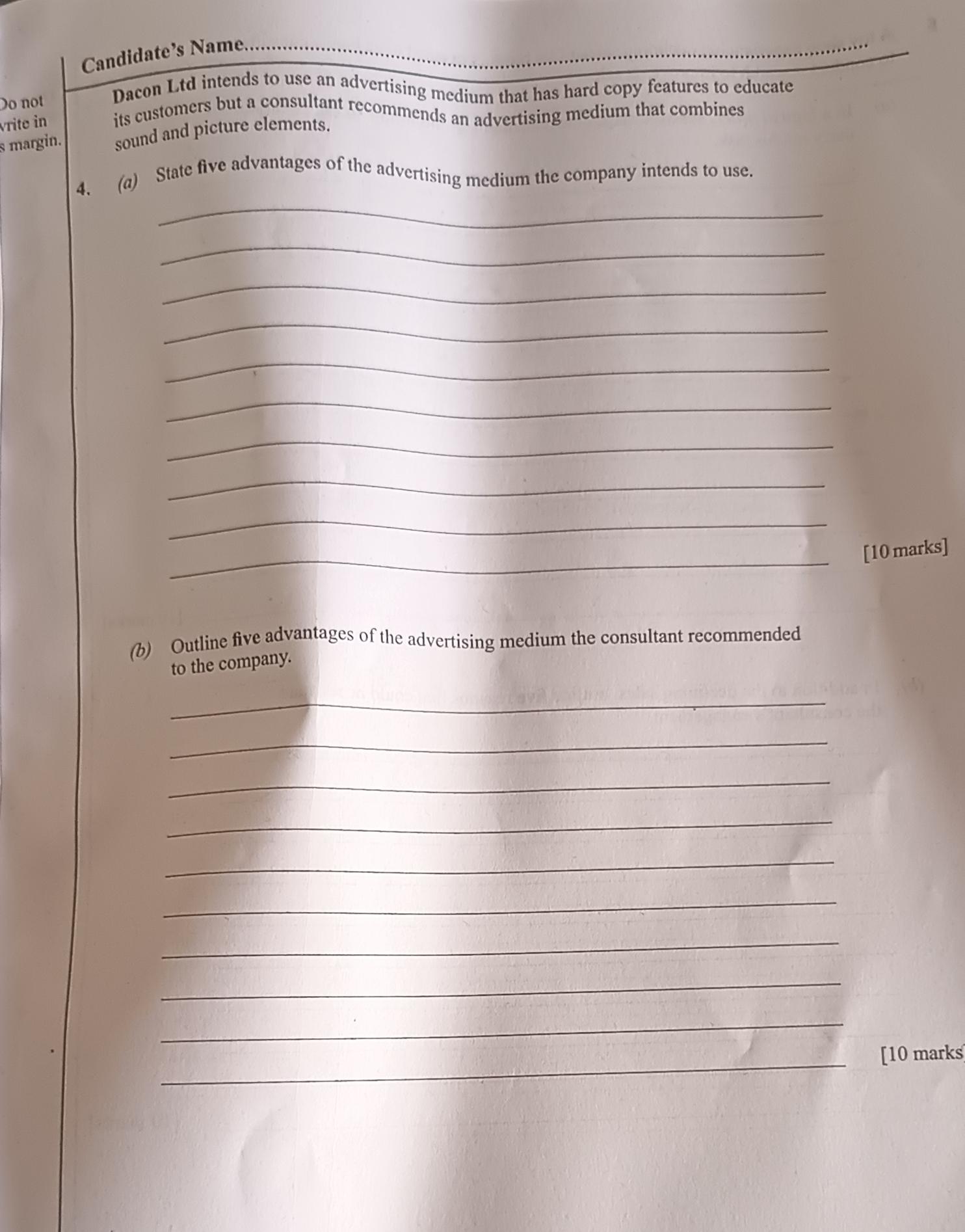
(4a)
(PICK ANY FIVE)
(i) It provides a permanent record of the advertisement which can be kept, read repeatedly, and referred to whenever the need arises by customers.
(ii) It can carry detailed information about products and services, including prices, features, uses, and conditions of sale for readers.
(iii) It reaches a large number of readers within a short period because of its wide circulation in urban and rural areas.
(iv) It is suitable for educating, informing, and creating awareness among customers about products, services, and business activities.
(v) It allows the use of pictures, diagrams, charts, illustrations, and attractive layouts to make advertisements more appealing to readers.
(vi) It can be directed at specific groups of readers through specialized newspapers and magazines designed for particular interests.
(vii) It enjoys a high degree of public acceptance and credibility because printed information is often regarded as reliable.
(viii) Readers can read the advertisement at their convenience and can return to it several times for better understanding of the message.
(ix) It is useful for announcing new products, changes in prices, discounts, special offers, and other promotional activities.
(x) It can be circulated across towns, cities, states, and countries, thereby increasing the advertiser’s market coverage and visibility.
(4b)
(PICK ANY FIVE)
(i) It combines sound, pictures, colour, motion, and visual effects, making advertisements more attractive and appealing to viewers.
(ii) It attracts and holds the attention of viewers more effectively than many other advertising media due to its audio-visual nature.
(iii) It reaches a very large audience across different geographical locations and social groups at the same time.
(iv) It demonstrates the use, operation, and benefits of products in a practical and realistic manner to consumers.
(v) It creates a strong, lasting, and memorable impression on viewers because both sight and sound are involved.
(vi) It is highly effective in influencing consumer attitudes, preferences, and purchasing decisions in the market.
(vii) It enhances the image, reputation, and goodwill of the advertiser while promoting brand recognition.
(viii) It is suitable for advertising a wide variety of products and services to different categories of consumers.
(ix) It provides entertainment while delivering advertising messages, thereby increasing audience interest and attention.
(x) It enables advertisers to reach both literate and illiterate audiences through a combination of visual and audio presentations.
————————————————————————————————————
(VERSION II)
(4a)
(PICK ANY FIVE)
(i) It provides a permanent record of the advertisement which can be kept for future reference.
(ii) Readers can read and re-read the advertisement at their convenience, thereby improving understanding of the message.
(iii) Detailed information about a product can be presented because there is sufficient space for explanations and illustrations.
(iv) It allows advertisers to target specific groups of readers through specialized newspapers and magazines.
(v) The cost of advertising in some print media is relatively lower than that of television advertising.
(vi) Print advertisements can be easily carried from one place to another.
(vii) Newspapers and magazines enjoy a high degree of credibility among readers.
(viii) The advertisement can reach many readers through circulation and sharing.
(4b)
(PICK ANY FIVE)
(i) Television combines sight, sound, motion, and colour, making advertisements more attractive and effective.
(ii) It has a wide audience reach and can communicate with millions of viewers at the same time.
(iii) Demonstrations of products can be shown, making it easier for consumers to understand how the product works.
(iv) Television advertisements have a strong impact on viewers and are easily remembered.
(v) It is effective in creating awareness for new products and improving brand image.
(vi) Television can influence consumers’ buying decisions through visual and audio appeal.
(vii) It reaches both literate and illiterate members of the population.
(viii) It provides immediate and rapid dissemination of advertising messages.
(ix) Television advertisements can create emotional appeal through the use of music, drama, and pictures.
(x) It is suitable for advertising products meant for a national or mass market.
(5a)
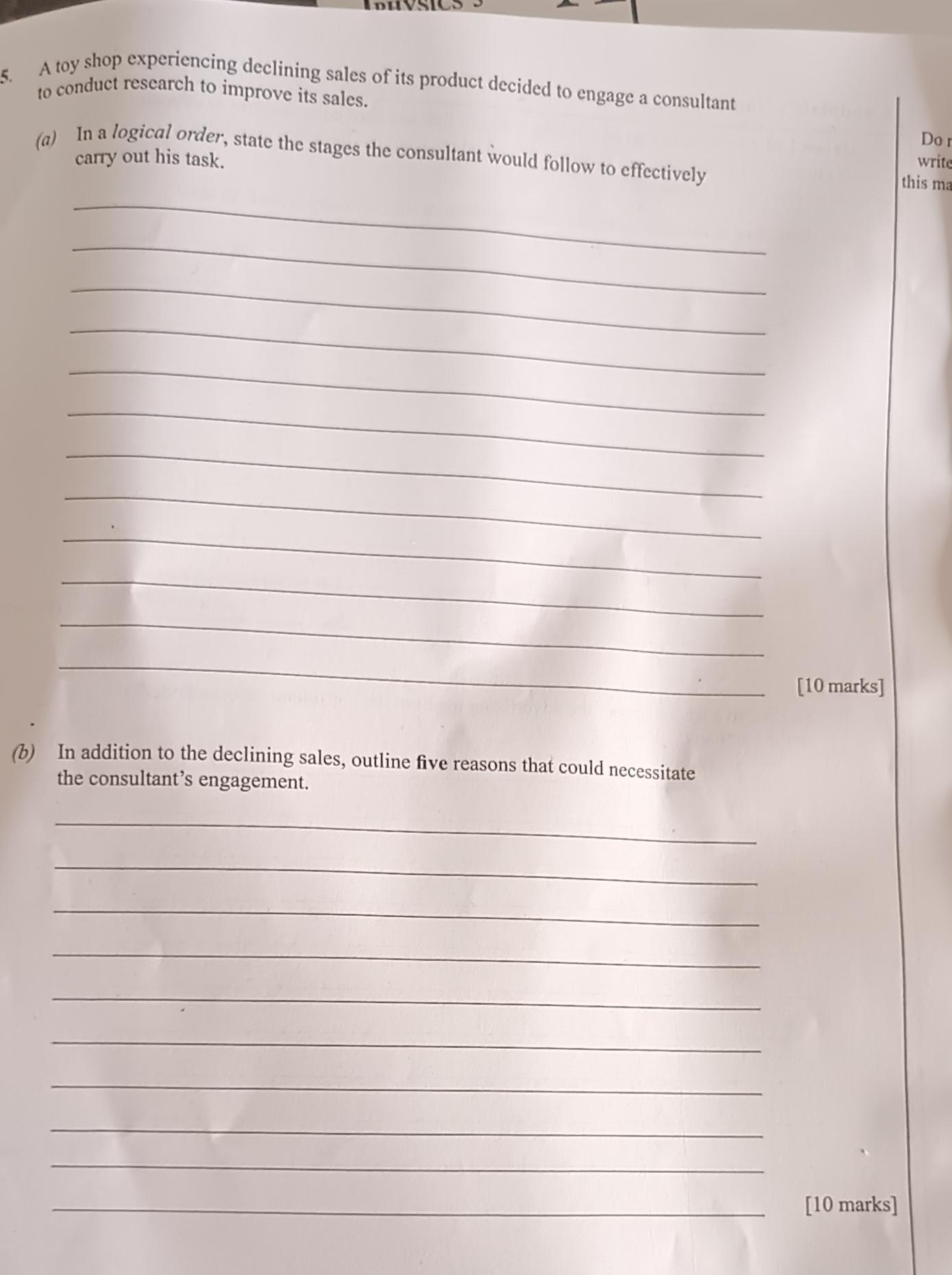
(i) The consultant would first identify and clearly define the problem of declining sales facing the toy shop.
(ii) He would determine the objectives of the research and specify the information required for the study.
(iii) He would develop an appropriate research plan, including methods, sources of data, and research instruments.
(iv) He would collect relevant data from customers, competitors, retailers, and other useful market sources.
(v) He would organize, classify, and process the data collected to make it suitable for analysis.
(vi) He would analyze and interpret the data to identify the causes of the decline in sales.
(vii) He would draw conclusions based on the findings obtained from the analysis of the research data.
(viii) He would prepare a comprehensive report containing findings, conclusions, and recommendations for management.
(ix) He would present the report to the management of the toy shop for consideration and implementation.
(x) He would monitor and evaluate the effectiveness of the recommendations after they have been implemented.
(5b)
(PICK ANY FIVE)
(i) The toy shop may wish to introduce a new product and require information about customers’ acceptance and preferences.
(ii) The management may be experiencing intense competition and need professional advice on maintaining or increasing market share.
(iii) The business may intend to expand into new markets and require research before making investment decisions.
(iv) The toy shop may be facing customer complaints and need to determine the causes of dissatisfaction.
(v) The management may want to review its pricing policy to ensure products remain competitive and profitable.
(vi) The business may need information on changing consumer tastes and preferences to remain relevant in the market.
(vii) The company may be considering a new advertising campaign and require research to determine its likely effectiveness.
(viii) The toy shop may be experiencing distribution problems and need professional guidance on improving product availability.
(ix) The management may wish to improve customer service and require research to identify customers’ expectations.
(x) The business may want to assess the strengths and weaknesses of competitors to improve its marketing strategies.
(xi) The company may need information for forecasting future demand and making effective production or stocking decisions.
(xii) The management may be considering rebranding its products and require research to determine customers’ reactions.
(xiii) The business may wish to identify new market opportunities and profitable customer segments for future growth.
————————————————————————————————————
(VERSION II)
(5a)
(PICK ANY FIVE)
(i) The consultant would identify and define the research problem facing the toy shop and the possible causes of the declining sales.
(ii) He would determine the objectives of the research study and the information required for effective decision-making.
(iii) He would develop an appropriate research plan and methodology for conducting the investigation.
(iv) He would identify relevant sources of data, including both primary and secondary sources of information.
(v) He would design research instruments such as questionnaires, interview schedules, and observation guides for data collection.
(vi) He would collect relevant data and information from customers, retailers, competitors, and other important sources.
(vii) He would organize, classify, and tabulate the data collected to facilitate proper analysis and interpretation.
(viii) He would analyze and interpret the data obtained in order to identify trends, patterns, and findings.
(ix) He would draw conclusions and make findings based on the results of the analysis conducted.
(x) He would prepare and present a comprehensive research report containing findings, conclusions, and recommendations for improving sales.
(5b)
(PICK ANY FIVE)
(i) The toy shop may be planning to introduce a new product into the market and would need information about its likely acceptance by consumers.
(ii) The management may be experiencing falling profit levels despite continued production and marketing activities.
(iii) The toy shop may be facing changes in consumer tastes, preferences, and buying habits which are affecting sales.
(iv) The management may be concerned about the entry of new competitors into the market offering similar products.
(v) The toy shop may be planning to expand into new markets or geographical areas where customer behaviour is not well known.
(vi) The management may need information for determining an appropriate pricing policy for its products.
(vii) The toy shop may be experiencing poor customer response to its existing products or services in the market.
(viii) The management may wish to improve its advertising, promotional, and other marketing activities in order to increase sales.
(ix) The toy shop may be experiencing a decline in its market share due to increasing competition or changing market conditions.
(x) The management may need to assess customer satisfaction, identify customer needs, and improve product quality for better business performance.
(6a)
(PICK ANY TWO)
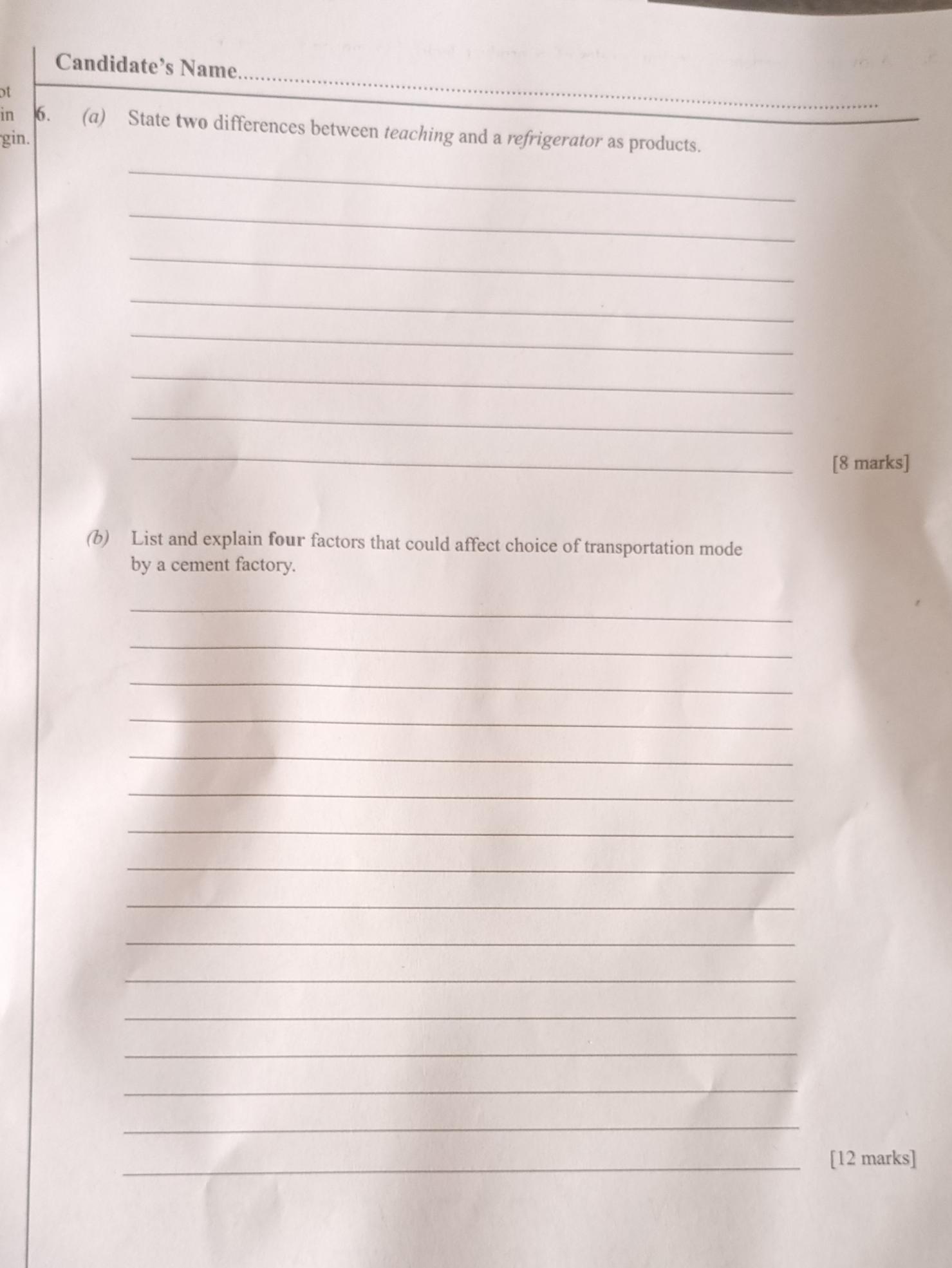
(i) Teaching is a service product, while a refrigerator is a tangible product.
(ii) Teaching cannot be seen, touched, or stored before use, whereas a refrigerator can be seen, touched, stored, and transported from one place to another.
(iii) Teaching is produced and consumed at the same time, while a refrigerator is produced first and consumed later.
(iv) Teaching depends largely on the skill and performance of the teacher, whereas a refrigerator is a manufactured product whose quality can be standardized.
(6b)
(PICK ANY FOUR)
(i) Cost of transportation: The factory will choose a mode of transport that minimizes transportation costs and helps maximize profit.
(ii) Nature of the product: Since cement is bulky and heavy, transportation modes capable of carrying large quantities efficiently, such as rail or road haulage, may be preferred.
(iii) Distance to the destination: The distance between the factory and the market influences the choice of transport. Long distances may require rail or water transport, while short distances may be served by road transport.
(iv) Availability of transport facilities: The factory will consider whether suitable roads, railways, ports, vehicles, or other transport facilities are available for moving the cement.
(v) Speed of delivery: Where customers require urgent delivery, the factory may choose a faster means of transportation.
(vi) Safety and security of goods: The transport mode selected should reduce the risk of damage, theft, or loss of the cement during transit.
(vii) Quantity of goods to be transported: Large quantities of cement may require transportation modes with high carrying capacity, such as rail transport.
(viii) Weather and climatic conditions: Bad weather conditions may affect the availability and efficiency of certain means of transport, thereby influencing the factory’s choice.
————————————————————————————————————
(VERSION II)
(6a)
(PICK ANY TWO)
(i) Teaching is an intangible product or service that cannot be seen or touched, whereas a refrigerator is a tangible product that can be seen, touched, and examined physically.
(ii) Teaching cannot be physically possessed, owned, or transferred from one person to another, whereas a refrigerator can be purchased, owned, and transferred to another person.
(iii) Teaching is produced and consumed at the same time during its delivery, whereas a refrigerator is manufactured first before it is sold and used by consumers.
(iv) Teaching cannot be stored, stocked, or kept for future sale or use, whereas a refrigerator can be stored in warehouses or shops before being sold.
(v) The quality of teaching may differ according to the teacher’s skills, experience, and method of delivery, whereas refrigerators are usually produced according to standard specifications.
(vi) Teaching requires direct contact and interaction between the teacher and the learner, whereas a refrigerator can be bought and used without direct interaction with the manufacturer.
(vii) Teaching is a service rendered to satisfy educational and knowledge needs, whereas a refrigerator is a physical consumer durable good used for preserving food, drinks, and other perishable items.
(6b)
(PICK ANY FOUR)
(i) Cost of transportation:
The cement factory will consider the amount required to move cement from the factory to the destination. A cheaper mode of transport may be preferred in order to reduce distribution costs and increase profit.
(ii) Nature of the product:
Cement is a bulky, heavy, and dusty product. Therefore, the factory will choose a mode of transport that can conveniently handle such goods without damage or excessive cost.
(iii) Distance to be covered:
The distance between the factory and the market will influence the choice of transport. Some modes are more suitable for long-distance transportation, while others are better for short distances.
(iv) Speed of delivery required: Where customers need cement urgently, the factory may select a faster means of transport to ensure prompt delivery and customer satisfaction.
(v) Availability of transport facilities: The choice of transport will depend on whether roads, railways, waterways, ports, or other facilities are available and accessible.
(vi) Safety and security of goods: The factory will prefer a mode of transport that minimizes the risk of theft, accidents, loss, or damage to the cement while in transit.
(vii) Quantity of cement to be transported: Large quantities of cement may require transportation modes with high carrying capacity, such as rail or water transport.
(viii) Condition of routes:
The state of roads, rail tracks, bridges, and other transport routes can influence the suitability and efficiency of a transport mode.
(ix) Reliability of the transport service: The factory may choose a mode that operates regularly and delivers goods according to schedule in order to avoid delays.
(x) Weather and climatic conditions: Heavy rainfall, flooding, storms, or other adverse weather conditions may affect the efficiency of certain modes of transport and influence the choice made by the factory.
Answers Loading...