2026 WAEC CRS answers, WAEC CRS answers 2026, WAEC Christian Religious Studies answers 2026, 2026 WAEC CRS expo, WAEC CRS runz 2026, 2026 WAEC CRS questions and answers, WAEC 2026 CRS objective answers, WAEC 2026 CRS theory answers, 2026 WAEC CRS likely questions, WAEC CRS 2026 runs, free WAEC CRS answers 2026, 2026 WAEC CRS answer sheet, WAEC CRS 2026 dubs, verified WAEC CRS answers 2026, 2026 WAEC CRS midnight answers, WAEC CRS 2026 solution, 2026 WAEC Christian Religious Knowledge answers, WAEC CRS 2026 correct answers, 2026 WAEC CRS answer key, real WAEC CRS answers 2026
Are you preparing for the WAEC 2026 Christian Religious Studies (CRS) examination? Noniexpo.com is your trusted destination for the latest WAEC updates, CRS revision materials, past questions, study guides, and examination tips designed to help you prepare effectively.
2026 WAEC CHRISTIAN RELIGIOUS STUDIES ANSWERS
Monday, 1st June 2026
CRS OBJ:
1-10: DCABACBDBA
11-20: ABBBACCDDC
21-30: ADBBCDADDC
31-40: ACBCBCBCBA
41-50: ACCDCBBADB
A gentle reminder to all daily subscribers: kindly try as much as possible to always send your subscription the night before your paper.
This helps us organize everything properly and serve everyone smoothly. Thank you for your understanding and cooperation. Wishing you success in your exams!
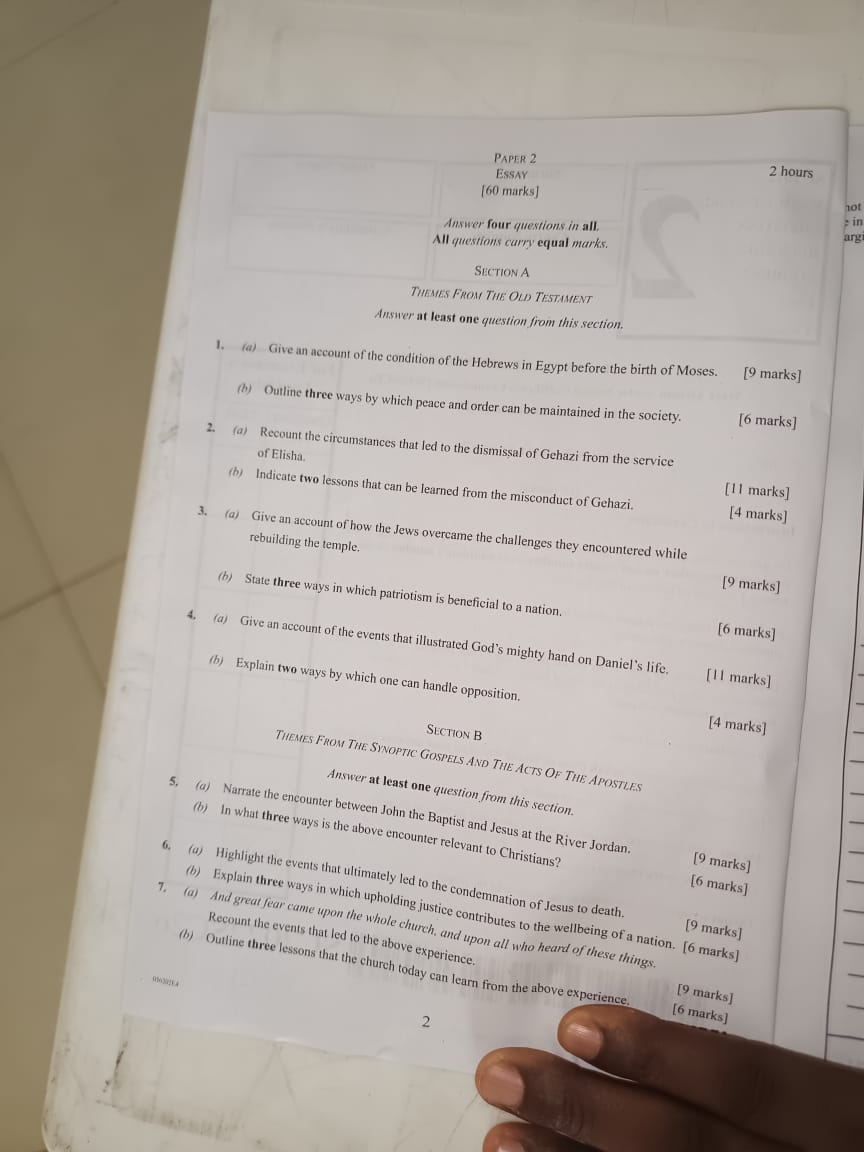
(1a)
The Hebrews, who were the descendants of Jacob, came to Egypt during the time of Joseph. Joseph had become a powerful ruler in Egypt and helped the country survive a severe famine. Because of Joseph’s influence, his family was welcomed and settled in the fertile land of Goshen. Over time, the Hebrews multiplied greatly and became a large and prosperous people.
After the death of Joseph and his generation, a new Pharaoh arose in Egypt who did not know Joseph or remember the good he had done for the nation. When Pharaoh noticed the rapid increase in the population of the Hebrews, he became afraid. He feared that they might become more numerous and powerful than the Egyptians. He also thought that if war should occur, the Hebrews might join Egypt’s enemies and fight against the nation.
To prevent this, Pharaoh decided to oppress the Hebrews. He appointed taskmasters over them and subjected them to hard labour. The Hebrews were forced to build the store cities of Pithom and Rameses for Pharaoh. They worked under very harsh conditions, making bricks and carrying out other difficult construction tasks. Their lives became bitter because of the heavy burdens placed upon them. However, the more they were oppressed, the more they multiplied and spread throughout the land.
Pharaoh’s fear increased when he realized that forced labour had failed to reduce their population. He therefore ordered the Hebrew midwives, Shiphrah and Puah, to kill every male Hebrew child at birth while allowing the female children to live. The midwives, however, feared God and refused to obey the king’s command. They preserved the lives of the Hebrew boys and explained to Pharaoh that the Hebrew women gave birth before they arrived.
When this plan failed, Pharaoh issued a more severe decree. He commanded all the Egyptians to throw every newly born Hebrew boy into the River Nile while allowing the girls to live. This cruel order brought fear, sorrow, and suffering upon the Hebrew people. Parents lived in constant anxiety as they tried to protect their sons from being killed.
It was during this period of slavery, oppression, and persecution that Moses was born. The Hebrews cried unto God because of their suffering, and God heard their prayers. He prepared Moses to become the leader who would eventually deliver the Israelites from bondage in Egypt.
(1b)
(PICK ANY THREE)
(i) Obedience to the laws of the land.
(ii) Respect for constituted authority.
(iii) Promotion of justice and fairness.
(iv) Tolerance of one another’s views and beliefs.
(v) Peaceful settlement of disputes through dialogue.
(vi) Respect for human rights and dignity.
(VERSION II)
(1a)
The condition of the Hebrews in Egypt before the birth of Moses was characterized by oppression, slavery and suffering.
After the death of Joseph, a new Pharaoh who did not know Joseph arose in Egypt. When he noticed that the Israelites were increasing rapidly in number, he became afraid that they might become more powerful than the Egyptians and join their enemies in time of war.
To prevent this, Pharaoh subjected the Hebrews to forced labour and placed taskmasters over them.
They were compelled to build the store cities of Pithom and Rameses for Egypt. The Egyptians treated them harshly and made their lives bitter with hard labour in brick-making and other forms of work.
In spite of the oppression, the Israelites continued to multiply. Pharaoh then ordered the Hebrew midwives, Shiphrah and Puah, to kill every male Hebrew child at birth. However, the midwives feared God and refused to carry out the king’s order. When this plan failed, Pharaoh commanded that every Hebrew baby boy should be thrown into the River Nile, while the female children were allowed to live.
As a result, the Hebrews lived in fear, bondage and great suffering under Egyptian rule. They were oppressed, enslaved and threatened with the destruction of their male children until God raised Moses to deliver them.
(1b)
(PICK ANY THREE)
(i)Obedience to the laws of the land and constituted authorities.
(ii)Promotion of justice, equity and fairness among citizens.
(iii)Tolerance and mutual respect for one another irrespective of differences.
(iv)Peaceful settlement of disputes through dialogue and reconciliation.
(v)Respect for the fundamental human rights of every individual.
(2a)
Gehazi was the servant of Elisha the prophet. One day, Naaman, the commander of the Syrian army, came to Elisha seeking healing from leprosy. Elisha instructed him to wash seven times in the Jordan River, and he was completely healed. Out of gratitude, Naaman offered Elisha gifts of silver, gold and expensive clothes, but Elisha refused to accept any reward because he wanted Naaman to know that God’s blessings could not be bought.
After Naaman had departed, Gehazi became greedy and desired the gifts that Elisha had rejected. Without Elisha’s knowledge, he ran after Naaman and lied to him, saying that Elisha had sent him to request a talent of silver and two changes of clothes for two young prophets who had just arrived. Believing Gehazi’s story, Naaman gladly gave him two talents of silver and two changes of garments.
Gehazi collected the gifts and hid them in his house before returning to Elisha. When Elisha asked him where he had been, Gehazi lied and claimed that he had gone nowhere. However, Elisha, through the Spirit of God, knew everything that had happened. He rebuked Gehazi for his greed, dishonesty and misuse of his prophetic position for personal gain.
As punishment, Elisha declared that the leprosy of Naaman would cling to Gehazi and his descendants forever. Immediately, Gehazi became leprous, his skin turning white as snow. Because of his greed, deception and disobedience, Gehazi lost his position and was dismissed from the service of Elisha.
(2b)
(PICK ANY TWO)
(i) Christians should avoid greed and covetousness because the love of material wealth can lead to sin and destruction.
(ii) People should always be honest and truthful, as lying brings shame and punishment.
(iii) We should be content with what we have and not seek dishonest gain.
(iv) Those who serve God should not use their position for personal enrichment.
(v) Disobedience to God’s commands and to rightful authority attracts punishment.
(vi) God sees and knows all human actions, even those done in secret.
(vii) Christians should uphold integrity and good character in all their dealings.
(viii) Wrong actions have consequences not only for the offender but may also affect others.
(ix) People should avoid deceit and fraud in order to maintain a good reputation.
(x) Faithfulness and obedience are necessary qualities for anyone who wants to enjoy God’s favour and blessings.
————————————————————————————————————
(VERSION II)
(2a)
The circumstances that led to the dismissal of Gehazi from the service of Elisha began after Naaman, the commander of the Syrian army, was healed of leprosy through Elisha’s instruction.
After his healing, Naaman returned to thank Elisha and offered him gifts, but Elisha refused to accept them.
Gehazi, however, was motivated by greed and ran after Naaman without Elisha’s knowledge. He lied to Naaman that Elisha had sent him to collect a talent of silver and two changes of garments for two young prophets who had just arrived. Naaman gladly gave him two talents of silver and two changes of garments.
After collecting the gifts, Gehazi hid them in his house and returned to Elisha. When Elisha asked him where he had been, Gehazi lied that he had not gone anywhere. Through God’s revelation, Elisha knew all that Gehazi had done. He rebuked him for his greed, dishonesty and misuse of the prophetic office for personal gain.
As punishment, Elisha declared that the leprosy of Naaman would cling to Gehazi and his descendants forever. Immediately, Gehazi became leprous, white as snow, and was dismissed from the service of Elisha.
(2b)
(PICK ANY TWO)
(i)Christians should avoid greed, covetousness and the excessive love of material possessions.
(ii)Honesty and truthfulness should be upheld because God punishes deceit and dishonesty.
(iii)Believers should be contented with what they have and avoid selfish ambitions.
(iv)People should not misuse their positions or authority for personal gain.
(v)Disobedience to God’s will attracts punishment and negative consequences.
(3a)
After the Jews returned from exile in Babylon, they began the rebuilding of the temple in Jerusalem under the leadership of Zerubbabel and Jeshua. However, they faced many challenges. Their enemies, especially the Samaritans, opposed the work and tried to discourage them. When the Jews refused to allow them to join in building the temple, the enemies became hostile and attempted to frustrate the project.
The opponents sent false reports and accusations against the Jews to the Persian kings, claiming that the Jews were planning to rebel. As a result, an order was given for the work on the temple to stop, and the rebuilding was suspended for some years. The people became discouraged and turned their attention to building their own houses instead of God’s temple.
To overcome these challenges, God raised prophets such as Haggai and Zechariah who encouraged the people to continue the work. The prophets reminded them that rebuilding the temple was God’s will and that He would be with them. Their messages strengthened the people’s faith and determination.
Zerubbabel and Jeshua also provided strong leadership and motivated the people to resume the work. When their enemies again questioned their authority, the Jews appealed to King Darius of Persia. A search was made in the royal records, and the decree earlier issued by King Cyrus permitting the rebuilding of the temple was found.
King Darius then confirmed the decree and ordered that the work should continue without interference. He even instructed that expenses for the project should be provided from the royal treasury. With God’s help, encouragement from the prophets, and support from the Persian king, the Jews successfully completed the rebuilding of the temple and dedicated it with great joy and thanksgiving to God.
(3b)
(PICK ANY THREE)
(i) Patriotism promotes unity among citizens by encouraging them to work together for the progress of the nation.
(ii) It helps to maintain peace and stability because citizens learn to respect the laws and authorities of the country.
(iii) Patriotism encourages hard work and dedication, leading to national growth and development.
(iv) It motivates citizens to protect the nation’s resources and public property from destruction and misuse.
(v) Patriotism promotes loyalty to the nation and strengthens national identity.
(vi) It encourages citizens to participate in civic responsibilities such as voting, paying taxes and community service.
(vii) It helps in defending the nation against external threats and aggression.
(viii) Patriotism fosters cooperation among different ethnic, religious and cultural groups within the country.
(ix) It promotes good leadership and responsible citizenship as people seek the welfare of the nation.
(x) It enhances the country’s image and reputation through the positive actions of its citizens.
(VERSION II)
(3a)
The Jews overcame the challenges they encountered while rebuilding the temple through God’s intervention, encouragement from the prophets, and support from the Persian authorities. After returning from exile, the Jews began rebuilding the temple in Jerusalem. However, their enemies, especially the Samaritans, opposed the work and tried to discourage them.
The opponents first requested to join in the rebuilding, but their offer was rejected by Zerubbabel and the Jewish leaders. As a result, they became hostile and frustrated the efforts of the builders. They also wrote accusations against the Jews to the Persian kings, causing the work on the temple to stop for some time.
Despite these challenges, God raised the prophets Haggai and Zechariah to encourage the people to resume the rebuilding work. Their messages inspired Zerubbabel, Joshua the high priest, and the people to continue the project.
When Governor Tattenai questioned their authority to rebuild, the Jews explained that King Cyrus had earlier granted permission for the work. A search was conducted, and Cyrus’ decree was discovered in the royal archives. King Darius then confirmed the decree and ordered that the rebuilding should continue without interference.
Darius also instructed that expenses for the project should be provided from the royal treasury. With God’s help, prophetic encouragement, and royal support, the Jews successfully completed and dedicated the temple.
(3b)
(PICK ANY THREE)
(i)Patriotism promotes national unity and integration.
(ii)It encourages citizens to obey laws and constituted authority.
(iii)It promotes peace, stability and security in the nation.
(iv)Patriotic citizens contribute to national development and progress.
(v)It encourages citizens to protect and defend their country’s interests and resources.
(4a)
Daniel was among the Jewish exiles taken to Babylon by King Nebuchadnezzar. Even in captivity, God was with him and gave him wisdom, knowledge and understanding above his peers.
Daniel and his three friends refused to defile themselves with the king’s food and wine, and God made them healthier and wiser than the other young men in the palace.
God also revealed to Daniel the dream of King Nebuchadnezzar and its interpretation when none of the wise men in Babylon could do so. As a result, Daniel was promoted to a high position in the kingdom. Later, Daniel interpreted another dream of Nebuchadnezzar concerning the king’s pride and subsequent humiliation, and the prophecy was fulfilled exactly as he had foretold.
During the reign of Belshazzar, Daniel interpreted the mysterious handwriting on the wall, which announced the fall of the Babylonian kingdom. His interpretation came to pass that very night.
Another event that demonstrated God’s mighty hand on Daniel’s life was his deliverance from the lions’ den. Daniel continued to pray to God despite a royal decree forbidding prayer to anyone except the king. His enemies reported him, and he was thrown into a den of lions. However, God sent His angel to shut the mouths of the lions, and Daniel came out unharmed. Consequently, King Darius acknowledged the power of Daniel’s God and ordered that He should be honoured throughout the kingdom.
(4b)
(PICK ANY TWO)
(i)Through prayer to God: One can handle opposition by praying to God for strength, wisdom and protection in difficult situations.
(ii)By remaining steadfast in one’s convictions: A person should stand firmly for what is right and not give in to pressure from opponents.
(iii)By exercising patience and self-control: One should remain calm and avoid reacting violently or angrily when faced with opposition.
(iv)By seeking dialogue and peaceful resolution: Misunderstandings and conflicts can be resolved through discussion, negotiation and reconciliation.
(v)By trusting in God and maintaining faith: Having faith in God helps one to overcome fear and remain hopeful despite opposition.
(5a)
John the Baptist was preaching in the wilderness of Judea and baptizing people in the River Jordan. He called on the people to repent of their sins because the kingdom of God was near. Many people came to him and were baptized after confessing their sins.
One day, Jesus came from Galilee to the River Jordan to be baptized by John. When John saw Him, he recognized that Jesus was greater than he was. Therefore, John tried to stop Him, saying that he needed to be baptized by Jesus rather than baptizing Him. However, Jesus replied that it was necessary for them to do so in order to fulfil all righteousness and carry out God’s will.
John then agreed and baptized Jesus in the River Jordan. As Jesus came up out of the water, the heavens were opened, and the Holy Spirit descended upon Him in the form of a dove. At the same time, a voice came from heaven saying, “This is my beloved Son, in whom I am well pleased.”
This event revealed Jesus as the Son of God and marked the beginning of His public ministry. It also showed the presence of the Trinity, which is God the Father speaking from heaven, God the Son being baptized, and God the Holy Spirit descending like a dove. The encounter between John the Baptist and Jesus at the River Jordan was therefore a significant event in the history of Christianity.
(5b)
(PICK ANY THREE)
(i) The encounter shows the importance of baptism in the Christian faith.
(ii) It teaches Christians the need for obedience to God’s will, just as Jesus obeyed God by submitting Himself for baptism.
(iii) It serves as an example of humility, as Jesus willingly allowed John to baptize Him.
(iv) It encourages Christians to live righteous and holy lives.
(v) The event confirms that Jesus is the Son of God and strengthens the faith of believers in Him.
(vi) It reveals the doctrine of the Trinity which is God the Father, God the Son and God the Holy Spirit.
(vii) It teaches Christians the importance of repentance and spiritual renewal.
(viii) It reminds Christians that God rewards those who please Him and do His will.
(ix) It marks the beginning of Jesus’ ministry and encourages Christians to dedicate themselves to God’s service.
(x) It assures Christians of the presence and guidance of the Holy Spirit in their lives.
(VERSION II)
(5a)
The encounter between John the Baptist and Jesus at the River Jordan took place when Jesus came from Galilee to the River Jordan to be baptized by John. On seeing Jesus, John recognized His greatness and tried to prevent Him from being baptized, saying that he needed to be baptized by Jesus instead.
Jesus, however, insisted that the baptism should take place in order to fulfill all righteousness. John then agreed and baptized Him in the River Jordan.
As soon as Jesus came out of the water, the heavens were opened, and the Holy Spirit descended upon Him in the form of a dove. At the same time, a voice came from heaven saying, "This is my beloved Son, in whom I am well pleased."
Through this encounter, Jesus was publicly identified as the Son of God, and His earthly ministry was inaugurated. The presence of God the Father, God the Son, and God the Holy Spirit was clearly manifested at the event.
(5b)
(PICK ANY THREE)
(i)It confirms that Jesus is the Son of God.The voice from heaven declared Jesus as God’s beloved Son, strengthening Christians’ faith in His divine nature.
(ii)It emphasizes the importance of baptism.
Since Jesus submitted Himself to baptism, Christians are encouraged to be baptized as an act of obedience to God.
(iii) It teaches humility and obedience. Jesus willingly accepted baptism even though He was without sin, showing that Christians should be humble and obedient to God’s will.
(iv)It reveals the Holy Trinity.God the Father spoke from heaven, Jesus was baptized, and the Holy Spirit descended like a dove. This helps Christians understand the doctrine of the Trinity.
(v)It marks the beginning of Christian service to God.
Jesus’ baptism marked the beginning of His public ministry. Likewise, Christians should dedicate themselves to serving God after accepting Christ.
(6a)
Jesus’ condemnation to death was the result of a series of events that took place before His crucifixion. After Jesus had preached, performed miracles and gained many followers, the Jewish religious leaders became jealous and feared that His influence was becoming too great. They began to look for ways to arrest and kill Him.
One of Jesus’ disciples, Judas Iscariot, agreed to betray Him to the chief priests for thirty pieces of silver. After the Last Supper, Jesus went to pray in the Garden of Gethsemane. There, Judas led a crowd of soldiers and officials to arrest Him. Judas identified Jesus by kissing Him.
Jesus was first taken before the Jewish council called Sanhedrin, where false witnesses accused Him. During the trial, the high priest asked Jesus whether He was the Messiah, the Son of God. When Jesus affirmed this, the leaders accused Him of blasphemy and declared that He deserved death.
Since the Jewish leaders did not have the authority to carry out the death sentence, they took Jesus to Pontius Pilate, the Roman governor. They changed their accusation and claimed that Jesus was misleading the people and calling Himself a king, which they presented as a threat to Roman authority.
Pilate examined Jesus and found no fault in Him. He sent Him to Herod Antipas, but Herod also found no reason to condemn Him and returned Him to Pilate. Despite this, the chief priests and the crowd continued to demand Jesus’ death. Pilate offered to release either Jesus or Barabbas, a known criminal, according to the custom of the Passover feast. The crowd, influenced by the religious leaders, chose Barabbas and demanded that Jesus be crucified.
Although Pilate believed Jesus was innocent, he feared a riot and gave in to the demands of the crowd. He washed his hands before them to show that he was not responsible for Jesus’ death and then handed Jesus over to be crucified. Thus, betrayal by Judas, false accusations, religious hostility and pressure from the crowd ultimately led to the condemnation of Jesus to death.
(6b)
(PICK ANY THREE)
(i) Upholding justice promotes peace and stability in the nation because people are treated fairly and conflicts are properly resolved.
(ii) It protects the rights and freedoms of citizens and prevents oppression and discrimination.
(iii) Justice encourages respect for the law and helps to maintain law and order in society.
(iv) It discourages crime and corruption because offenders know that wrongdoing will be punished.
(v) Justice promotes unity among citizens by ensuring that everyone is treated equally regardless of tribe, religion or social status.
(vi) It builds public confidence in government and other institutions when people see that fairness prevails.
(vii) Justice encourages economic growth and development by creating a safe and secure environment for businesses and investments.
(viii) It helps to protect the weak and vulnerable members of society from exploitation and abuse.
(ix) Justice promotes good governance, accountability and responsible leadership.
(x) It fosters national progress because citizens are more willing to contribute positively to a society where fairness and equality are upheld.
(7a)
The statement, “and great fear came upon the whole church, and upon all who heard of these things,” refers to the incident involving Ananias and Sapphira in the early Church.
In the early Christian community, believers shared their possessions and helped one another. Many members sold their lands and properties and brought the money to the apostles for distribution to those in need. One such believer was Barnabas, who sold his land and gave all the proceeds to the apostles.
Ananias and his wife, Sapphira, also sold a piece of land. However, they secretly agreed to keep back part of the money for themselves while pretending to give the entire amount to the apostles. Ananias brought only a portion of the money and laid it before the apostles, claiming that it was the full amount received from the sale.
Through the revelation of the Holy Spirit, Peter knew what Ananias had done. Peter rebuked him for lying, not to men, but to God and to the Holy Spirit. As soon as Ananias heard Peter’s words, he fell down and died. The young men wrapped up his body, carried it out and buried him.
About three hours later, Sapphira came in, not knowing what had happened to her husband. Peter asked her whether the amount presented was the full price of the land. She confirmed the lie by saying that it was. Peter then rebuked her for agreeing with her husband to test the Spirit of the Lord. Immediately, she also fell down and died. The young men carried her out and buried her beside her husband.
When the members of the church and others heard about these events, they were filled with great fear and reverence for God. They realized that God is holy and that dishonesty and hypocrisy would not be tolerated in the Christian community. Therefore, great fear came upon the whole church and upon all who heard of these things.
(7b)
(PICK ANY THREE)
(i) Christians should be honest in all their dealings and avoid every form of deceit.
(ii) Members of the church should not pretend to be what they are not in order to gain praise from others.
(iii) The church should uphold integrity and sincerity in giving and service to God.
(iv) Christians should understand that God knows the thoughts and actions of every person, even those done in secret.
(v) Believers should avoid greed and the desire for personal glory.
(vi) The church should maintain discipline and holiness among its members.
(vii) Christians should have reverence and respect for God at all times.
(viii) Husbands and wives should not cooperate in wrongdoing but should encourage one another to do what is right.
(ix) The church should teach and uphold truth, righteousness and accountability.
(x) Christians should remember that disobedience to God has consequences and should therefore strive to live upright lives.
(VERSION II)
(7a)
The events that led to the experience, “And great fear came upon the whole church, and upon all who heard of these things,” occurred in the early Church when believers shared their possessions and brought the proceeds to the apostles for distribution. A man named Ananias and his wife, Sapphira, sold a piece of land and agreed to keep back part of the money for themselves.
Ananias brought only a portion of the money and presented it as though it were the full amount. Through the revelation of the Holy Spirit, Peter discovered the deceit and asked Ananias why he had lied to God. Peter told him that the land and the money were his to keep if he wished, but he had sinned by pretending to give all. Immediately, Ananias fell down and died. The young men present wrapped up his body and buried him.
About three hours later, Sapphira came in, unaware of what had happened to her husband. Peter asked her whether the amount brought was the full price of the land. She repeated the same lie. Peter rebuked her for agreeing with her husband to test the Spirit of the Lord. Instantly, she also fell down and died. The young men carried her out and buried her beside her husband.
When the church and all who heard about the incident learned what had happened, great fear came upon them because they realized God’s judgment against hypocrisy and dishonesty.
(7b)
(PICK ANY THREE)
(i)Christians should be honest in all their dealings. Ananias and Sapphira were punished because they lied about their offering. The church should always uphold truthfulness.
(ii)God hates hypocrisy.Believers should not pretend to be more spiritual or generous than they really are in order to gain praise from others.
(iii)The Holy Spirit cannot be deceived.God knows the thoughts and intentions of every person; therefore, Christians should live transparently before Him.
(iv)The church should maintain holiness and discipline.The incident teaches that God’s people must strive for purity and avoid sinful practices that can bring judgment.
(v)Christians should fear and reverence God. The punishment of Ananias and Sapphira reminds believers that God is holy and should be worshipped with sincerity, respect, and obedience.
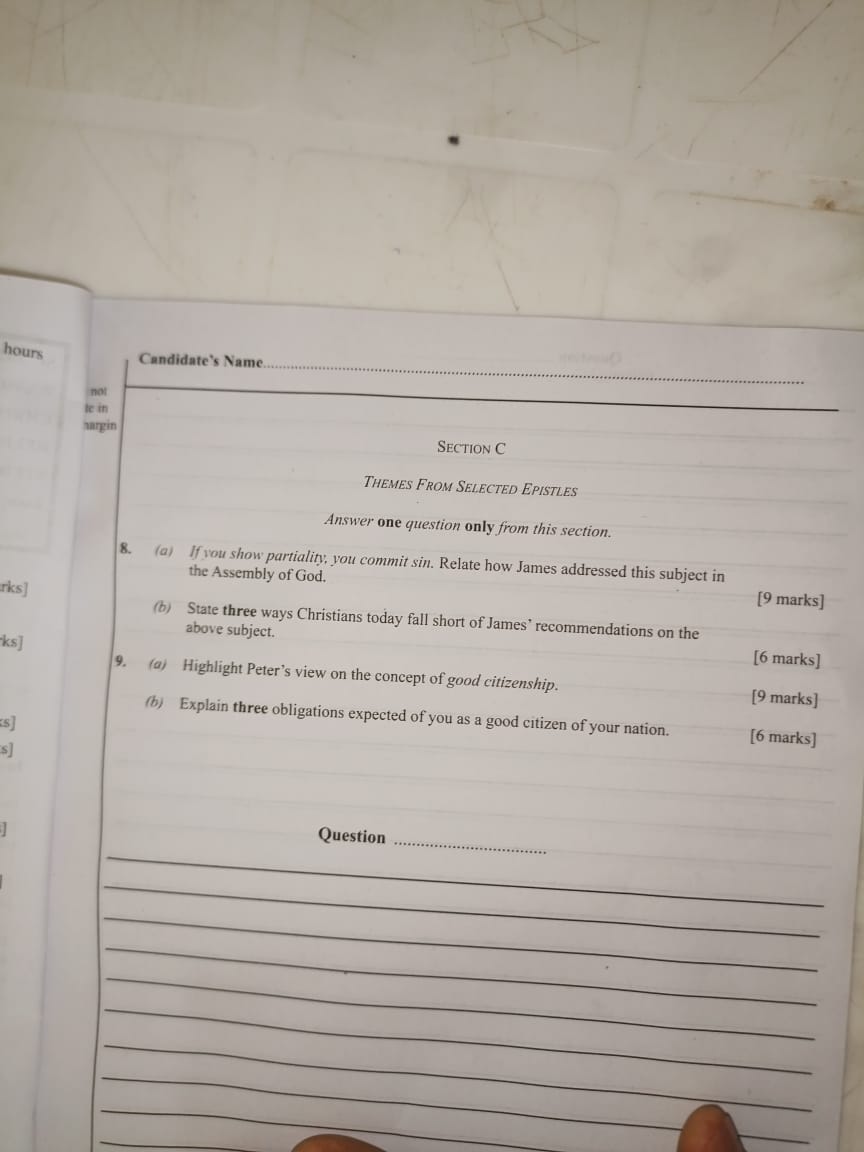
(8a)
James taught Christians not to show favouritism in the assembly of God. He said that believers in Christ should treat all people equally, whether they are rich or poor.
To explain this, James gave an example of a rich man wearing fine clothes and gold rings who entered the place of worship. He also spoke of a poor man wearing dirty clothes who entered the same gathering. The members of the assembly welcomed the rich man warmly and offered him a good seat, while the poor man was told to stand or sit on the floor.
James condemned this action and said that they had become judges with evil thoughts because they were judging people by their outward appearance. He reminded them that God does not look at people the way humans do and that many poor people are rich in faith and will inherit God’s kingdom.
He further told them that they were dishonouring the poor by their actions. James instructed them to obey the royal law which says, “Love your neighbour as yourself.” According to him, showing partiality is a sin because it goes against God’s commandment of love.
James concluded by advising Christians to treat everyone fairly, show mercy to all people, and avoid discrimination in the church. He stressed that God expects believers to love and respect others regardless of their wealth, position or appearance.
(8b)
(PICK ANY THREE)
(i) Christians fall short of James’ recommendation when they give special treatment to rich and influential members of the church while neglecting the poor.
(ii) Some Christians judge people by their appearance, dressing, social status or occupation instead of their character.
(iii) Some church leaders show favouritism in assigning positions and responsibilities.
(iv) Christians sometimes associate more with wealthy people and avoid those who are less privileged.
(v) Some churches give greater recognition and honour to those who make large financial contributions.
(vi) Christians may discriminate against others on the basis of tribe, ethnicity or family background.
(vii) Some believers look down on the poor and treat them with disrespect.
(viii) Christians sometimes show partiality in settling disputes by supporting friends and influential persons instead of standing for justice.
(ix) Some churches neglect the needs of the poor, widows and other vulnerable members of society.
(x) Christians may value people for their material possessions rather than for their faith and godly character.
(9a)
Peter’s view on good citizenship is found in his teaching to Christians in 1 Peter 2:13–17. He advised believers to be law-abiding citizens and to submit themselves to constituted authorities for the sake of the Lord.
Peter taught that Christians should respect and obey rulers, governors and other authorities because they are appointed to maintain law and order in society. According to him, government authorities are meant to punish those who do evil and commend those who do good.
He further encouraged Christians to live good and exemplary lives so that their conduct would silence false accusations made against them. Peter emphasized that believers should use their freedom responsibly and not as an excuse for wrongdoing.
He also instructed Christians to show respect to all people, love fellow believers, fear God and honour the king. Peter believed that good citizenship involves obedience to lawful authority, respect for others, good behaviour and faithfulness to God.
Therefore, according to Peter, a good citizen is one who obeys the laws of the land, respects authority, does good works, promotes peace in society and lives in a manner that brings glory to God.
(9b)
(PICK ANY THREE)
(i) As a good citizen, I am expected to obey the laws of my country and respect constituted authorities.
(ii) I should pay my taxes and other lawful dues to help the government provide public services and develop the nation.
(iii) I am expected to participate in civic responsibilities such as voting during elections and contributing to national development.
(iv) I should protect public property and national resources from damage, theft and misuse.
(v) I am expected to maintain peace and order by avoiding violence, crime and any act that may disrupt society.
(vi) I should respect the rights, beliefs and opinions of other citizens regardless of their ethnic, religious or social background.
(vii) I am expected to be loyal and patriotic by promoting the unity, progress and good image of my nation.
(viii) I should report criminal activities and cooperate with security agencies in maintaining law and order.
(ix) I am expected to contribute positively to my community through hard work, honesty and community service.
(x) I should uphold justice, fairness and integrity in all my dealings and encourage others to do the same.
(VERSION II)
(9a)
Peter’s view on the concept of good citizenship is that Christians should be law-abiding, responsible, and respectful members of society. In his teaching, Peter instructed believers to submit themselves to every human authority for the Lord’s sake, whether to the king as supreme or to governors appointed to punish wrongdoers and commend those who do right.
He taught that Christians should do good at all times so that their good conduct would silence ignorant accusations against them. Peter emphasized that although Christians are free people, they should not use their freedom as a cover for wrongdoing but should live as servants of God.
Furthermore, he urged believers to respect all people, love fellow Christians, fear God, and honour the king. He also advised servants to submit to their masters with respect, even when they were harsh. According to Peter, good citizenship involves obedience to lawful authority, respect for others, responsible conduct, and living a life that glorifies God.
(9b)
(PICK ANY THREE)
(i)Obey the laws of the nation: A good citizen should respect and obey the constitution and all lawful regulations. This helps to maintain peace, order, and stability in society.
(ii)Pay taxes and other lawful dues: Citizens are expected to pay taxes honestly so that the government can provide social amenities such as roads, schools, hospitals, and security.
(iii)Respect constituted authorities: A good citizen should respect government officials and lawful institutions and cooperate with them in promoting peace and development.
(iv)Protect public property: Citizens should safeguard government facilities and national assets from damage, theft, or vandalism because such properties belong to everyone.
(v)Participate in civic responsibilities: A good citizen should vote during elections, take part in community development projects, and contribute positively to the growth and progress of the nation.
Answers Loading...